. 2018 Mar 13;8(1):4459.
doi: 10.1038/s41598-018-22222-y.

Prevalence of the single-nucleotide polymorphism rs11554137 (IDH1105GGT) in brain tumors of a cohort of Italian patients

Affiliations

Prevalence of the single-nucleotide polymorphism rs11554137 (IDH1105GGT) in brain tumors of a cohort of Italian patients

Giorgia Acquaviva et al. Sci Rep. .

Abstract

IDH mutational status is required for proper diagnosis according to the WHO criteria revised in 2016. The single nucleotide polymorphism (SNP) rs11554137 (IDH1105GGT) at codon 105 of IDH1 has been reported in patients with several tumor types, including those with glioma. The aim of this study is to investigate the prevalence of IDH1105GGT in a cohort of brain tumors, and its association with clinicopathologic features and IDH1 and IDH2 missense mutations. Exon 4 of IDH1 and IDH2 was analyzed in a series of brain tumors classified according to current WHO criteria. DNA from control individuals was analyzed to infer the prevalence of IDH1105GGT in the reference population. Analysis was performed using next generation sequencing. IDH1105GGT was three times more frequent in patients with tumors (44/293 cases, 15.0%) vs. population controls (6/109, 5.5%) (p = 0.0102). IDH1105GGT was more frequent in grade III tumors (26.1%) compared to grade II (10.9%, p = 0.038) and grade IV tumors (13.7%, p = 0.041). IDH1 105GGT was more frequent in grade II and III tumors without an IDH tumor missense mutation (43.8%) than in those with (11.5%, p = 0.005). The IDH1105GGT SNP likely represents an important genetic marker, worthy of additional investigation to better understand the clinical and biological features of IDH-WT infiltrating gliomas.


Conflict of interest statement

The authors declare no competing interests.

Figures
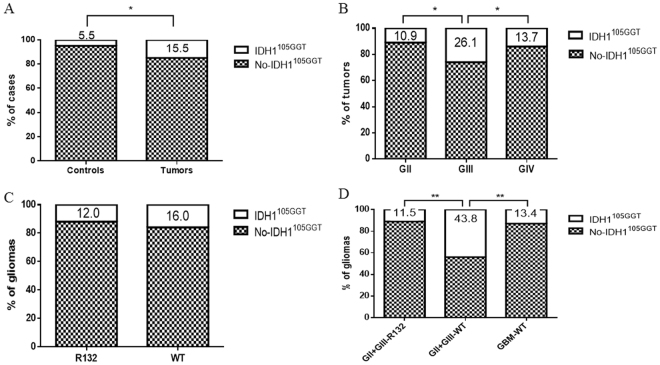
Figure 1
Figure 1
Prevalence of IDH105GGT. (A) Comparison of IDH105GGT between controls and patients with brain tumors. (B) IDH105GGT in grade II, III and IV brain tumors. (C) IDH105GGTin gliomas with and without IDH tumor missense mutation. (D) IDH105GGT in grade II and III gliomas with and without IDH tumor missense mutation and in grade IV without IDH tumor missense mutation. IDH105GGT: cases with IDH105GGT; No-IDH105GGT: cases without the IDH105GGT; GII: grade II brain tumors; GIII: grade III brain tumors; GIV: grade IV brain tumors; GBM: glioblastoma; R132: cases with IDH-missense mutation; WT: wild type.
Figure 2
Figure 2
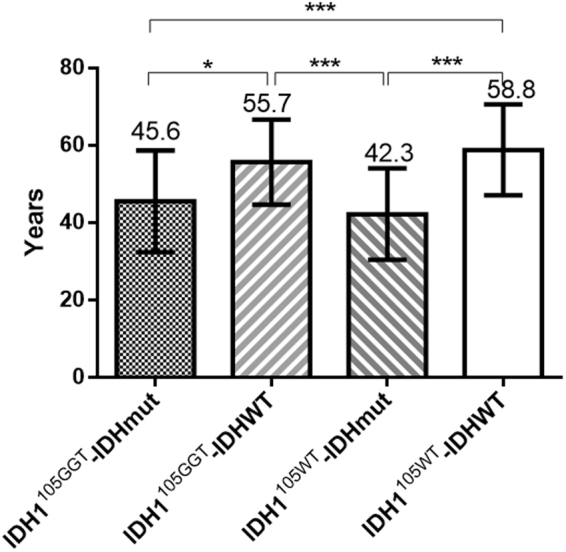
Age distribution of patients according to the presence of IDH1105GGT and IDH missense tumor mutations. IDH1105GGT: patients with tumor with IDH1105GGT; IDH1105WT: patients with tumor without IDH1105GGT; IDHmut: patients with tumor with IDH missense mutation; IDHWT: patients with tumor without IDH missense mutation. *p < 0.05 (Tukey’s multiple comparisons test); ***p < 0.001 (Tukey’s multiple comparisons test). Bars represent standard deviation (SD).

References

    1. Thompson CB. Metabolic enzymes as oncogenes or tumor suppressors. The New England journal of medicine. 2009;360:813–815. doi: 10.1056/NEJMe0810213. - DOI - PMC - PubMed
    1. Clark O, Yen K, Mellinghoff IK. Molecular Pathways: Isocitrate Dehydrogenase Mutations in Cancer. Clinical cancer research: an official journal of the American Association for Cancer Research. 2016;22:1837–1842. doi: 10.1158/1078-0432.CCR-13-1333. - DOI - PMC - PubMed
    1. Yen KE, Bittinger MA, Su SM, Fantin VR. Cancer-associated IDH mutations: biomarker and therapeutic opportunities. Oncogene. 2010;29:6409–6417. doi: 10.1038/onc.2010.444. - DOI - PubMed
    1. Sjoblom T, et al. The consensus coding sequences of human breast and colorectal cancers. Science. 2006;314:268–274. doi: 10.1126/science.1133427. - DOI - PubMed
    1. Forbes SA, et al. COSMIC: exploring the world’s knowledge of somatic mutations in human cancer. Nucleic acids research. 2015;43:D805–811. doi: 10.1093/nar/gku1075. - DOI - PMC - PubMed

Publication types

Substances