. 2018 Feb 27:9:173.
doi: 10.3389/fpsyg.2018.00173. eCollection 2018.

Child Maltreatment Is Associated with a Reduction of the Oxytocin Receptor in Peripheral Blood Mononuclear Cells

Affiliations

Child Maltreatment Is Associated with a Reduction of the Oxytocin Receptor in Peripheral Blood Mononuclear Cells

Sabrina Krause et al. Front Psychol. .

Abstract

Background: Child maltreatment (CM) and attachment experiences are closely linked to alterations in the human oxytocin (OXT) system. However, human data about oxytocin receptor (OXTR) protein levels are lacking. Therefore, we investigated oxytocin receptor (OXTR) protein levels in circulating immune cells and related them to circulating levels of OXT in peripheral blood. We hypothesized reduced OXTR protein levels, associated with both, experiences of CM and an insecure attachment representation. Methods: OXTR protein expressions were analyzed by western blot analyses in peripheral blood mononuclear cells (PBMC) and plasma OXT levels were determined by radioimmunoassay (RIA) in 49 mothers. We used the Childhood Trauma Questionnaire (CTQ) to assess adverse childhood experiences. Attachment representations (secure vs. insecure) were classified using the Adult Attachment Projective Picture System (AAP) and levels of anxiety and depression were assessed with the German version of the Hospital Depression and Anxiety scale (HADS-D). Results: CM-affected women showed significantly lower OXTR protein expression with significantly negative correlations between the OXTR protein expression and the CTQ sum score, whereas plasma OXT levels showed no significant differences in association with CM. Lower OXTR protein expression in PBMC were particularly pronounced in the group of insecurely attached mothers compared to the securely attached group. Anxiety levels were significantly higher in CM-affected women. Conclusion: This study demonstrated a significant association between CM and an alteration of OXTR protein expression in human blood cells as a sign for chronic, long-lasting alterations in this attachment-related neurobiological system.

Keywords: PBMC; anxiety; attachment; child maltreatment; oxytocin; oxytocin receptor.


Figures
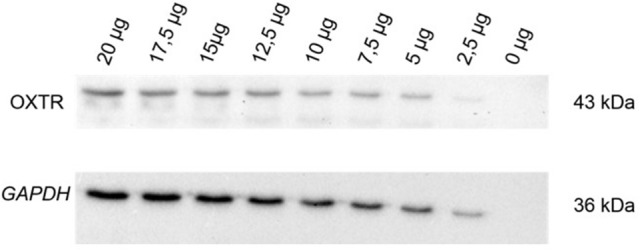
Figure 1
Figure 1
OXTR (43 kDa) expression and corresponding loading control GAPDH (36 kDa) were measured to show the linearity in the OXTR antibody detectability in human PBMC. Establishment of the antibody was performed with a protein amount dilution series from 2.5 to 20 μg in 2.5 μg steps within an internal reference control. A protein-free sample (0 μg) was used as negative control; OXTR, oxytocin receptor; GAPDH, glyceraldehyde 3-phosphate dehydrogenase; kDa, kilodalton.
Figure 2
Figure 2
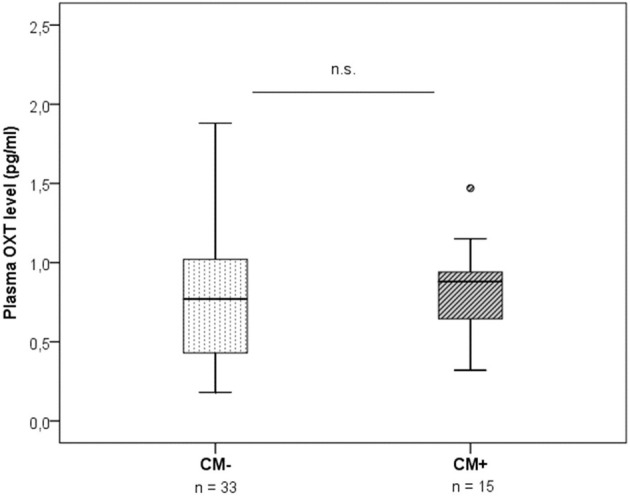
Plasma OXT levels measured by radioimmunoassay in plasma samples of CM− mothers vs. CM+ mothers (n = 48). No group differences in OXT were found (Mann-Whitney-U test, z = −0.49, p = 0.625). CM+, women with at least moderate to severe child maltreatment experiences; CM−, women without a history of child maltreatment.
Figure 3
Figure 3
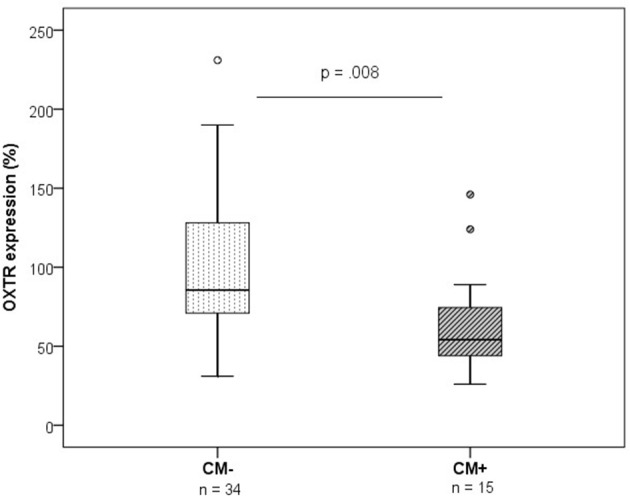
OXTR protein expression levels measured by western blotting (n = 49, group means: CM− mothers = 99%, SEM = 8%; CM+ = 66%, SEM = 6%). OXTR protein expression was lower in PBMC of CM+ mothers compared to CM− mothers (Mann-Whitney-U test, z = −2.66, p = 0.008). OXTR protein expression values were normalized to the loading control GAPDH and represented as % of an internal reference sample run on each blot. CM+, women with at least moderate to severe child maltreatment experiences; CM−, women without a history of child maltreatment; SEM, standard error of the mean.
Figure 4
Figure 4
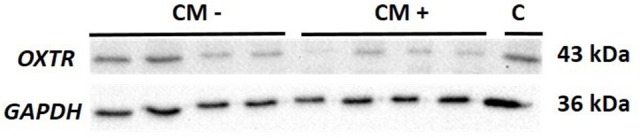
Representative blot of OXTR (43 kDa) protein expression and the corresponding loading control GAPDH (36 kDa) measured in human PBMC. OXTR, oxytocin receptor; GAPDH, glyceraldehyde 3-phosphate dehydrogenase; kDa, kilodalton; CM−, women without a history of child maltreatment; CM+, women with at least moderate to severe child maltreatment experiences; C, internal reference sample running on each blot.
Figure 5
Figure 5
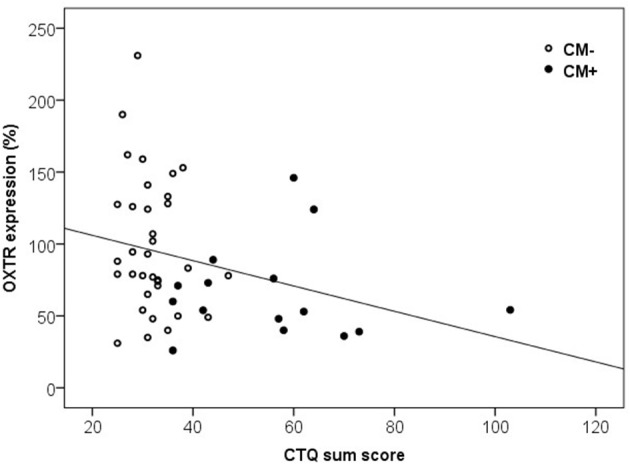
Correlation of CTQ sum scores and OXTR protein expression in human PBMC. Mothers with a higher CTQ sum score presented a lower level of OXTR protein expression in PBMC [Spearman-Rho Correlation, r(49) = −0.36, p = 0.010]. OXTR, oxytocin receptor; CTQ, Childhood Trauma Questionnaire.
Figure 6
Figure 6
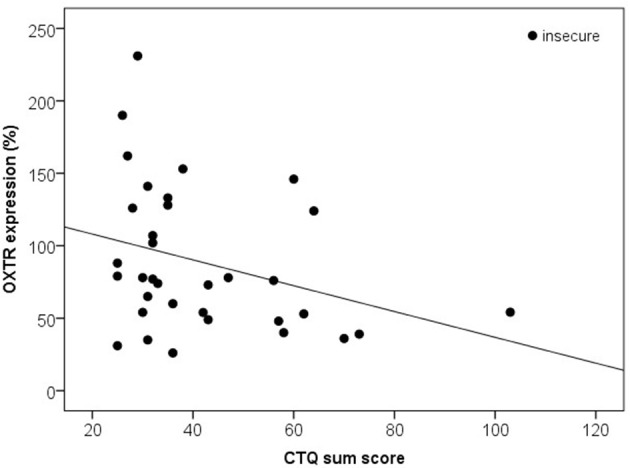
Correlation of the CTQ sum score with the OXTR protein expression in human PBMC of insecure mothers (Ds, E, and U). Insecure mothers revealed lower OXTR protein expression associated with higher CTQ sum scores [Spearman-Rho Correlation, r(34) = −0.35, p = 0.040]. OXTR, oxytocin receptor; CTQ, Childhood Trauma Questionnaire.

References

    1. Agid O., Kohn Y., Lerer B. (2000). Environmental stress and psychiatric illness. Biomed. Pharmacother. 54, 135–141. 10.1016/S0753-3322(00)89046-0 - DOI - PubMed
    1. Ainsworth M. D. S., Blehar M. C., Waters E., Wall S. (1978). Patterns of Attachment: A Psychological Study of the Strange Situation. Hillsdale, NJ: Lawrence Erlbaum Associates.
    1. Bader K., Hänny C., Schäfer V., Neuckel A., Kuhl C. (2009). Childhood trauma questionnaire – psychometrische eigenschaften einer deutschsprachigen version. Z. Psychol. Psychother. 38, 223–230. 10.1026/1616-3443.38.4.223 - DOI
    1. Bakermans-Kranenburg M. J., van Ijzendoorn M. H. (2013). Sniffing around oxytocin: review and meta-analyses of trials in healthy and clinical groups with implications for pharmacotherapy. Transl. Psychiatry 3:e258. 10.1038/tp.2013.34 - DOI - PMC - PubMed
    1. Bernstein D., Fink L. (1998). Manual for the Childhood Trauma Questionnaire. New York, NY: The Psychological Corporation.

LinkOut - more resources