


Inhibitory Control Mediates the Association between Perceived Stress and Secure Relationship Quality
- PMID: 29535664
- PMCID: PMC5834476
- DOI: 10.3389/fpsyg.2018.00217
Inhibitory Control Mediates the Association between Perceived Stress and Secure Relationship Quality
Abstract
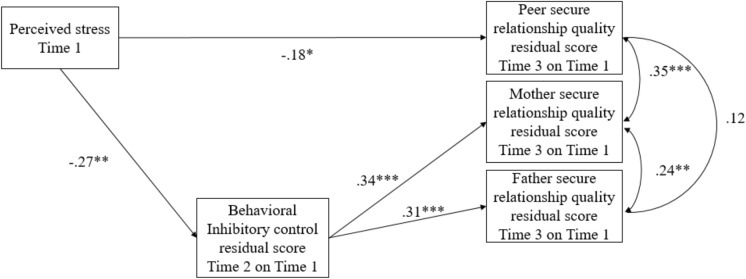
Past research has demonstrated negative associations between exposure to stressors and quality of interpersonal relationships among children and adolescents. Nevertheless, underlying mechanisms of this association remain unclear. Chronic stress has been shown to disrupt prefrontal functioning in the brain, including inhibitory control abilities, and evidence is accumulating that inhibitory control may play an important role in secure interpersonal relationship quality, including peer problems and social competence. In this prospective longitudinal study, we examine whether changes in inhibitory control, measured at both behavioral and neural levels, mediate the association between stress and changes in secure relationship quality with parents and peers. The sample included 167 adolescents (53% males) who were first recruited at age 13 or 14 years and assessed annually three times. Adolescents' inhibitory control was measured by their behavioral performance and brain activities, and adolescents self-reported perceived stress levels and relationship quality with mothers, fathers, and peers. Results suggest that behavioral inhibitory control mediates the association between perceived stress and adolescent's secure relationship quality with their mothers and fathers, but not their peers. In contrast, given that stress was not significantly correlated with neural inhibitory control, we did not further test the mediation path. Our results highlight the role of inhibitory control as a process through which stressful life experiences are related to impaired secure relationship quality between adolescents and their mothers and fathers.
Keywords: adolescence; functional magnetic resonance imaging; inhibitory control; perceived stress; relationship quality.
Figures
References
-
- Arbuckle J. L. (1996). “Full information estimation in the presence of incomplete data,” in Advanced Structural Equation Modeling: Issues and Techniques, eds Marcoulides G. A., Schumacker R. E. (Mahwah, NJ: Erlbaum; ), 243–277.
-
- Balaraman G. R. (2003). Children’s self-regulation and peer interaction at 36 and 54 months: concurrent and longitudinal relations. Paper Presented at the Biennial Meeting of the Society for Research in Child Development, Tampa, FL.
Grants and funding
LinkOut - more resources
Full Text Sources
Other Literature Sources
Miscellaneous
