. 2018 Feb 26:9:323.
doi: 10.3389/fmicb.2018.00323. eCollection 2018.

In Silico Approach for Prediction of Antifungal Peptides

Affiliations

In Silico Approach for Prediction of Antifungal Peptides

Piyush Agrawal et al. Front Microbiol. .

Abstract

This paper describes in silico models developed using a wide range of peptide features for predicting antifungal peptides (AFPs). Our analyses indicate that certain types of residue (e.g., C, G, H, K, R, Y) are more abundant in AFPs. The positional residue preference analysis reveals the prominence of the particular type of residues (e.g., R, V, K) at N-terminus and a certain type of residues (e.g., C, H) at C-terminus. In this study, models have been developed for predicting AFPs using a wide range of peptide features (like residue composition, binary profile, terminal residues). The support vector machine based model developed using compositional features of peptides achieved maximum accuracy of 88.78% on the training dataset and 83.33% on independent or validation dataset. Our model developed using binary patterns of terminal residues of peptides achieved maximum accuracy of 84.88% on training and 84.64% on validation dataset. We benchmark models developed in this study and existing methods on a dataset containing compositionally similar antifungal and non-AFPs. It was observed that binary based model developed in this study preforms better than any model/method. In order to facilitate scientific community, we developed a mobile app, standalone and a user-friendly web server 'Antifp' (http://webs.iiitd.edu.in/raghava/antifp).

Keywords: amino acid composition; antifungal peptides; antimicrobial peptides; motifs; support vector machine.


Figures
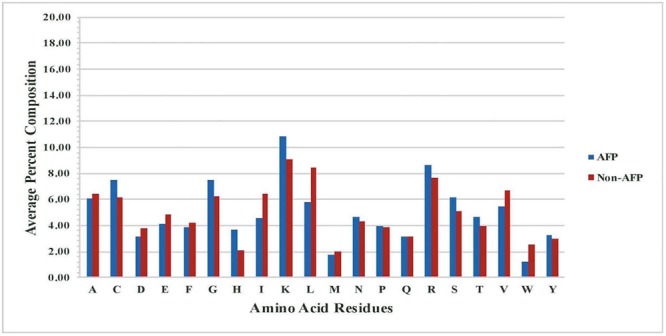
FIGURE 1
FIGURE 1
Comparison of percent average amino acid composition of the AFPs- and non- AFPs in Antifp_Main dataset.
FIGURE 2
FIGURE 2
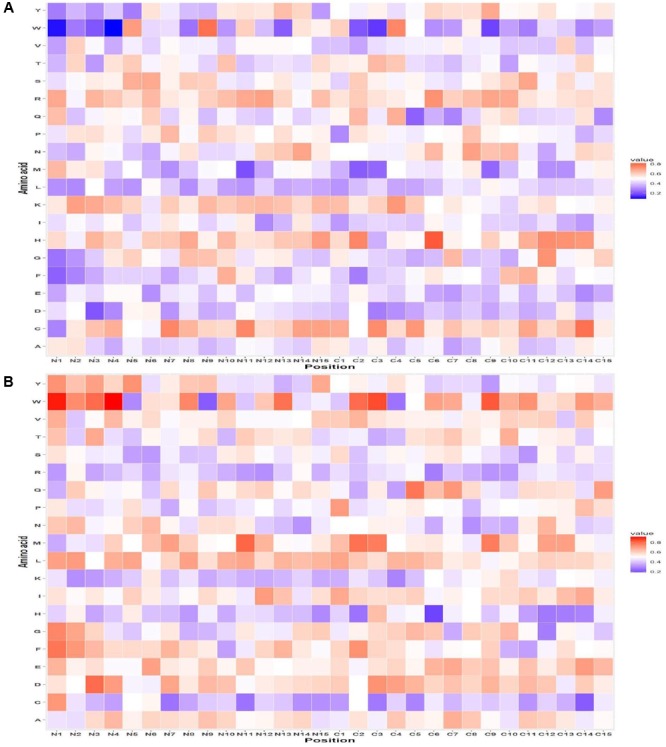
Heat map illustrating the positional preference of each type of residue at (first 15 positions) N and C-terminus (A) positive and (B) negative data of Antifp_Main dataset.
FIGURE 3
FIGURE 3
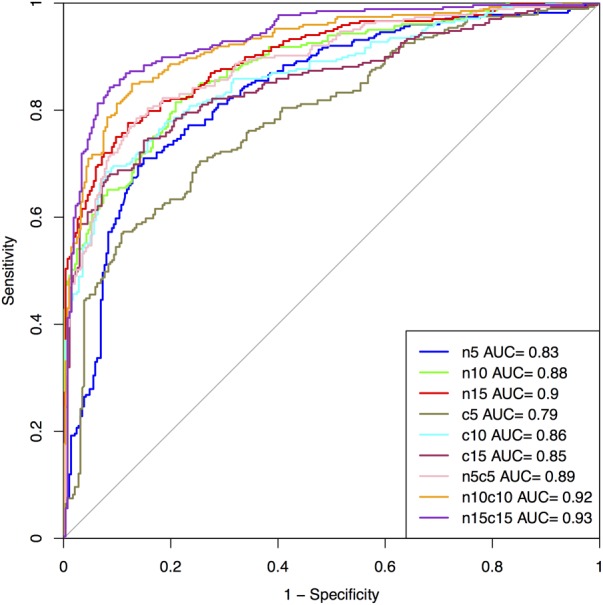
The performance of models on Antifp_Main dataset in term of ROC curves, models were developed using composition features of peptides.
FIGURE 4
FIGURE 4
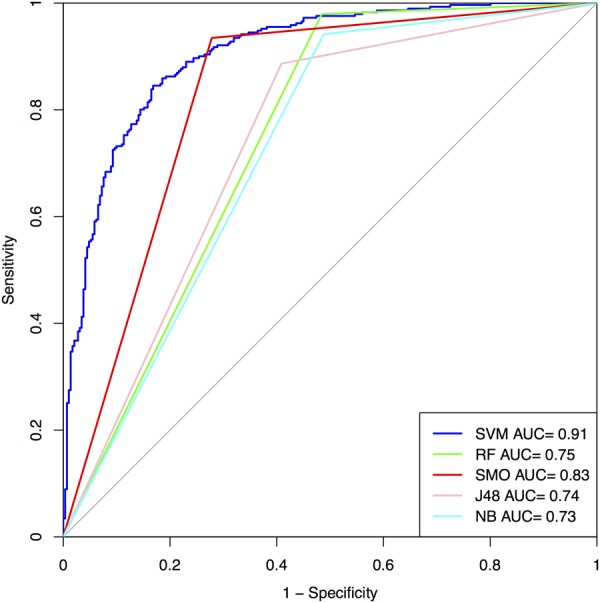
ROC curves show performance of models on Antifp_Main dataset developed using composition features along with mass, charge, and pI value.
FIGURE 5
FIGURE 5
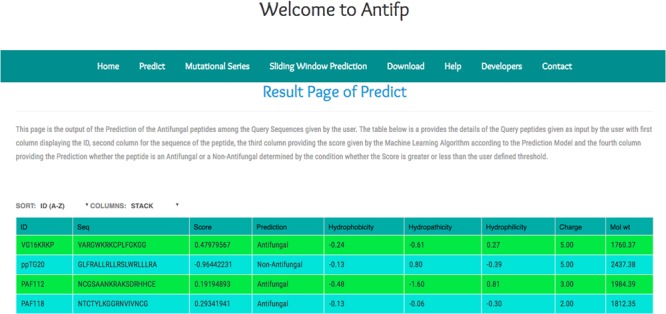
Screenshot of the “Antifp” predict page showing the result of the sequences taken in case study.
FIGURE 6
FIGURE 6
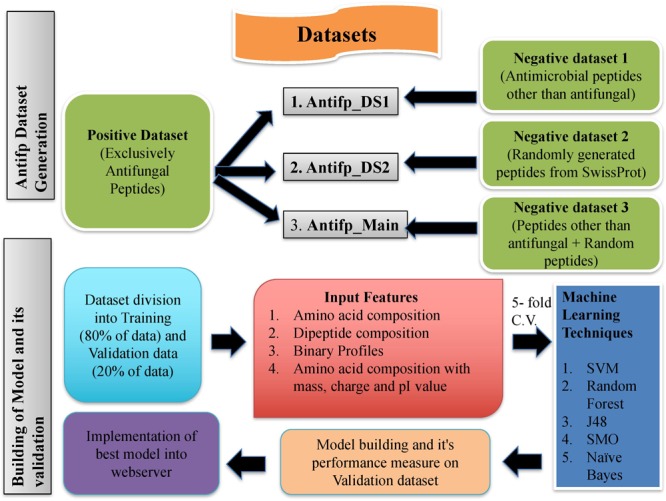
Schematic representation of procedure used to create datasets and building models in this study.

References

    1. Agrawal P., Bhalla S., Usmani S. S., Singh S., Chaudhary K., Raghava G. P. S., et al. (2016). CPPsite 2.0: a repository of experimentally validated cell-penetrating peptides. Nucleic Acids Res. 44 D1098–D1103. 10.1093/nar/gkv1266 - DOI - PMC - PubMed
    1. Bhalla S., Chaudhary K., Kumar R., Sehgal M., Kaur H., Sharma S., et al. (2017). Gene expression-based biomarkers for discriminating early and late stage of clear cell renal cancer. Sci. Rep. 7:44997. 10.1038/srep44997 - DOI - PMC - PubMed
    1. Brown G. D., Denning D. W., Gow N. A. R., Levitz S. M., Netea M. G., White T. C. (2012). Hidden killers: human fungal infections. Sci. Transl. Med. 4:165rv13. 10.1126/scitranslmed.3004404 - DOI - PubMed
    1. Chaudhary K., Kumar R., Singh S., Tuknait A., Gautam A., Mathur D., et al. (2016). A web server and mobile app for computing hemolytic potency of peptides. Sci. Rep. 6:22843. 10.1038/srep22843 - DOI - PMC - PubMed
    1. Chou K.-C. (2011). Some remarks on protein attribute prediction and pseudo amino acid composition. J. Theor. Biol. 273 236–247. 10.1016/j.jtbi.2010.12.024 - DOI - PMC - PubMed

LinkOut - more resources