Clinical and microbiological effects of egg yolk antibody against Porphyromonas gingivalis as an adjunct in the treatment of moderate to severe chronic periodontitis: a randomized placebo-controlled clinical trial
- PMID: 29535890
- PMCID: PMC5841267
- DOI: 10.5051/jpis.2018.48.1.47
Clinical and microbiological effects of egg yolk antibody against Porphyromonas gingivalis as an adjunct in the treatment of moderate to severe chronic periodontitis: a randomized placebo-controlled clinical trial
Abstract
Purpose: To evaluate the clinical and microbiological effects of the local use of egg yolk immunoglobulin against Porphyromonas gingivalis (anti-P.g. IgY) as an adjunct to scaling and root planing (SRP) in the treatment of moderate to severe chronic periodontitis.
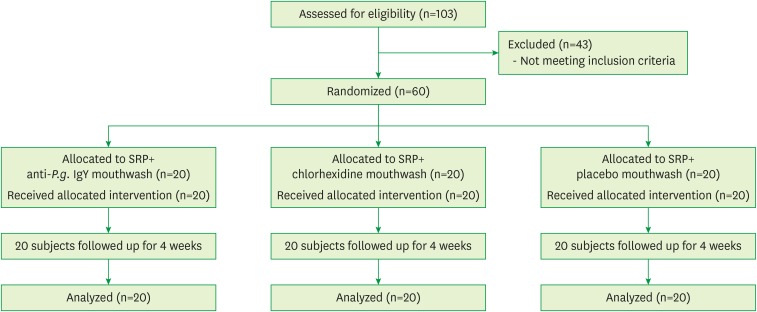
Methods: This was a randomized, placebo-controlled, double-blind trial involving 60 systematically healthy patients with moderate to severe chronic periodontitis. Subjects (n=20/group) were randomly assigned to receive SRP combined with subgingival irrigation of anti-P.g. IgY and anti-P.g. IgY mouthwash, subgingival irrigation of 0.2% chlorhexidine and 0.2% chlorhexidine mouthwash, or subgingival irrigation of placebo and placebo mouthwash for 4 weeks. Probing pocket depth, clinical attachment level, bleeding on probing, and the plaque index were evaluated at baseline and at 4 weeks. Subgingival plaque, gingival crevicular fluid, and saliva were simultaneously collected for microbiological analysis.
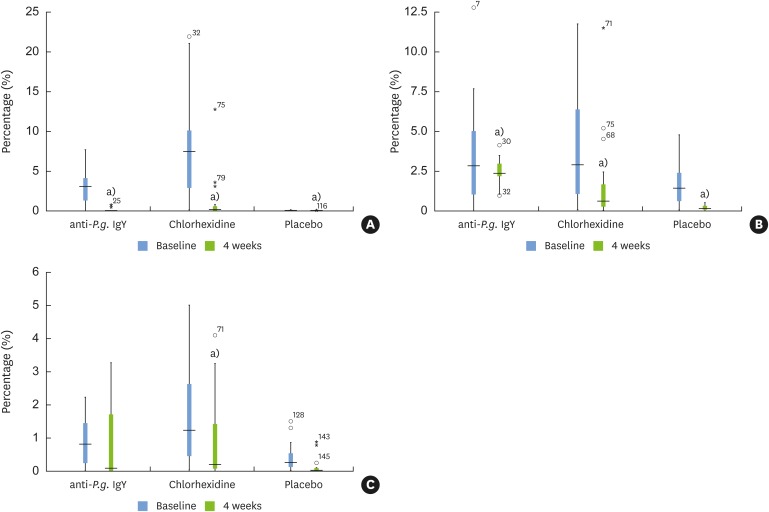
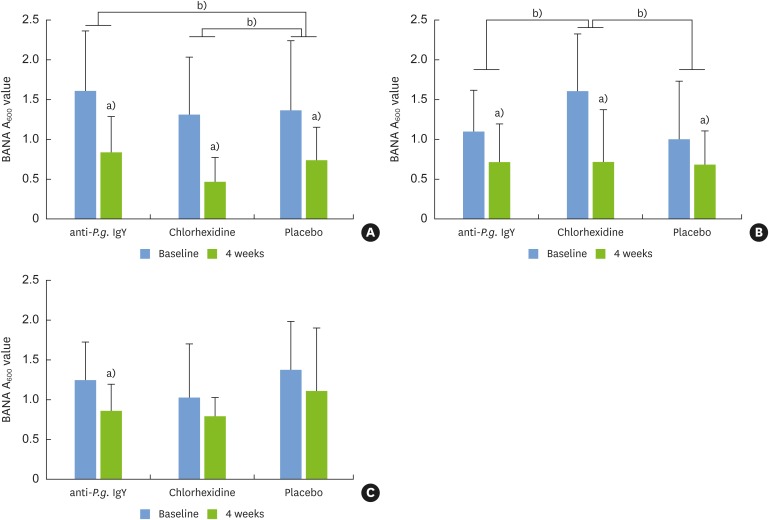
Results: Our results showed that anti-P.g. IgY mouthwash was as effective as chlorhexidine at improving clinical parameters over a 4-week period. All the groups showed a significant reduction in levels of P.g. at 4 weeks. No significant difference was observed in the test group when compared to placebo regarding the reduction in the levels of P.g. Anti-P.g. IgY significantly suppressed the numbers of red complex bacteria (RCB) in subgingival plaque and saliva in comparison with placebo. No adverse effects were reported in any of the subjects.
Conclusions: Within the limitations of the study, the present investigation showed that passive immunization with anti-P.g. IgY may prove to be effective in the treatment of chronic periodontitis due to its ability to improve clinical parameters and to reduce RCB. No significant differences were found between the anti-P.g. IgY and placebo groups in the reduction of P.g.
Keywords: Chlorhexidine; Passive immunization; Periodontitis; Porphyromonas gingivalis; Therapeutics.
Conflict of interest statement
Conflict of Interest: No potential conflict of interest relevant to this article was reported.
Figures
References
-
- Sanz M, van Winkelhoff AJ. Periodontal infections: understanding the complexity--consensus of the Seventh European Workshop on Periodontology. J Clin Periodontol. 2011;38(Suppl 11):3–6. - PubMed
-
- Corbet EF, Leung WK. Epidemiology of periodontitis in the Asia and Oceania regions. Periodontol 2000. 2011;56:25–64. - PubMed
-
- Dye BA. Global periodontal disease epidemiology. Periodontol 2000. 2012;58:10–25. - PubMed
-
- Grenier D, Mayrand D. Periodontitis as an ecological imbalance. In: Kuramitsu HK, Ellen RP, editors. Oral bacterial ecology: the molecular basis. Wymondham: Horizon Scientific; 2000. pp. 275–310.
-
- Slots J, Ting M. Actinobacillus actinomycetemcomitans and Porphyromonas gingivalis in human periodontal disease: occurrence and treatment. Periodontol 2000. 1999;20:82–121. - PubMed
LinkOut - more resources
Full Text Sources
Other Literature Sources