


Open versus arthroscopic repair of the triangular fibrocartilage complex: a systematic review
- PMID: 29536282
- PMCID: PMC5849747
- DOI: 10.1186/s40634-018-0120-1
Open versus arthroscopic repair of the triangular fibrocartilage complex: a systematic review
Abstract
Background and purpose: To investigate the outcome of open versus arthroscopic repair of injuries of the triangular fibrocartilage complex (TFCC).
Methods: An electronic literature search of articles published between January 1, 1985, and May 26, 2016, in PubMed, Embase, and the Cochrane Library was carried out in May 2016 and updated in March and December 2017. Studies comparing open and arthroscopic repair of TFCC injury with a mean follow up of more than 1 year were eligible for inclusion. The Preferred Reporting Items for Systematic Reviews and Meta-Analyses (PRISMA) checklist guided the extraction and reporting of data. The methodological quality of the included articles was assessed with the Cochrane Collaboration's tool for assessing risk of bias. The primary outcome measure was the rate of postoperative distal radioulnar joint (DRUJ) re-instability. Secondary outcome measures were range of motion (ROM), grip strength, residual pain, functional wrist scores and the rates of complications and re-operations.
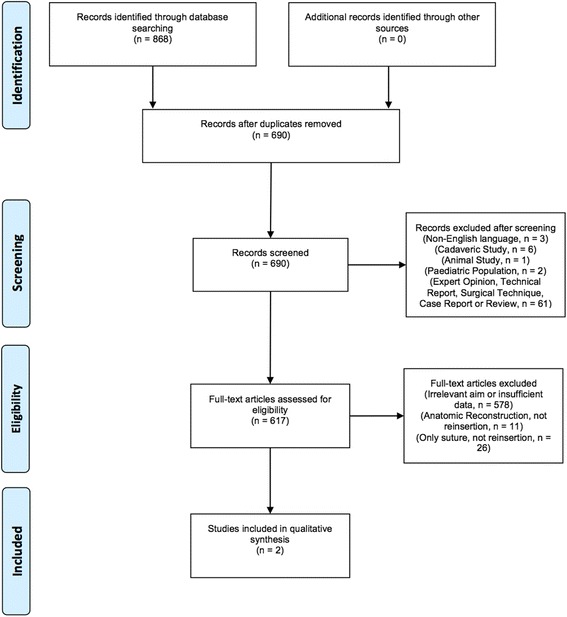
Results: A total of 868 articles were identified by the electronic search. After duplicate removal and subsequent study selection, a total of two studies were included in this systematic review. The methodological quality of the included articles displayed risks of bias. There was no difference in DRUJ re-instability between open and arthroscopic repair of the TFCC. There were no differences in obtained postoperative ROM, grip strength or values in functional outcome scores, between open and arthroscopic TFCC repair in the two included studies, except for the Disability of the Arm Shoulder and Hand (DASH) questionnaire - in favor of arthroscopic surgery - in one of the included studies.
Conclusions: This systematic review shows comparable results between open and arthroscopic repair of the TFCC, in terms of DRUJ re-instability and functional outcome scores. There is insufficient evidence to recommend one technique over the other in clinical practice. There is an immense lack of comparison studies with high level of evidence in the area of wrist ligament repair and reconstruction, including TFCC-injuries and DRUJ-instability.
Keywords: Arthroscopic repair, Systematic review; Open repair; Triangular fibrocartilage complex.
Conflict of interest statement
Competing interests
The authors declare that they have no competing interests.
Publisher’s Note
Springer Nature remains neutral with regard to jurisdictional claims in published maps and institutional affiliations.
Figures
References
-
- Andernord D, Desai N, Björnsson H, Ylander M, Karlsson J, Samuelsson K. Patient predictors of early revision surgery after anterior cruciate ligament reconstruction: a cohort study of 16,930 patients with 2-year follow-up. Am J Sports Med. 2015;43:121–127. doi: 10.1177/0363546514552788. - DOI - PubMed
-
- Andersson J, Axelsson P. Wrist ligament injuries – diagnostics. Lakartidningen. 2011;42:2096–2101. - PubMed
Publication types
LinkOut - more resources
Full Text Sources
Other Literature Sources
