


doi: 10.1002/anie.201712931.
Epub 2018 Apr 6.
Chelating Rotaxane Ligands as Fluorescent Sensors for Metal Ions
Affiliations
- PMID: 29537728
- PMCID: PMC5947674
- DOI: 10.1002/anie.201712931
Item in Clipboard
Chelating Rotaxane Ligands as Fluorescent Sensors for Metal Ions
Angew Chem Int Ed Engl.
.
Abstract
Although metal-ion-binding interlocked molecules have been under intense investigation for over three decades, their application as scaffolds for the development of sensors for metal ions remains underexplored. In this work, we demonstrate the potential of simple rotaxanes as metal-ion-responsive ligand scaffolds through the development of a proof-of-concept selective sensor for Zn2+ .
Keywords: fluorescent probes; rotaxanes; sensors; supramolecular chemistry; zinc.
© 2018 The Authors. Published by Wiley-VCH Verlag GmbH & Co. KGaA.
Conflict of interest statement
The authors declare no conflict of interest.
Figures
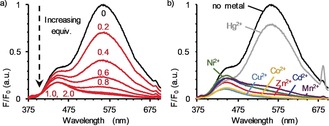
Emission profile of rotaxane 4 (MeCN, 100 μm , λ
ex=343 nm) in the presence of varying amounts of Zn(ClO4)2⋅6 H2O (a), and in the presence of 5 equiv M(ClO4)2 (b). No emission was observed with Fe(ClO4)2.
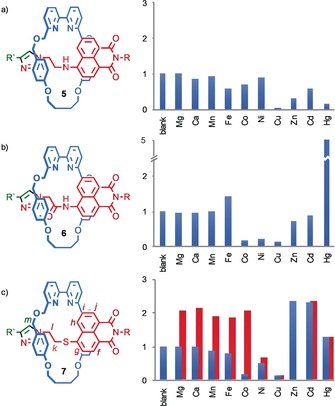
Rotaxanes a) 5 (λ
ex=435 nm), b) 6 (λ
ex=380 nm), and c) 7 (λ
ex=379 nm) and their fluorescence response to 5 equiv M(ClO4)2 (MeCN, 100 μm ; blue bars). Red bars in (c) refer to the fluorescence response upon sequential addition of M2+ followed by Zn2+ (5 equiv each). R=CH2C(H)Ph2, R′=3,5‐di‐tBu‐C6H3.
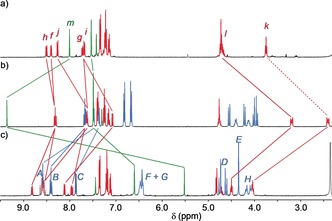
Partial 1H NMR spectra (CD3CN, 400 MHz, 298 K) of a) the non‐interlocked axle of rotaxane 7, b) rotaxane 7, and c) rotaxane 7+Zn(ClO4)2⋅6 H2O. For labelling scheme, see Scheme 1 (macrocycle) and Figure 2 (axle).
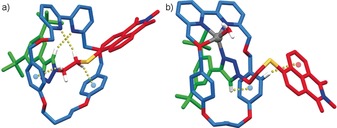
a) Solid‐state structure of rotaxane 7 (selected distances in Å: C−Hm⋅⋅⋅N=2.46, C‐Hk⋅⋅⋅N=2.71, C−Hk⋅⋅⋅π=2.66, C‐Hl⋅⋅⋅π=2.79; dihedral angle Ck‐S‐C‐Cipso=8.2°). b) Solid‐state structure of [Zn(7)]2+ (selected distances: C−O⋅⋅⋅Zn=2.28, C−Hm⋅⋅⋅π=2.74, C−HF⋅⋅⋅π=2.86; dihedral angle Ck‐S‐C‐Cipso=29.9°).
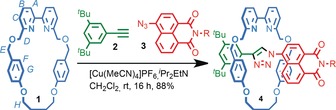
Synthesis of fluorescent rotaxane 4 using the AT‐CuAAC reaction. R=CH2C(H)Ph2.

UV/Vis (λ=322 nm) titrations of 7 (100 μm ) with M(ClO4)2 as a function of a) Zn2+, b) Zn2+ (2 % H2O/MeCN), c) Cd2+ (MeCN), and d) Cd2+ (2 % H2O‐MeCN). e) Emission spectra (λ
ex=380 nm) of 7 (black), 7+5 equiv Cd2+ (blue), 7+5 equiv Zn2+ (red), 7+5 equiv each Zn2+ and Cd2+ (black dashed) in 2 % H2O/MeCN.
References
-
- Reviews:
-
- Domaille D. W., Que E. L., Chang C. J., Nat. Chem. Biol. 2008, 4, 168; - PubMed
Publication types
Grants and funding
LinkOut - more resources
Full Text Sources
Other Literature Sources
