


Composition and diversity of rhizosphere fungal community in Coptis chinensis Franch. continuous cropping fields
- PMID: 29538438
- PMCID: PMC5851603
- DOI: 10.1371/journal.pone.0193811
Composition and diversity of rhizosphere fungal community in Coptis chinensis Franch. continuous cropping fields
Abstract
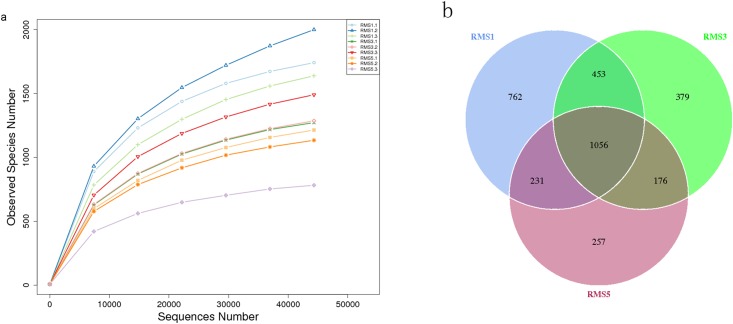
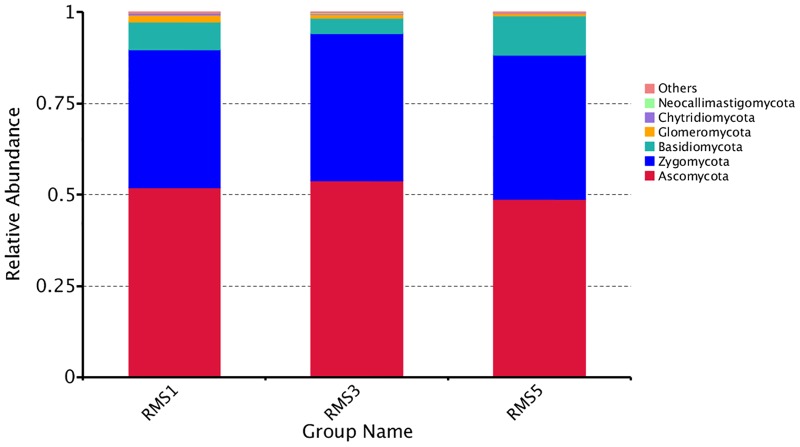
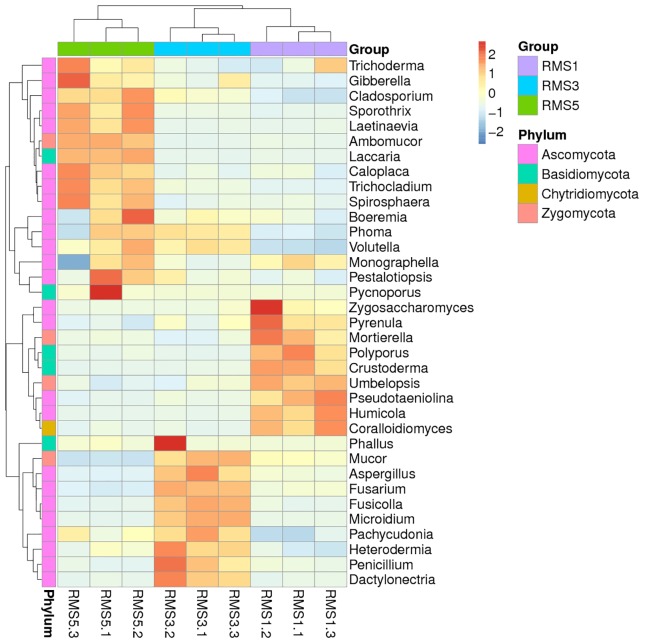
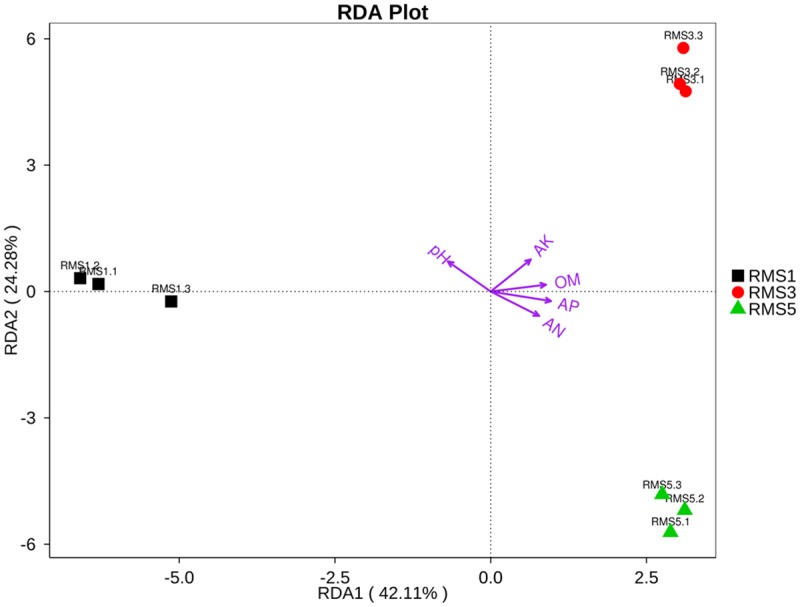
In this study, effects of continuous cropping on soil properties, enzyme activities, and relative abundance, community composition and diversity of fungal taxa were investigated. Rhizosphere soil from field continuously cropped for one-year, three-year and five-year by Coptis chinensis Franch. was collected and analyzed. Illumina high-throughput sequencing analysis showed that continuous cropping of C. chinensis resulted in a significant and continuous decline in the richness and diversity of soil fungal population. Ascomycota, Zygomycota, Basidiomycota, and Glomeromycota were the dominant phyla of fungi detected in rhizosphere soil. Fungal genera such as Phoma, Volutella, Pachycudonia, Heterodermia, Gibberella, Cladosporium, Trichocladium, and Sporothrix, were more dominant in continuously cropped samples for three-year and five-year compared to that for one-year. By contrast, genera, such as Zygosaccharomyces, Pseudotaeniolina, Hydnum, Umbelopsis, Humicola, Crustoderma, Psilocybe, Coralloidiomyces, Mortierella, Polyporus, Pyrenula, and Monographella showed higher relative abundance in one-year samples than that in three-year and five-year samples. Cluster analysis of the fungal communities from three samples of rhizosphere soil from C. chinensis field revealed that the fungal community composition, diversity, and structure were significantly affected by the continuous cropping. Continuous cropping of C. chinensis also led to significant declines in soil pH, urease, and catalase activities. Redundancy analysis showed that the soil pH had the most significant effect on soil fungal population under continuous cropping of C. chinensis.
Conflict of interest statement
Figures
References
-
- Tang J, Feng Y, Tsao S, Wang N, Curtain R, Wang Y. Berberine and Coptidis rhizoma as novel antineoplastic agents: a review of traditional use and biomedical investigations. J Ethnopharmacol. 2009; 126: 5–17. doi: 10.1016/j.jep.2009.08.009 - DOI - PubMed
-
- Wang L, Zhang SY, Chen L, Huang XJ, Zhang QW, Jiang RW, et al. New enantiomeric isoquinoline alkaloids from Coptis chinensis. Phytochem Lett. 2014; 7: 89–92. doi: 10.1016/j.phytol.2013.10.007 - DOI
-
- Yan D, Jin C, Xiao XH, Dong XP. Antimicrobial properties of berberines alkaloids in Coptis chinensis Franch. by microcalorimetry. J Biochem Biophy Meth. 2008; 70(6): 845–849. doi: 10.1016/j.jbbm.2007.07.009 - DOI - PubMed
-
- Park EK, Rhee HI, Jung HS, Ju SM, Lee YA, Lee SH, et al. Anti-inflammatory effects of a combined herbal preparation (RAH13) of Phellodendron amurense and Coptis chinensis in animal models of inflammation. Phytother Res. 2007; 21: 746–750. - PubMed
-
- Chen HB, Luo CD, Liang JL, Zhang ZB, Lin GS, Wu JZ, et al. Anti-inflammatory activity of coptisine free base in mice through inhibition of NF-κB and MAPK signaling pathways. Eur J Pharmacol. 2017; 811: 222–231. doi: 10.1016/j.ejphar.2017.06.027 - DOI - PubMed
Publication types
MeSH terms
Substances
LinkOut - more resources
Full Text Sources
Other Literature Sources
Medical
