


Plasticity for desiccation tolerance across Drosophila species is affected by phylogeny and climate in complex ways
- PMID: 29540521
- PMCID: PMC5879635
- DOI: 10.1098/rspb.2018.0048
Plasticity for desiccation tolerance across Drosophila species is affected by phylogeny and climate in complex ways
Abstract
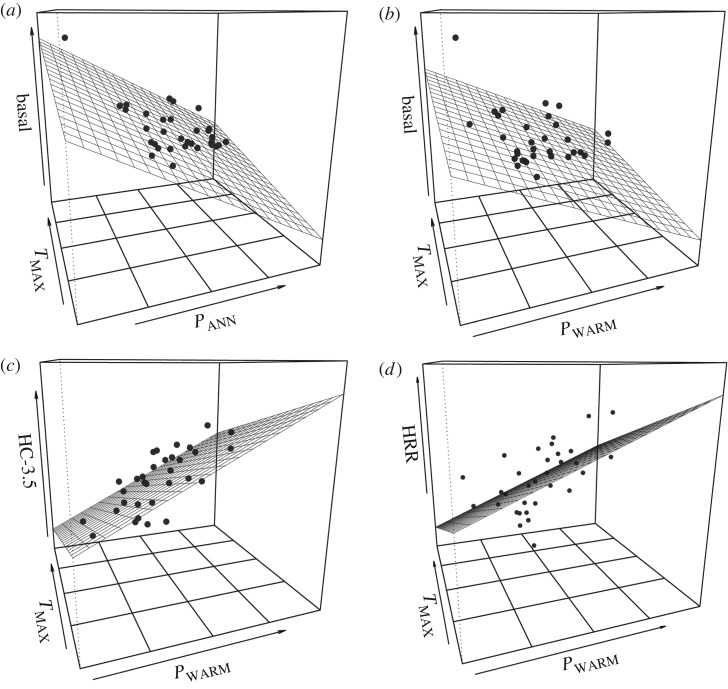
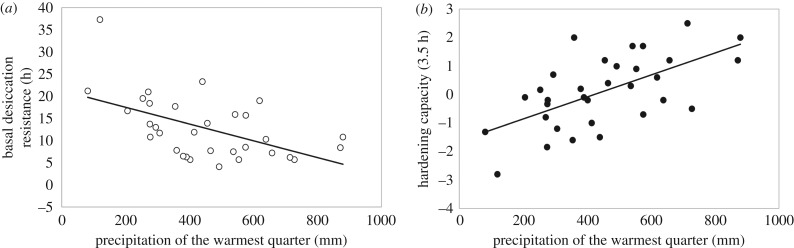
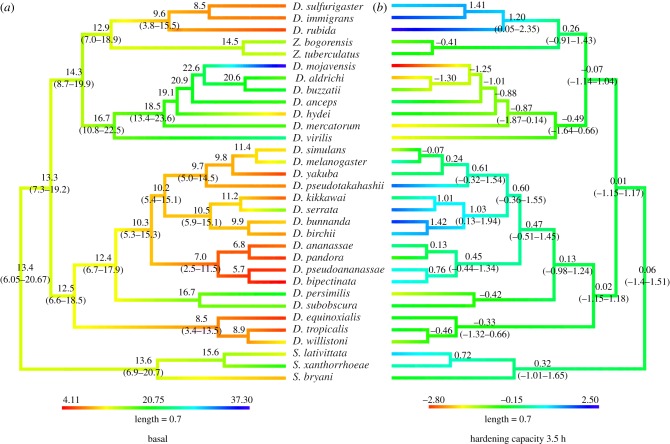
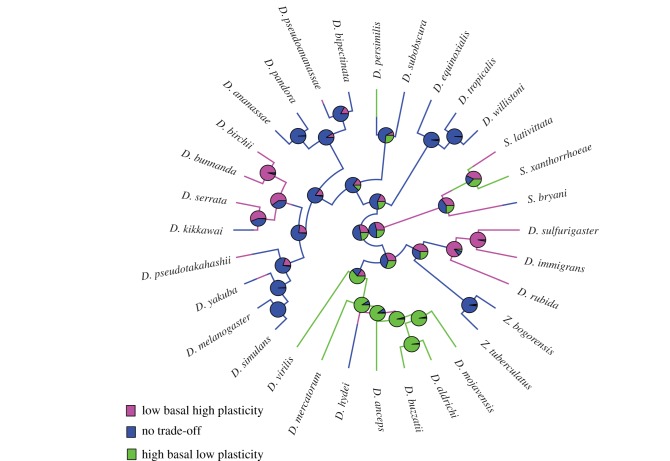
Comparative analyses of ectotherm susceptibility to climate change often focus on thermal extremes, yet responses to aridity may be equally important. Here we focus on plasticity in desiccation resistance, a key trait shaping distributions of Drosophila species and other small ectotherms. We examined the extent to which 32 Drosophila species, varying in their distribution, could increase their desiccation resistance via phenotypic plasticity involving hardening, linking these responses to environment, phylogeny and basal resistance. We found no evidence to support the seasonality hypothesis; species with higher hardening plasticity did not occupy environments with higher and more seasonal precipitation. As basal resistance increased, the capacity of species to respond via phenotypic plasticity decreased, suggesting plastic responses involving hardening may be constrained by basal resistance. Trade-offs between basal desiccation resistance and plasticity were not universal across the phylogeny and tended to occur within specific clades. Phylogeny, environment and trade-offs all helped to explain variation in plasticity for desiccation resistance but in complex ways. These findings suggest some species have the ability to counter dry periods through plastic responses, whereas others do not; and this ability will depend to some extent on a species' placement within a phylogeny, along with its basal level of resistance.
Keywords: climate change; desiccation; phenotypic plasticity; seasonality; trade-off.
© 2018 The Author(s).
Conflict of interest statement
We declare we have no competing interests.
Figures
References
-
- IPCC. 2014. Climate change 2014: mitigation of climate change. Contribution of working group III to the fifth assessment report of the intergovernmental panel on climate change. Cambridge, UK: Cambridge University Press.
-
- Parmesan C. 2006. Ecological and evolutionary responses to recent climate change. Annu. Rev. Ecol. Evol. Syst 37, 637–669. (10.1146/annurev.ecolsys.37.091305.110100) - DOI
-
- Kellermann V, Loeschcke V, Hoffmann AA, Kristensen TN, Fløjgaard C, David JR, Overgaard J. 2012. Phylogenetic constraints in key functional traits behind species' climate niches: patterns of desiccation and cold resistance across 95 Drosophila species. Evolution 66, 3377 (10.1111/j.1558-5646.2012.01685.x) - DOI - PubMed
Publication types
MeSH terms
Associated data
LinkOut - more resources
Full Text Sources
Other Literature Sources
Molecular Biology Databases
Research Materials
