. 2018 Mar 27;115(13):3398-3403.
doi: 10.1073/pnas.1715382115. Epub 2018 Mar 14.

Nitrate is an important nitrogen source for Arctic tundra plants

Affiliations

Nitrate is an important nitrogen source for Arctic tundra plants

Xue-Yan Liu et al. Proc Natl Acad Sci U S A. .

Abstract

Plant nitrogen (N) use is a key component of the N cycle in terrestrial ecosystems. The supply of N to plants affects community species composition and ecosystem processes such as photosynthesis and carbon (C) accumulation. However, the availabilities and relative importance of different N forms to plants are not well understood. While nitrate (NO3-) is a major N form used by plants worldwide, it is discounted as a N source for Arctic tundra plants because of extremely low NO3- concentrations in Arctic tundra soils, undetectable soil nitrification, and plant-tissue NO3- that is typically below detection limits. Here we reexamine NO3- use by tundra plants using a sensitive denitrifier method to analyze plant-tissue NO3- Soil-derived NO3- was detected in tundra plant tissues, and tundra plants took up soil NO3- at comparable rates to plants from relatively NO3--rich ecosystems in other biomes. Nitrate assimilation determined by 15N enrichments of leaf NO3- relative to soil NO3- accounted for 4 to 52% (as estimated by a Bayesian isotope-mixing model) of species-specific total leaf N of Alaskan tundra plants. Our finding that in situ soil NO3- availability for tundra plants is high has important implications for Arctic ecosystems, not only in determining species compositions, but also in determining the loss of N from soils via leaching and denitrification. Plant N uptake and soil N losses can strongly influence C uptake and accumulation in tundra soils. Accordingly, this evidence of NO3- availability in tundra soils is crucial for predicting C storage in tundra.

Keywords: Arctic tundra plants; nitrogen dynamics; plant nitrate; soil nitrate; stable isotopes.


Conflict of interest statement

The authors declare no conflict of interest.

Figures

Fig. 1.
Fig. 1.
Concentrations of NO3 in plant leaves (A) and roots (B) across different ecosystems. The box encompasses the 25th to 75th percentiles, and whiskers are the SD values. The line and square in each box mark the median and mean values of studied plants at each site, respectively. Unique letters above the boxes mark significant differences at the level of P < 0.05. Detailed site information, including site abbreviation definitions, and species-specific values are given in SI Appendix, Tables S1 and S2. dw, dry weight.
Fig. 2.
Fig. 2.
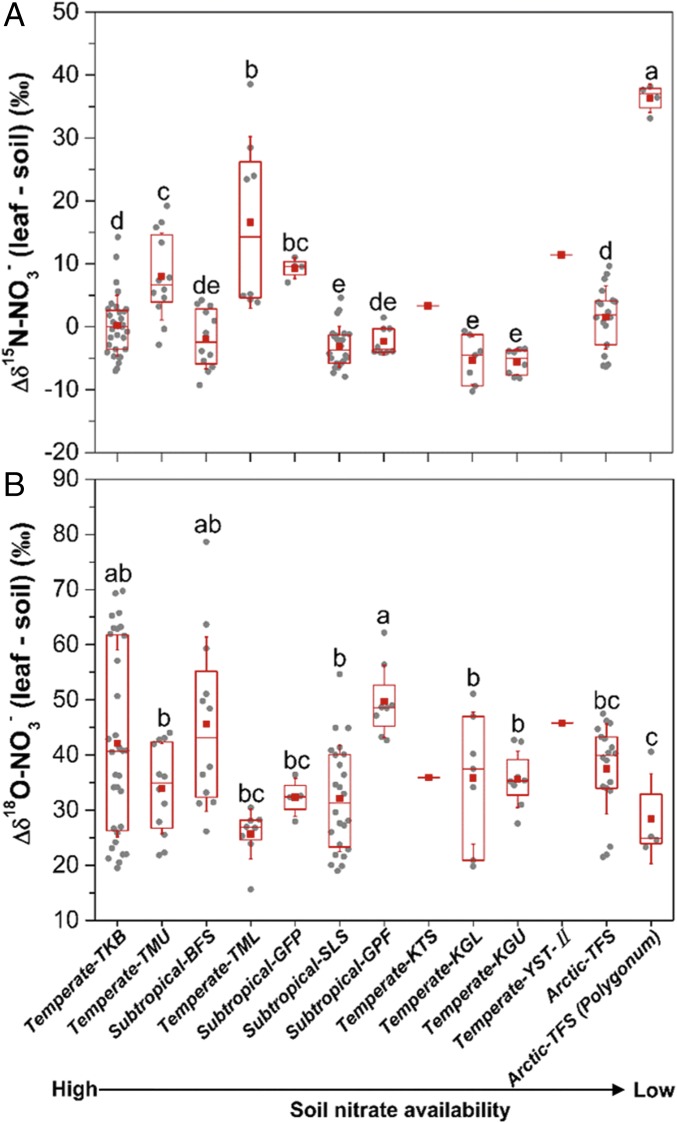
Differences (∆ values) in δ15N (A) and δ18O (B) between leaf NO3 and soil NO3 across different ecosystems. The box encompasses the 25th to 75th percentiles, whiskers are the SD values, and the red line and red square in each box mark the median and mean values, respectively. Unique letters above the boxes indicate significant differences at the level of P < 0.05. The ∆ values were calculated using replicate values of plant tissues minus mean values of soil in corresponding sites (SI Appendix, Fig. S8 and Table S1).
Fig. 3.
Fig. 3.
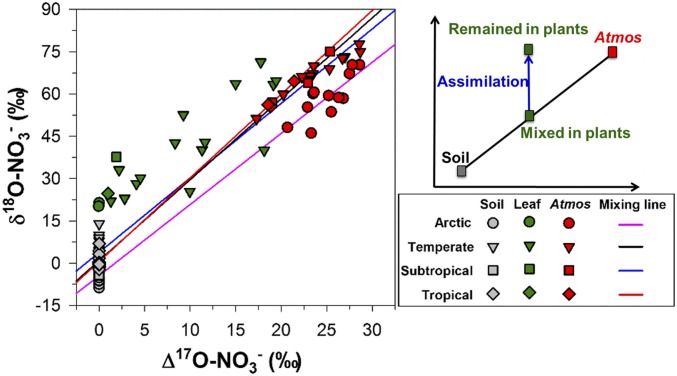
Δ17O vs. δ18O plots of NO3 in soil, leaves, and atmospheric (Atmos, as precipitation or snow) deposition across different ecosystems. The mixing lines of Arctic and tropical sites (y = 2.52x − 4.42 and y = 2.97x + 0.58, respectively) were based on isotopic values of soil NO3 (n = 18) (54) and snowpack NO3 (n = 12) (56) at Barrow, and of soil NO3 (n = 18) and precipitation NO3 (n = 3) at Jianfengling in tropical China (49), respectively. The mixing line of temperate sites (y = 2.64x + 3.82) was based on isotopic values of soil NO3 at Japanese temperate sites (n = 22) and precipitation at TML (n = 12) in this study. The mixing line of subtropical sites (y = 2.87x + 0.91) was based on isotopic values of soil NO3 (n = 29) at subtropical sites and precipitation NO3 at Guiyang, China (n = 3) in this study. The Δ17O of soil NO3 was assumed to be zero.
Fig. 4.
Fig. 4.
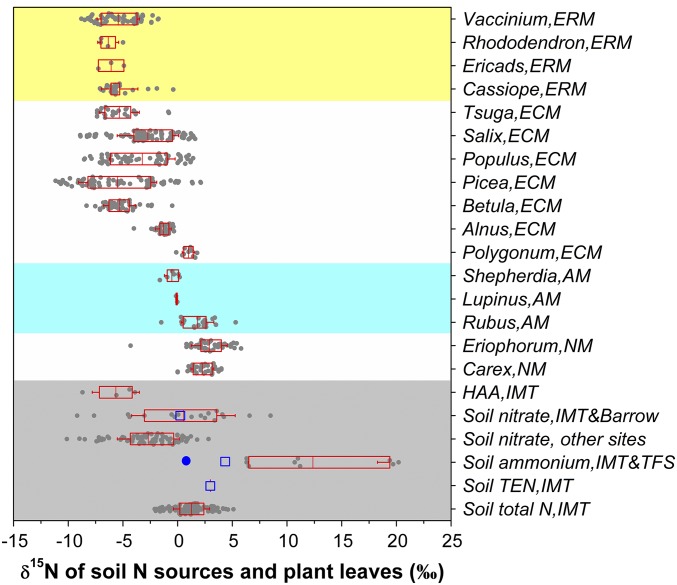
δ15N values of leaf total N and soil N sources of tundra plants in Alaska. AM, arbuscular mycorrhiza; ECM, ectomycorrhiza; ERM, ericoid mycorrhiza; NM, nonmycorrhiza. The box encompasses the 25th to 75th percentiles, and whiskers are the SD values. The line in each box marks the mean value. Plant δ15N data were summarized from ref. and those of SI Appendix, Fig. S9B. The empty squares show soil δ15N data reported at IMT (53) and the blue-filled circle shows data at TFS (21). Soil δ15N-NO3 values of other sites are summarized from available data of non-Arctic sites in this study; soil δ15N-NO3 values at Barrow are cited from ref. .
Fig. 5.
Fig. 5.
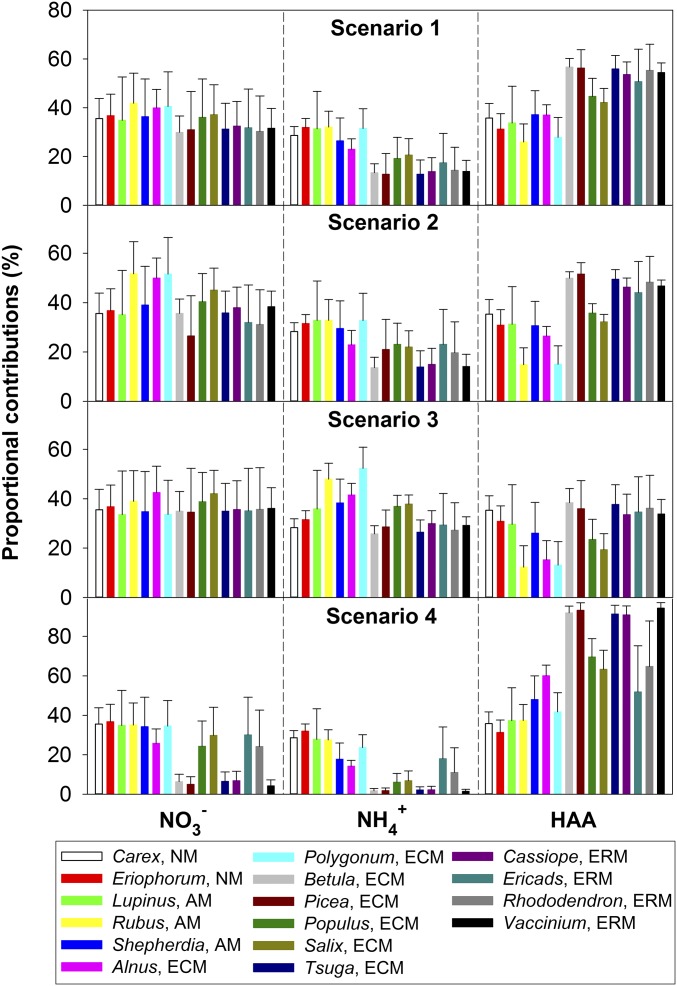
Proportional contributions (mean ± SD) of soil NO3, NH4+, and HAA to leaf total N of tundra plants in Alaska. The 15ε values [0‰ for NM plants, −5.0‰ for AM plants, −6.9‰ for ECM plants, and −7.7‰ for ERM plants (21, 62)] were considered for NO3, NH4+, and HAA (scenario 1); for NH4+ and HAA only (scenario 2); for HAA only (scenario 3); for none of NO3, NH4+, and HAA (scenario 4).

References

    1. Chapin FS, III, Matson PA, Vitousek PM. Principles of Terrestrial Ecosystem Ecology. 2nd Ed Springer; New York: 2011.
    1. Bloom AJ, Burger M, Rubio Asensio JS, Cousins AB. Carbon dioxide enrichment inhibits nitrate assimilation in wheat and Arabidopsis. Science. 2010;328:899–903. - PubMed
    1. Reich PB, Hobbie SE, Lee TD. Plant growth enhancement by elevated CO2 eliminated by joint water and nitrogen limitation. Nat Geosci. 2014;7:920–924.
    1. Schimel JP, Bennett J. Nitrogen mineralization: Challenges of a changing paradigm. Ecology. 2004;85:591–602.
    1. Mack MC, Schuur EA, Bret-Harte MS, Shaver GR, Chapin FS., III Ecosystem carbon storage in Arctic tundra reduced by long-term nutrient fertilization. Nature. 2004;431:440–443. - PubMed

Publication types