


Mobile Phone Incentives for Childhood Immunizations in Rural India
- PMID: 29540571
- PMCID: PMC5869335
- DOI: 10.1542/peds.2017-3455
Mobile Phone Incentives for Childhood Immunizations in Rural India
Abstract
Objectives: Young children in resource-poor settings remain inadequately immunized. We evaluated the role of compliance-linked incentives versus mobile phone messaging to improve childhood immunizations.
Methods: Children aged ≤24 months from a rural community in India were randomly assigned to either a control group or 1 of 2 study groups. A cloud-based, biometric-linked software platform was used for positive identification, record keeping for all groups, and delivery of automated mobile phone reminders with or without compliance-linked incentives (Indian rupee Rs30 or US dollar $0.50 of phone talk time) for the study groups. Immunization coverage was analyzed by using multivariable Poisson regression.
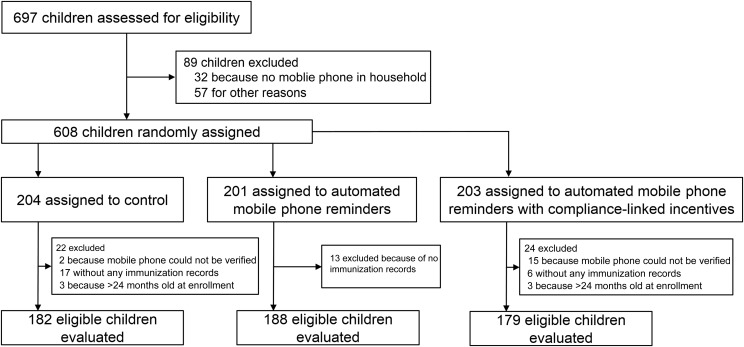
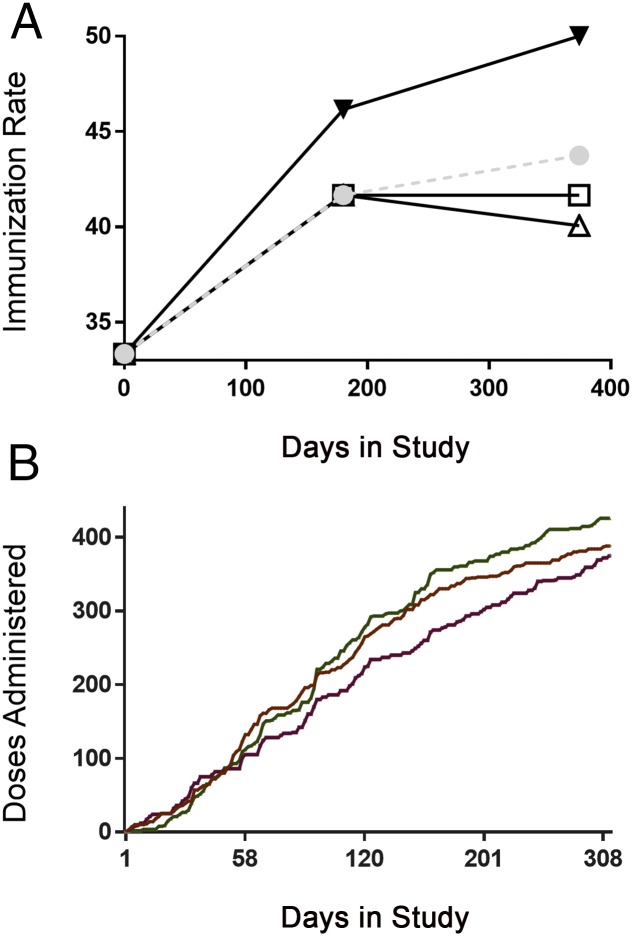
Results: Between July 11, 2016, and July 20, 2017, 608 children were randomly assigned to the study groups. Five hundred and forty-nine (90.3%) children fulfilled eligibility criteria, with a median age of 5 months; 51.4% were girls, 83.6% of their mothers had no schooling, and they were in the study for a median duration of 292 days. Median immunization coverage at enrollment was 33% in all groups and increased to 41.7% (interquartile range [IQR]: 23.1%-69.2%), 40.1% (IQR: 30.8%-69.2%), and 50.0% (IQR: 30.8%-76.9%) by the end of the study in the control group, the group with mobile phone reminders, and the compliance-linked incentives group, respectively. The administration of compliance-linked incentives was independently associated with improvement in immunization coverage and a modest increase in timeliness of immunizations.
Conclusions: Compliance-linked incentives are an important intervention for improving the coverage and timeliness of immunizations in young children in resource-poor settings.
Trial registration: ClinicalTrials.gov NCT03180138.
Copyright © 2018 by the American Academy of Pediatrics.
Conflict of interest statement
POTENTIAL CONFLICT OF INTEREST: Dr Ajay K. Jain reports grants and personal fees from Alexion Pharmaceuticals outside the submitted work; the other authors have indicated they have no potential conflicts of interest to disclose.
Figures
Comment in
-
Mobile Phone Technology Based Incentives to Enhance Routine Childhood Immunization: Evidence-based Medicine Viewpoint.Indian Pediatr. 2018 Aug 15;55(8):687-690. Indian Pediatr. 2018. PMID: 30218517 No abstract available.
-
Mobile Phone Technology Based Incentives to Enhance Routine Childhood Immunization: Pediatrician's Viewpoint.Indian Pediatr. 2018 Aug 15;55(8):690-691. Indian Pediatr. 2018. PMID: 30218518 No abstract available.
-
Mobile Phone Technology Based Incentives to Enhance Routine Childhood Immunization: Medical Information Technologist's Viewpoint.Indian Pediatr. 2018 Aug 15;55(8):691. Indian Pediatr. 2018. PMID: 30218519 No abstract available.
References
-
- World Health Organization; United Nations Children’s Fund 1 in 10 infants worldwide did not receive any vaccinations in 2016. Available at: www.who.int/mediacentre/news/releases/2017/infants-worldwide-vaccination.... Accessed November 30, 2017
-
- PRICE 88% of households in India have a mobile phone. Available at: www.ice360.in/en/projects/homepageservey/88-of-households-in-india-have-.... Accessed September 25, 2017
-
- Rai S. India just crossed 1 billion mobile subscribers milestone and the excitement’s just beginning. Forbes January 6, 2016. Available at: https://www.forbes.com/sites/saritharai/2016/01/06/india-just-crossed-1-.... Accessed September 25, 2017
-
- International Telecommunication Union ICT facts and figures 2017. Available at: www.itu.int/en/ITU-D/Statistics/Documents/facts/ICTFactsFigures2017.pdf. Accessed September 25, 2017
Publication types
MeSH terms
Associated data
Grants and funding
LinkOut - more resources
Full Text Sources
Other Literature Sources
Medical
