


Residential Proximity to Major Roadways and Risk of Incident Ischemic Stroke in NOMAS (The Northern Manhattan Study)
- PMID: 29540609
- PMCID: PMC5871599
- DOI: 10.1161/STROKEAHA.117.019580
Residential Proximity to Major Roadways and Risk of Incident Ischemic Stroke in NOMAS (The Northern Manhattan Study)
Abstract
Background and purpose: The evidence supporting the deleterious cardiovascular health effects of living near a major roadway is growing, although this association is not universal. In primary analyses, we hypothesized that residential proximity to a major roadway would be associated with incident ischemic stroke and that cardiovascular risk factors would modify that association.
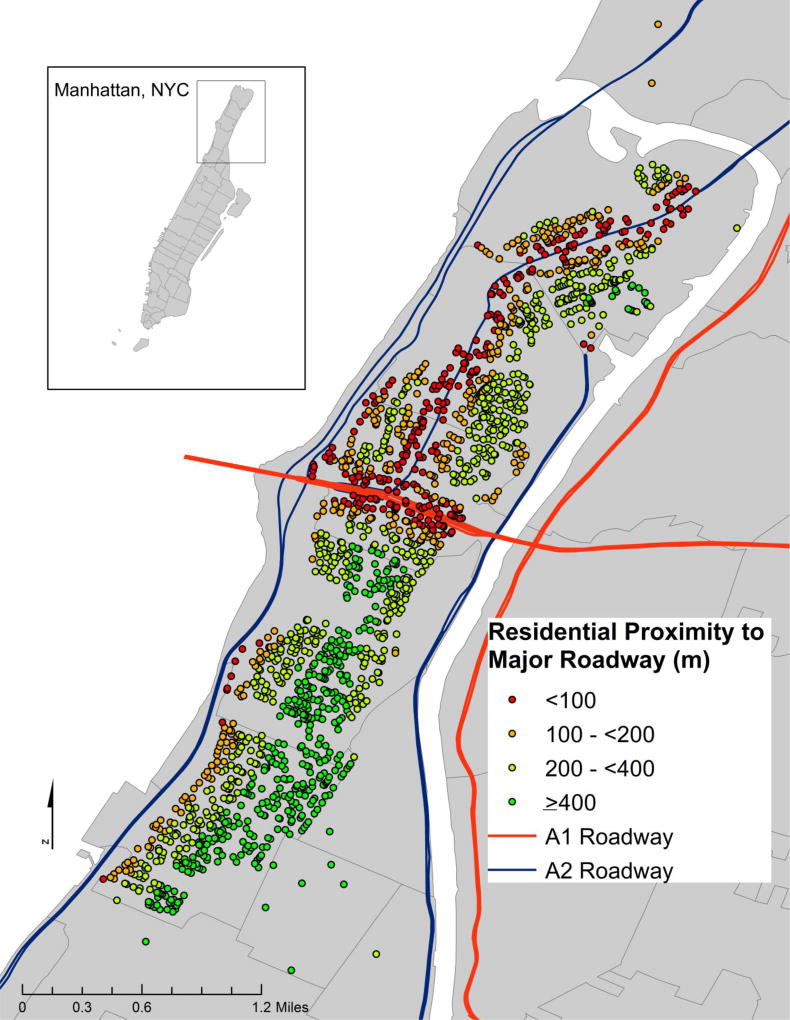
Methods: NOMAS (The Northern Manhattan Study) is an ongoing, population-based cohort study designed to measure cardiovascular risk factors, stroke incidence, and other outcomes in a multiethnic urban population. Recruitment occurred from 1993 to 2001 and participants are followed-up annually by telephone. Residential addresses at baseline were geocoded and Euclidean distance to nearest major roadway was estimated and categorized as in prior studies. We used Cox proportional hazard models to calculate hazard ratios and 95% confidence intervals for the association of this distance to incidence of stroke and other outcomes, adjusting for sociodemographic and cardiovascular risk factors, year at baseline, and neighborhood socioeconomic status. We assessed whether these associations varied by age, sex, smoking status, diabetes mellitus, and hypertension.
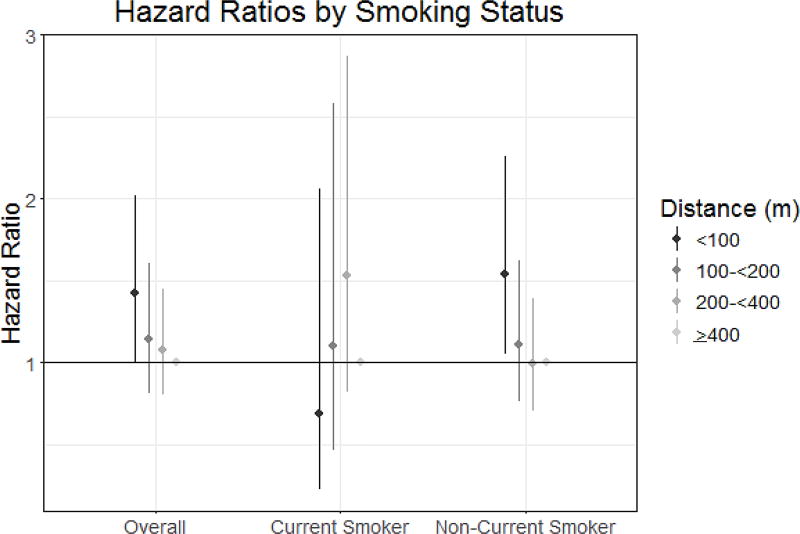
Results: During a median follow-up period of 15 years (n=3287), 11% of participants were diagnosed with ischemic stroke. Participants living <100 m from a roadway had a 42% (95% confidence interval, 1.01-2.02) higher rate of ischemic stroke versus those living >400 m away. This association was more pronounced among noncurrent smokers (hazard ratio, 1.54; 95% confidence interval, 1.05-2.26) and not evident among smokers (hazard ratio, 0.69; 95% confidence interval, 0.23-2.06). There was no clear pattern of association between proximity to major roadways and other cardiovascular events including myocardial infarction, all-cause death, or vascular death.
Conclusions: In this urban multiethnic cohort, we found evidence supporting that within-city variation in residential proximity to major roadway is associated with higher risk of ischemic stroke. An individual's smoking history modified this association, with the association remaining only among participants not currently smokers.
Keywords: air pollution; cardiovascular diseases; incidence; smokers; stroke.
© 2018 American Heart Association, Inc.
Figures
References
-
- Stroke 10:Fast facts on stroke. National Stroke Association; [Accessed July, 8, 2017]. http://www.stroke.org/sites/default/files/resources/NSA_FactSheet_Stroke....
-
- Ovbiagele B, Goldstein LB, Higashida RT, Howard VJ, Johnston SC, Khavjou OA, et al. Forecasting the Future of Stroke in the United States. Stroke. 2013;44 - PubMed
-
- Feigin VL, Roth GA, Naghavi M, Parmar P, Krishnamurthi R, Chugh S, et al. Global burden of stroke and risk factors in 188 countries, during 1990–2013: a systematic analysis for the Global Burden of Disease Study 2013. Lancet Neurol. 2016;15:913–924. - PubMed
-
- O’Donnell MJ, Chin SL, Rangarajan S, Xavier D, Liu L, Zhang H, et al. Global and regional effects of potentially modifiable risk factors associated with acute stroke in 32 countries (INTERSTROKE): a case-control study. Lancet. 2016;388:761–75. - PubMed
Publication types
MeSH terms
Grants and funding
LinkOut - more resources
Full Text Sources
Other Literature Sources
Medical
