. 2018 Mar 14;8(1):4540.
doi: 10.1038/s41598-018-22715-w.

Porous 3D Prussian blue/cellulose aerogel as a decorporation agent for removal of ingested cesium from the gastrointestinal tract

Affiliations

Porous 3D Prussian blue/cellulose aerogel as a decorporation agent for removal of ingested cesium from the gastrointestinal tract

Ilsong Lee et al. Sci Rep. .

Abstract

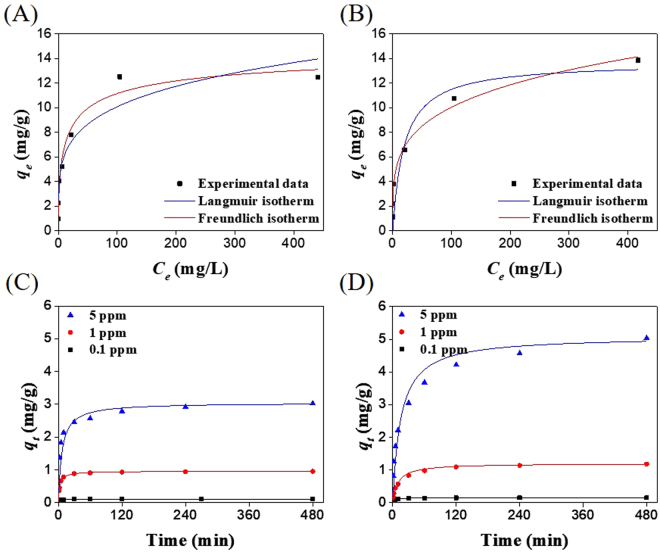
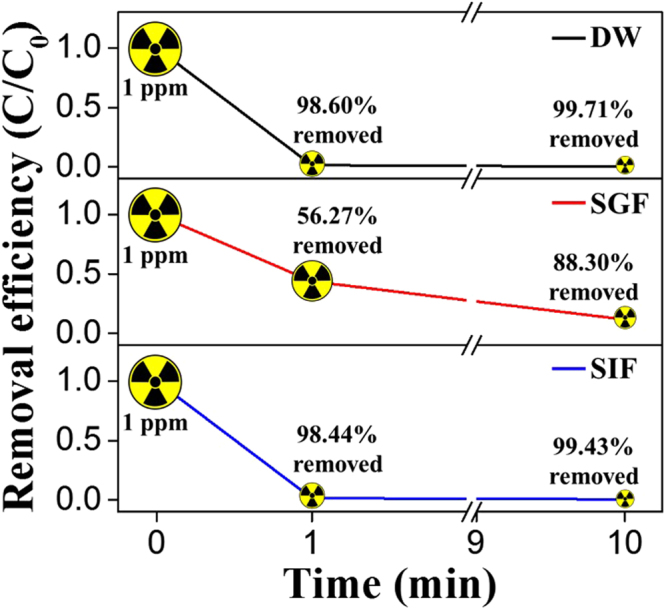
In the present study, we successfully synthesized a porous three-dimensional Prussian blue-cellulose aerogel (PB-CA) composite and used it as a decorporation agent for the selective removal of ingested cesium ions (Cs+) from the gastrointestinal (GI) tract. The safety of the PB-CA composite was evaluated through an in vitro cytotoxicity study using macrophage-like THP-1 cells and Caco-2 intestinal epithelial cells. The results revealed that the PB-CA composite was not cytotoxic. An adsorption study to examine the efficiency of the decorporation agent was conducted using a simulated intestinal fluid (SIF). The adsorption isotherm was fitted to the Langmuir model with a maximum Cs+ adsorption capacity of 13.70 mg/g in SIF that followed pseudo-second-order kinetics. The PB-CA composite showed excellent stability in SIF with a maximum Cs+ removal efficiency of 99.43%. The promising safety toxicology profile, remarkable Cs+ adsorption efficacy, and excellent stability of the composite demonstrated its great potential for use as an orally administered drug for the decorporation of Cs+ from the GI tract.


Conflict of interest statement

The authors declare no competing interests.

Figures

Figure 1
Figure 1
(A) Schematic diagram of the action of PB-CA in the gastrointestinal tract. (B) Illustrative morphology of PB-CA composite. (C) Cesium adsorption mechanism of PB.
Figure 2
Figure 2
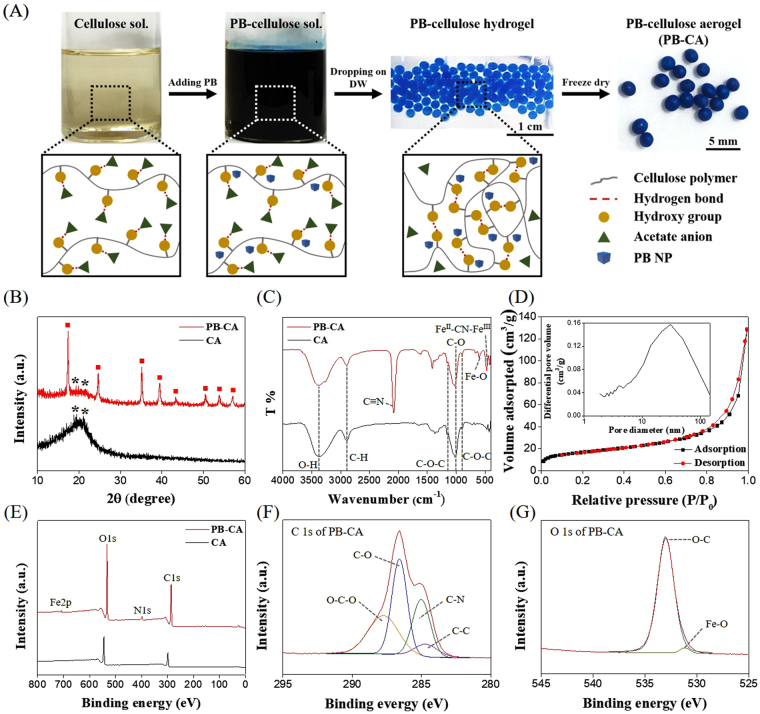
Fabrication and characterization of PB-CA. (A) Schematic diagram of the fabrication of PB-CA composite, (B) XRD patterns of CA and PB-CA composite, (C) FT-IR spectra of CA and PB-CA composite, (D) BET isotherm of PB-CA composite (inset: pore size distribution of PB-CA composite), (E) XPS survey spectra of CA and PB-CA composite, (F) C 1s spectra of PB-CA composite, and (G) O 1s spectra of PB-CA composite.
Figure 3
Figure 3
SEM images of the PB-CA composite. (A) Surface morphology, (B,C) inner morphology at different magnifications, and (D) cross section morphology.
Figure 4
Figure 4
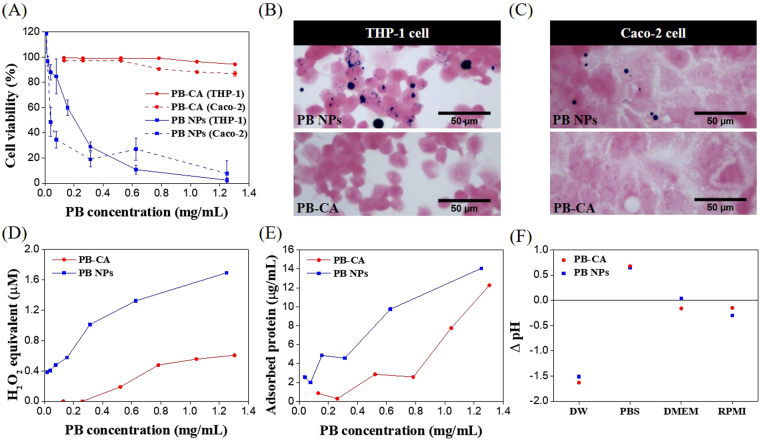
Cell viability analysis of PB and PB-CA (direct and indirect mechanisms). (A) Cytotoxicity of PB and PB-CA in macrophage-like THP-1 cells (solid line) and Caco-2 intestinal epithelial cells (dashed line). (B) Optical images of macrophage-like THP-1 cells treated by PB NPs (upper panel) and PB-CA (lower panel). (C) Optical images of Caco-2 intestinal epithelial cells treated by PB NPs (upper panel) and PB-CA (lower panel). (D) Potential of ROS generation of PB and PB-CA measured by DCFH-DA assay. (E) Protein corona binding affinity assay of PB and PB-CA (the data are expressed as adsorbed protein levels). (F) The change of pH before and after incubation of PB and PB-CA in various media.
Figure 5
Figure 5
Adsorption stability test of PB-CA. (A) UV spectra of PB-CA treated in SGF (upper panel) and SIF (lower panel) for 24 h (the insets present optical microscopy images to show the stability behavior of PB NPs and PB-CA in SGF (upper panel) and SIF (lower panel) treated for 24 h). (B) UV spectra of PB-CA after gamma ray irradiated at 0 kGy (upper panel), 6 kGy (middle panel), and 60 kGy (lower panel) (the insets represent optical microscopy images to show the behavior of PB-CA after gamma ray irradiation at 0 kGy (upper panel), 6 kGy (middle panel), and 60 kGy (lower panel)).
Figure 6
Figure 6
Cesium adsorption isotherm and kinetics studies of PB-CA. (A) Cesium adsorption isotherms fitted with Langmuir and Freundlich models in DW. (B) Cesium adsorption isotherms fitted with Langmuir and Freundlich models in SIF. (C) Cesium adsorption kinetics of PB-CA in DW fitted with pseudo-second order kinetics model. (D) Cesium adsorption kinetics of PB-CA in SIF fitted with pseudo-second order kinetics model.
Figure 7
Figure 7
Cesium removal efficiency in DW, SGF, and SIF after 1 and 10 min (10 mL of cesium solution with 50 mg of PB-CA).
Figure 8
Figure 8
Intra-particle diffusion model of cesium adsorption. (A) Diffusion studies of cesium into PB-CA from DW. (B) Diffusion studies of cesium into PB-CA from SIF (dashed lines represent external mass transfer, solid lines represent intra-particle diffusion, and dotted lines represent saturation of cesium ions in PB-CA). (C) Schematic diagrams of cesium adsorption into the PB-CA from DW. (D) Schematic diagrams of cesium adsorption into the PB-CA from SIF (cesium and potassium concentrations are 0.1 and 2000 ppm, respectively).
Figure 9
Figure 9
Cesium distribution on PB-CA after adsorption. (A) SEM image of the cryo-fractured PB-CA. (B) EDS mapping of iron. (C) EDS mapping of cesium. (D) EDS mapping of iron-cesium-overlay.

References

    1. Awual MR, et al. Radioactive cesium removal from nuclear wastewater by novel inorganic and conjugate adsorbents. Chem. Eng. J. 2014;242:127–135. doi: 10.1016/j.cej.2013.12.072. - DOI
    1. Yang D, et al. Capture of radioactive cesium and iodide ions from water by using titanate nanofibers and nanotubes. Angew. Chem. Int. Ed. 2011;50:10594–10598. doi: 10.1002/anie.201103286. - DOI - PubMed
    1. Kumamoto Y, et al. Meridional distribution of Fukushima-derived radiocesium in surface seawater along a trans-Pacific line from the Arctic to Antarctic Oceans in summer 2012. J. Radioanal. Nucl. Chem. 2016;307:1703–1710. doi: 10.1007/s10967-015-4439-0. - DOI
    1. Gok C, Gerstmann U, Höllriegl V, Aytas S. Preparation of Ca-alginate biopolymer beads and investigation of their decorporation characteristics for 85Sr, 238U and 234Th by in vitro experiments. Radiat. Prot. Dosim. 2012;153:47–55. doi: 10.1093/rpd/ncs088. - DOI - PubMed
    1. Weil GL. Hazards of nuclear power plants. Science. 1955;121:315–317. doi: 10.1126/science.121.3140.315. - DOI - PubMed

Publication types

LinkOut - more resources