


Comparisons of energy cost and economical walking speed at various gradients in healthy, active younger and older adults
- PMID: 29541103
- PMCID: PMC5812843
- DOI: 10.1016/j.jesf.2015.06.001
Comparisons of energy cost and economical walking speed at various gradients in healthy, active younger and older adults
Abstract
Background/objective: Oxygen consumption during walking per unit distance (Cw ; mL/kg/m) is known to be greater for older adults than younger adults, although its underlying process is controversial.
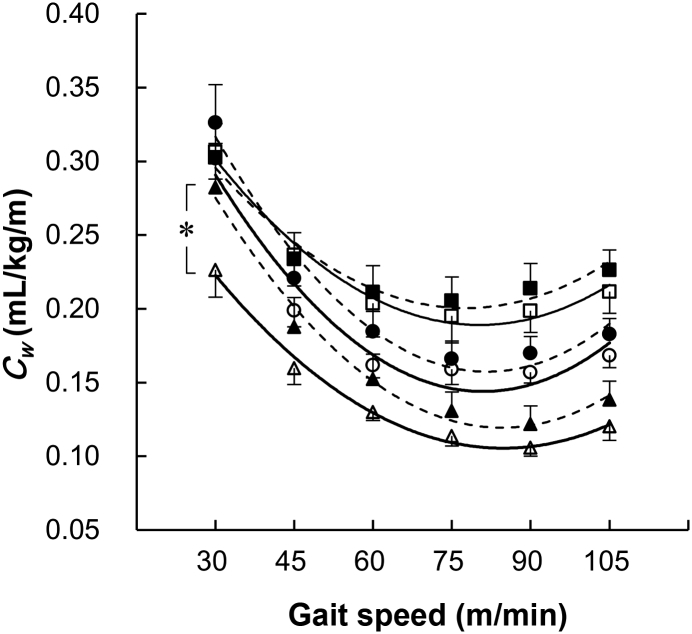
Methods: We measured the Cw values at six gait speeds from 30 m/min to 105 m/min on level ground and gradient slopes (±5%) in healthy younger and older male adults. A quadratic approximation was applied for a relationship between Cw and gait speeds (v; m/min). It gives a U-shaped Cw -v relationship, which includes a particular gait speed minimizing the Cw , the so-called economical speed (ES). The age-related difference of the Cw -v relationship was assessed by comparisons of ES and/or Cw .
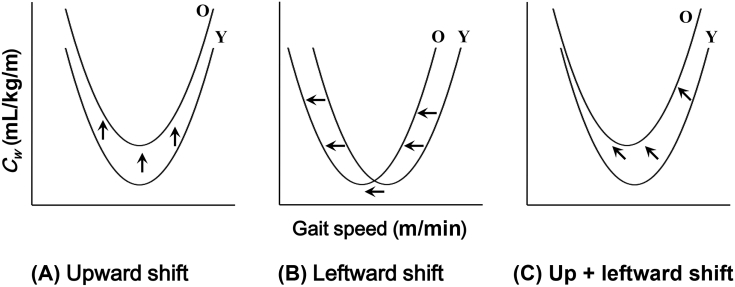
Results: A significantly greater Cw at 30 m/min and slower ES were found for older adults at the downhill gradient, suggesting that a combination of leftward and upward shifts of the Cw -v relationship was found at that gradient. Only a slower ES was found for older adults at the uphill gradient, suggesting that a leftward shift was found for older adults at that gradient. Neither a significant leftward nor an upward shift was found at the level gradient. Leg length significantly correlated to the ES for younger adults at the level and downhill gradients, while such a significant relationship was observed only at the level gradient for older adults. The maximal quadriceps muscle strength significantly correlated to the ES for older adults at all gradients, but not for younger adults.
Conclusion: The age-related alteration of the Cw -v relationship depends on the gradient, and its related factors were different between age groups.
Keywords: Aging; Bipedal locomotion; Gait; Optimal speed; Oxygen consumption.
Figures
References
-
- Saibene F., Minetti A.E. Biomechanical and physiological aspects of legged locomotion in humans. Eur J Appl Physiol. 2003;88:297–316. - PubMed
-
- Saibene F. The mechanisms for minimizing energy expenditure in human locomotion. Eur J Clin Nutr. 1990;44(suppl 1):65–71. - PubMed
-
- Abe D., Muraki S., Yasukouchi A. Ergonomic effects of load carriage on energy cost of gradient walking. Appl Ergon. 2008;39:144–149. - PubMed
-
- Abe D., Muraki S., Yasukouchi A. Ergonomic effects of load carriage on the upper and lower back on metabolic energy cost of walking. Appl Ergon. 2008;39:392–398. - PubMed
-
- Wezenberg D., van der Woude L.H., Faber W.X. Relation between aerobic capacity and walking ability in older adults with a lower-limb amputation. Arch Phys Med Rehabil. 2013;94:1714–1720. - PubMed
LinkOut - more resources
Full Text Sources
Other Literature Sources
