


Understanding Mechanism of Photocatalytic Microbial Decontamination of Environmental Wastewater
- PMID: 29541632
- PMCID: PMC5835762
- DOI: 10.3389/fchem.2018.00033
Understanding Mechanism of Photocatalytic Microbial Decontamination of Environmental Wastewater
Abstract
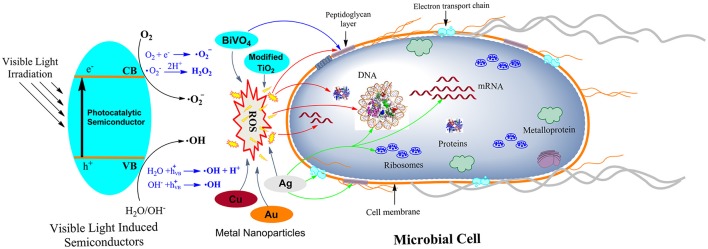
Several photocatalytic nanoparticles are synthesized and studied for potential application for the degradation of organic and biological wastes. Although these materials degrade organic compounds by advance oxidation process, the exact mechanisms of microbial decontamination remains partially known. Understanding the real mechanisms of these materials for microbial cell death and growth inhibition helps to fabricate more efficient semiconductor photocatalyst for large-scale decontamination of environmental wastewater or industries and hospitals/biomedical labs generating highly pathogenic bacteria and toxic molecules containing liquid waste by designing a reactor. Recent studies on microbial decontamination by photocatalytic nanoparticles and their possible mechanisms of action is highlighted with examples in this mini review.
Keywords: environmental pollutants; mechanisms of action; microbial inactivation; photocatalysis for environment; semiconductors.
Figures
References
-
- Adhikari S., Banerjee A., Eswar N. K. R., Sarkar D., Madras G. (2015). Photocatalytic inactivation of E. coli by ZnO–Ag nanoparticles under solar radiation. RSC Adv. 5, 51067–51077. 10.1039/C5RA06406F - DOI
-
- Ansari M. A., Khan H. M., Alzohairy M. A., Jalal M., Ali S. G., Pal R., et al. (2015). Green synthesis of Al2O3 nanoparticles and their bactericidal potential against clinical isolates of multi-drug resistant Pseudomonas aeruginosa. World J. Microbiol. Biotechnol. 31, 153–164. 10.1007/s11274-014-1757-2 - DOI - PubMed
-
- Berberidou C., Paspaltsis I., Pavlidou E., Sklaviadis T., Poulios I. (2012). Heterogenous photocatalytic inactivation of B. stearothermophilus endospores in aqueous suspensions under artificial and solar irradiation. Appl. Catal. B Environ. 125, 375–382. 10.1016/j.apcatb.2012.06.005 - DOI
-
- Booshehri A. Y., Goh S. C., Hong J., Jinag R., Xu R. (2014). Effect of depositing silver nanoparticles on BiVO4 in enhancing visible light photocatalytic inactivation of bacteria in water. J. Mater. Chem. A 2, 6209–6217. 10.1039/C3TA15392D - DOI
-
- Cavassin E. D., de Figueiredo L. F., Otoch J. P., Seckler M. M., de Oliveira R. A., Franco F. F., et al. (2015). Comparison of methods to detect the in vitro activity of silver nanoparticles (AgNP) against multidrug resistant bacteria. J. Nanobiotechnol. 13, 64. 10.1186/s12951-015-0120-6 - DOI - PMC - PubMed
Publication types
LinkOut - more resources
Full Text Sources
Other Literature Sources
