. 2018 Mar 1;7(1):11.
doi: 10.1186/s40169-018-0185-6.

Analyses of repeated failures in cancer therapy for solid tumors: poor tumor-selective drug delivery, low therapeutic efficacy and unsustainable costs

Affiliations

Analyses of repeated failures in cancer therapy for solid tumors: poor tumor-selective drug delivery, low therapeutic efficacy and unsustainable costs

Hiroshi Maeda et al. Clin Transl Med. .

Abstract

For over six decades reductionist approaches to cancer chemotherapies including recent immunotherapy for solid tumors produced outcome failure-rates of 90% (±5) according to governmental agencies and industry. Despite tremendous public and private funding and initial enthusiasm about missile-therapy for site-specific cancers, molecular targeting drugs for specific enzymes such as kinases or inhibitors of growth factor receptors, the outcomes are very bleak and disappointing. Major scientific reasons for repeated failures of such therapeutic approaches are attributed to reductionist approaches to research and infinite numbers of genetic mutations in chaotic molecular environment of solid tumors that are bases of drug development. Safety and efficacy of candidate drugs tested in test tubes or experimental tumor models of rats or mice are usually evaluated and approved by FDA. Cost-benefit ratios of such 'targeted' therapies are also far from ideal as compared with antibiotics half a century ago. Such alarming records of failure of clinical outcomes, the increased publicity for specific vaccines (e.g., HPV or flu) targeting young and old populations, along with increasing rise of cancer incidence and death created huge and unsustainable cost to the public around the globe. This article discusses a closer scientific assessment of current cancer therapeutics and vaccines. We also present future logical approaches to cancer research and therapy and vaccines.

Keywords: Cancer financial toxicity; Cancer therapeutic failure; Cancer vaccines; Cancer/medical establishment; Decision makers; Enhanced permeability and retention (EPR); Genomic mutations; Immunotherapy; Incredible price of drugs; Inflammation; Medical/scientific ponzi schemes; Molecular false flags; Molecular target drugs; Nanoparticles; Oxidative stress and mutations; Precision and personalized medicine; ROS; Targeted therapy; Tarnished immune surveillance; Yin and Yang of acute inflammation.


Figures
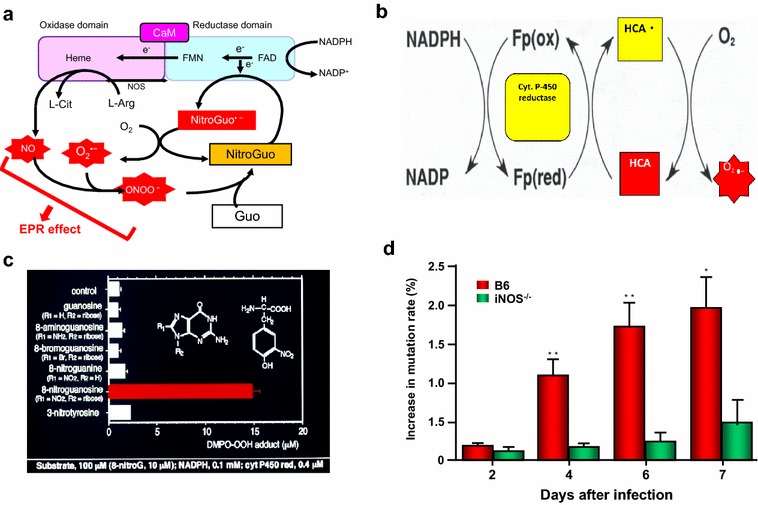
Fig. 1
Fig. 1
Generation of free radicals by infection and by heterocyclic amine (HCA), and generation of nitrated bases and mutation in Sendai virus via NO. Pathways a, c and d are involved in infection-induced inflamed tissue involving induction of inducible form of nitric oxide synthase (iNOS), and subsequently generation of nitric oxide (NO) and superoxide (O2·−) and then peroxynitrite (ONOO), which nitrated guanine (→ 8-nitroguanine), and 8-nitroguanosine (NitroGuo), as substrates of NOS or cytochrome c reductase, thereby generation of O2·−. The total system progressively produces O2·−, with stoichiometry of greater than 1:1 [51, 100, 108]. b Generation of O2·− from heterocyclic amine (HCA) in the presence of cytochrome (Cyt) P450 reductase and NADPH, resulting in DNA damage, cleavage and mutation. c NADPH cytochrome P450 reductase would generates O2·− most effectively from nitroguanosine among other base-modified derivatives [–61]. d Shows the NO dependence of viral mutation. *, **, significant changes in % viral mutations in B6 mice, in comparison with iNOS knockout mice by time. ** statistical significance (< 0.01). See text
Fig. 2
Fig. 2
Schematic representation of plasma concentration of different molecular size drugs [33, 34]: a low-MW free drugs (e.g., doxorubicin, DOX) and b–e their polymer complexes. The drug concentration in plasma after i.v. injection of low-MW drugs decreases rapidly (a). Representative polymer conjugates, micelles, and the liposomal drug (DOX) complex remain in the plasma at higher levels (b–e). However (b) shows a micellar drug of non-covalently encapsulated low MW drug which burst rapidly. Thus, no therapeutic benefit due to the EPR effect as its stability is too poor; (c) a styrene-co-maleic acid (SMA)-polymer covalent conjugate having better relative stability [103, 105]; (d) a more biocompatible polymer (HPMA) of pirarubicin conjugate [34]; (e) highly stable and biocompatible liposome complex such as Doxil®, showing high concentration in plasma for long period. This stable liposome complex is a pegylated stealth liposome. However, it is too stable and thus little drug release even after reaching to the target tumor, and thus only a limited therapeutic effect. Nano-size drugs (c–e) of high biocompatibility, having long plasma half-lifer, are advantageous for tumor selective targeting because they can utilize the EPR effect [33, 34]
Fig. 3
Fig. 3
Superiority of macromolecular photosensitizer: a polymer (HPMA)-conjugated zinc protoporphyrin (ZnPP) and b bovine serum albumin (BSA)-conjugated rhodamine. Fluorescence shows as visible only in tumors (a) and (b) (T marks). However, when both low MW photosensitizer, free ZnPP (), and free tetramethylrhodamine () in tumor-bearing mice are injected iv, no tumor selective fluorescence image was visible. Macromolecules, namely polymer-(HPMA) ZnPP and BSA-rhodamine with apparent MWs about 50–70 kDa, respectively, selectively accumulated in tumors, because of the EPR effect, as shown by in vivo fluorescent imaging system; Contrary to above, free ZnPP and free rhodamine, with MWs less than 1000 Da, showed little tumor uptake (,). c Demonstrates therapeutic effect of PDT-treatment using polymeric ZnPP and endoscopic xenon light irradiation. Tumors used were chemically (diaminobenzene[α]anthracene) induced breast cancer in rats. Polymer-ZnPP alone or light irradiation alone respectively has no therapeutic effect [99, 122] (Figures were adapted from Refs. [99, 122] with permission)

References

    1. Summary Health Statistics for U.S. Adults: National Health Interview Survey (2011) - PubMed
    1. Amiri-Kordestani L, Fojo T. Why do phase III clinical trials in oncology fail so often? J Natl Cancer Inst. 2012;104:568–569. doi: 10.1093/jnci/djs180. - DOI - PubMed
    1. Fojo T, Amiri-Kordestani L, Bates SE. Potential pitfalls of crossover and thoughts on iniparib in triple negative breast cancer. J Natl Cancer Inst. 2011;103:1738–1740. doi: 10.1093/jnci/djr386. - DOI - PMC - PubMed
    1. Amiri-Kordestani L, Basseville A, Kurziel K, Fojo AT, Bates SE. Targeting MDR in breast and lung cancer: discriminating its potential importance from the failure of drug resistance reversal studies. Drug resist update. 2012;15:50–61. doi: 10.1016/j.drup.2012.02.002. - DOI - PMC - PubMed
    1. Ledford H. Translational research: 4 ways to fix the clinical trial. Nature. 2011;477:526–528. doi: 10.1038/477526a. - DOI - PubMed