. 2018 Apr 3;90(7):4823-4831.
doi: 10.1021/acs.analchem.8b00283. Epub 2018 Mar 22.

Smartphone-Based Mobile Detection Platform for Molecular Diagnostics and Spatiotemporal Disease Mapping

Affiliations

Smartphone-Based Mobile Detection Platform for Molecular Diagnostics and Spatiotemporal Disease Mapping

Jinzhao Song et al. Anal Chem. .

Abstract

Rapid and quantitative molecular diagnostics in the field, at home, and at remote clinics is essential for evidence-based disease management, control, and prevention. Conventional molecular diagnostics requires extensive sample preparation, relatively sophisticated instruments, and trained personnel, restricting its use to centralized laboratories. To overcome these limitations, we designed a simple, inexpensive, hand-held, smartphone-based mobile detection platform, dubbed "smart-connected cup" (SCC), for rapid, connected, and quantitative molecular diagnostics. Our platform combines bioluminescent assay in real-time and loop-mediated isothermal amplification (BART-LAMP) technology with smartphone-based detection, eliminating the need for an excitation source and optical filters that are essential in fluorescent-based detection. The incubation heating for the isothermal amplification is provided, electricity-free, with an exothermic chemical reaction, and incubation temperature is regulated with a phase change material. A custom Android App was developed for bioluminescent signal monitoring and analysis, target quantification, data sharing, and spatiotemporal mapping of disease. SCC's utility is demonstrated by quantitative detection of Zika virus (ZIKV) in urine and saliva and HIV in blood within 45 min. We demonstrate SCC's connectivity for disease spatiotemporal mapping with a custom-designed website. Such a smart- and connected-diagnostic system does not require any lab facilities and is suitable for use at home, in the field, in the clinic, and particularly in resource-limited settings in the context of Internet of Medical Things (IoMT).


Conflict of interest statement

Notes

The authors declare no competing financial interest.

Figures
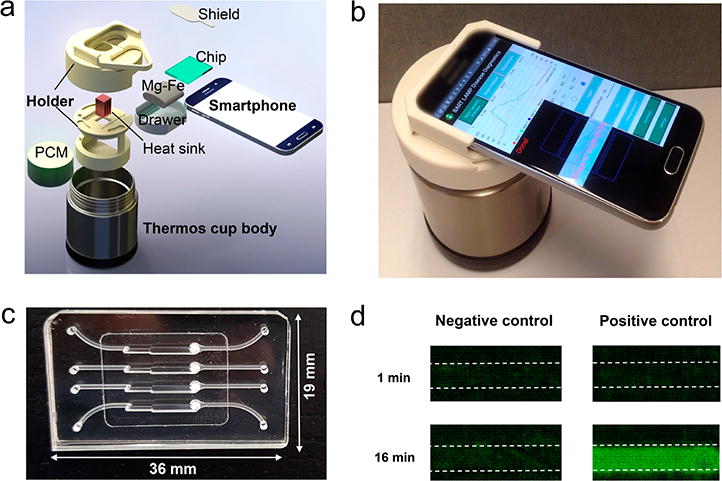
Figure 1
Figure 1
SCC platform for mobile molecular detection with BART-LAMP assay. (a) Exploded view of the SCC. The platform consists of a thermos cup body, 3D-printed holder, and a smartphone. (b) A photograph of the assembled SCC. (c) A photograph of our MIAR chip with four reactors for on-chip NA extraction and BART-LAMP assay. (d) Bioluminescence emission images detected with the smartphone camera from the isothermal amplification reactors (left: negative control; right: positive control) at 1 and 16 min after the start of incubation. The negative and positive control samples included, respectively, 0 and 500 PFU of ZIKV.
Figure 2
Figure 2
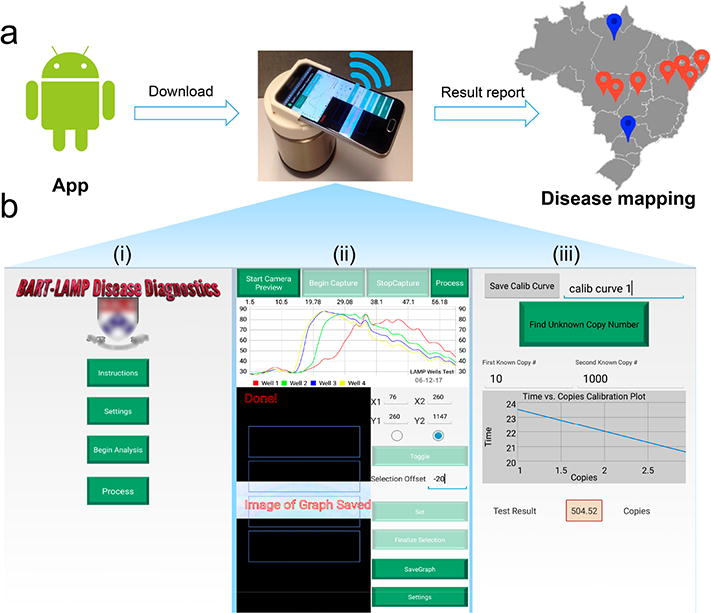
Android App for the smartphone-based molecular detection and disease mapping. (a) A flowchart of the SCC-based molecular detection and disease mapping. Red and blue dots denote, respectively, locations of positive and negative tests. (b) Screenshots of our smartphone interface: (i) main menu, (ii) real-time monitoring of the reactors of the MIAR chip, and (iii) calibration curve and result report.
Figure 3
Figure 3
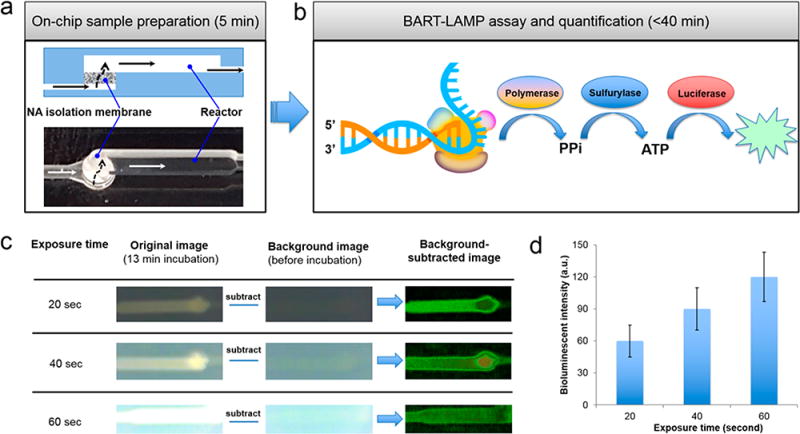
Excitation/filter-free BART-LAMP assay on the MIAR chip. (a) A cross-section (top) and a top image (bottom) as imaged by the smartphone camera of the flow-through reactor with nucleic acid isolation membrane. (b) Schematic of the light emission process during DNA synthesis. (c) Illustration of image processing to remove background noise at various exposure times. (d) Processed bioluminescence intensity as a function of camera’s exposure time (n = 3).
Figure 4
Figure 4
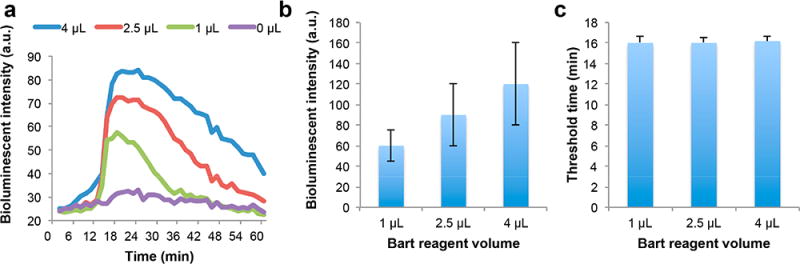
The effect of BART reporter concentration on BART-LAMP amplification curves and threshold times. (a) BART-LAMP emission intensity as a function of time with different volumes of BART reporter. The ZIKV RNA template concentration is 103 PFU per sample. (b) The bioluminescent intensity as a function of the volume of BART reporter (n = 3). (c) The threshold time (min) as a function of the volume of BART reporter volume (n = 3).
Figure 5
Figure 5
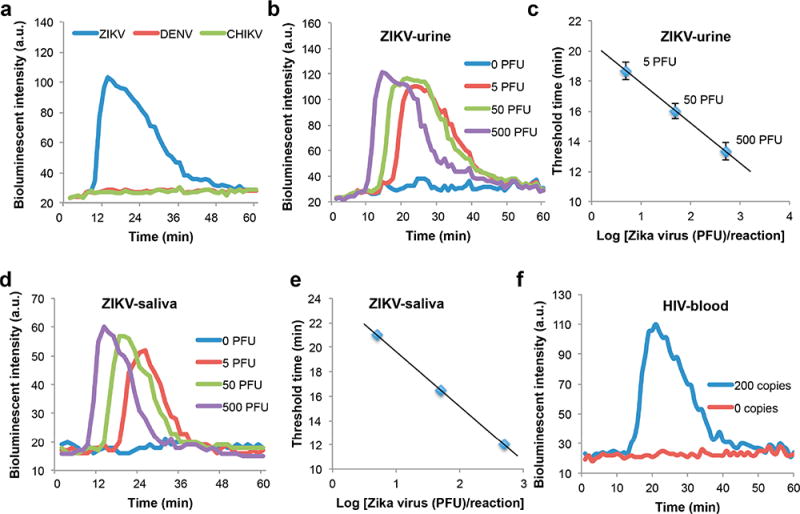
Quantitative detection of ZIKV in urine and saliva and HIV detection in blood. (a) Real-time monitoring of our BART-LAMP assay for ZIKV in the presence of 50 000 PFU ZIKV, DENV, or CHIKV. Only samples containing ZIKV are positive. (b) Real-time monitoring of BART-LAMP assay of urine samples spiked with 500, 50, 5, and 0 PFU (negative control) ZIKV per sample. (c) The threshold time Tt (in minutes) is depicted as a function of the ZIKV concentration (PFU per sample). The error bars indicate the scatter of the data (n = 3). (d) Real-time monitoring of BART-LAMP assay of saliva samples spiked with 500, 50, 5, and 0 PFU (negative control) per sample. (e) The threshold time Tt (in minutes) is depicted as a function of the ZIKV concentration (PFU per sample). (f) HIV detection in blood to demonstrate our SCC’s universality for various human samples.
Figure 6
Figure 6
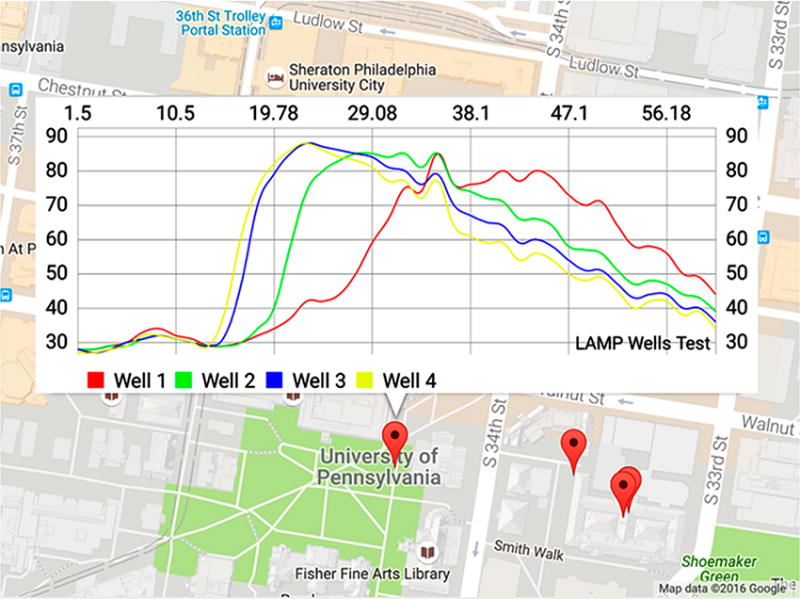
Spatiotemporal mapping of disease detection using a Google Maps-based interface. Copyright 2016, with permission from Google Inc.

References

    1. Chin CD, Laksanasopin T, Cheung YK, Steinmiller D, Linder V, Parsa H, Wang J, Moore H, Rouse R, Umviligihozo G, Karita E, Mwambarangwe L, Braunstein SL, van de Wijgert J, Sahabo R, Justman JE, El-Sadr W, Sia SK. Nat Med. 2011;17:1015–1019. - PubMed
    1. Mauk M, Song J, Bau HH, Gross R, Bushman FD, Collman RG, Liu C. Lab Chip. 2017;17:382–394. - PMC - PubMed
    1. Yager P, Edwards T, Fu E, Helton K, Nelson K, Tam MR, Weigl BH. Nature. 2006;442:412–418. - PubMed
    1. Faye O, Faye O, Diallo D, Diallo M, Weidmann M, Sall AA. Virol J. 2013;10:311. - PMC - PubMed
    1. Chen DF, Mauk M, Qiu XB, Liu CC, Kim JT, Ramprasad S, Ongagna S, Abrams WR, Malamud D, Corstjens PLAM, Bau HH. Biomed Microdevices. 2010;12:705–719. - PMC - PubMed

Publication types