. 2018 Mar 15;19(3):874.
doi: 10.3390/ijms19030874.

Calorie Restriction Effect of Heat-Processed Onion Extract (ONI) Using In Vitro and In Vivo Animal Models

Affiliations

Calorie Restriction Effect of Heat-Processed Onion Extract (ONI) Using In Vitro and In Vivo Animal Models

Yu-Ri Kang et al. Int J Mol Sci. .

Abstract

Onion (Allium cepa L.) is widely consumed as food or medicinal plant due to its well-defined health benefits. The antioxidant and antihyperlipidemic effects of onion and its extracts have been reported well. However, very limited information on anti-hyperglycemic effect is available in processed onion extracts. In our previous study, we reported that Amadori rearrangement compounds (ARCs) produced by heat-processing in Korean ginseng can reduce carbohydrate absorption by inhibiting intestinal carbohydrate hydrolyzing enzymes in both in vitro and in vivo animal models. To prove the enhancement of anti-hyperglycemic effect and ARCs content by heat-processing in onion extract, a correlation between the anti-hyperglycemic activity and the total content of ARCs of heat-processed onion extract (ONI) was investigated. ONI has a high content of ARCs and had high rat small intestinal sucrase inhibitory activity (0.34 ± 0.03 mg/mL, IC50) relevant for the potential management of postprandial hyperglycemia. The effect of ONI on the postprandial blood glucose increase was investigated in Sprague Dawley (SD) rats fed on sucrose or starch meals. The maximum blood glucose levels (Cmax) of heat-processed onion extract were significantly decreased by about 8.7% (from 188.60 ± 5.37 to 172.27 ± 3.96, p < 0.001) and 14.2% (from 204.04 ± 8.73 to 175.13 ± 14.09, p < 0.01) in sucrose and starch loading tests, respectively. These results indicate that ARCs in onion extract produced by heat-processing have anti-diabetic effect by suppressing carbohydrate absorption via inhibition of intestinal sucrase, thereby reducing the postprandial increase of blood glucose. Therefore, enhancement of ARCs in onion by heat-processing might be a good strategy for the development of the new product on the management of hyperglycemia.

Keywords: Amadori rearrangement compounds; calorie restriction; heat-process; hyperglycemia; onion.


Conflict of interest statement

The authors declare no conflict of interest.

Figures
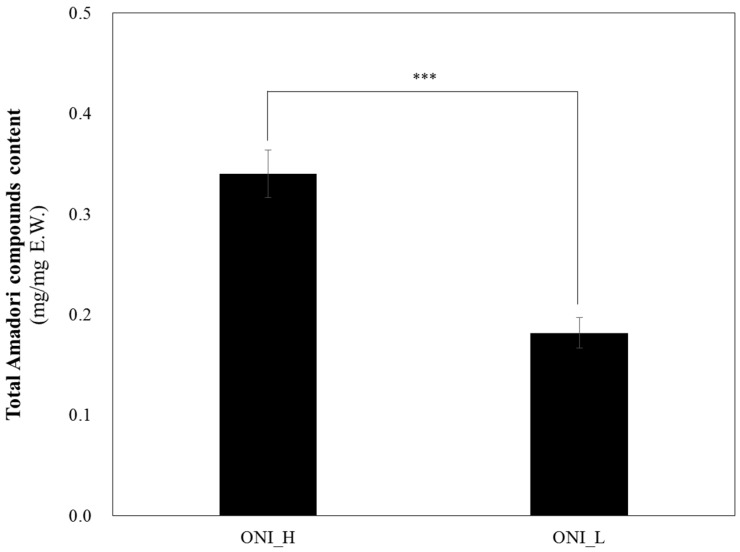
Figure 1
Figure 1
Total ARCs content of two different onion extracts (ONI_H and ONI_L). The results were expressed as mean ± S.D. Statistical significances were determined by Student’s t-test (*** p < 0.001).
Figure 2
Figure 2
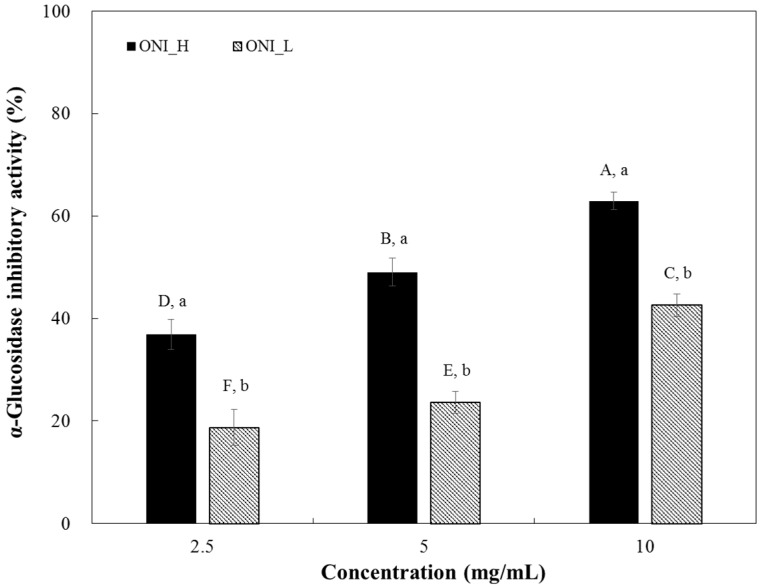
Dose dependent changes in rat small intestinal α-glucosidase inhibitory activities (% inhibition) of two different onion extracts (ONI_H and ONI_L). The results were expressed as mean ± S.D. with three independent experiments in triplicate. Different corresponding letters indicate significant differences at p < 0.05 by Duncan’s test. A–F The first letters in uppercase indicate significant differences among all samples and a–b the second letters in lowercase are different between ONI_H and ONI_L within the same concentration.
Figure 3
Figure 3
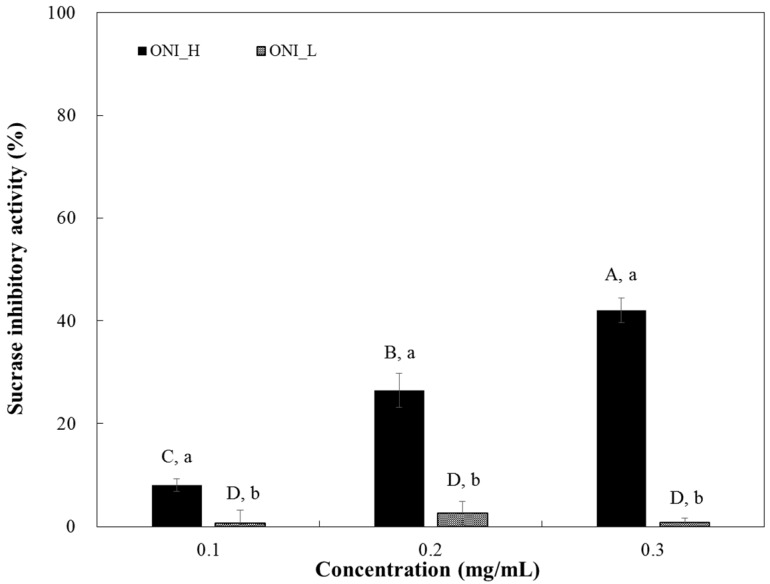
Dose dependent changes in rat small intestinal sucrase inhibitory activities (% inhibition) of two different onion extracts (ONI_H and ONI_L). The results were expressed as mean ± S.D. with three independent experiments in triplicate. Different corresponding letters indicate significant differences at p < 0.05 by Duncan’s test. A–D The first letters in uppercase indicate significant differences among all samples and a–b the second letters in lowercase are different between ONI_H and ONI_L within same concentration.
Figure 4
Figure 4
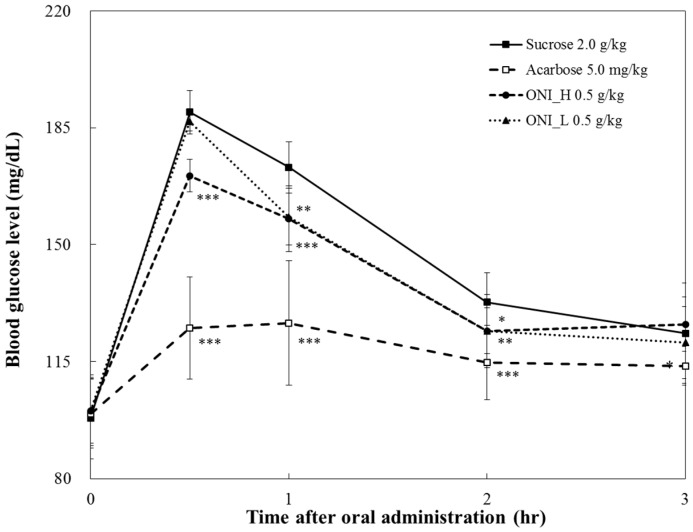
Comparison of postprandial blood glucose-lowering effects of ONI_H and ONI_L in sucrose loading test. After fasting for 24 h, five-week-old, male SD rats were orally administered sucrose solution (2.0 g/kg) with or without samples (onion extracts). The results were expressed as mean ± S.D. Statistical significances were determined by Student’s t-test (* p < 0.05; ** p < 0.01; and *** p < 0.001).
Figure 5
Figure 5
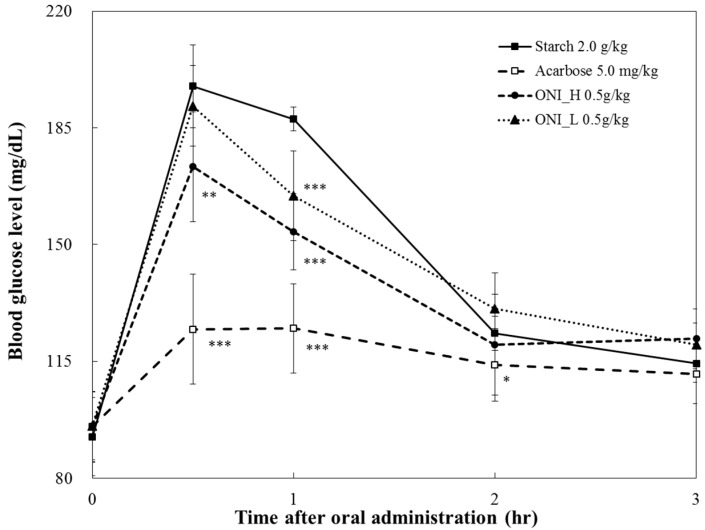
Comparison of postprandial blood glucose-lowering effects of pyridoxine, pyridoxal, and pyridoxamine in starch loading test. After fasting for 24 h, five-week-old, male SD rats were orally administered starch solution (2.0 g/kg) with or without samples (onion extracts). The results were expressed as mean ± S.D. Statistical significances were determined by Student’s t-test (* p < 0.05; ** p < 0.01; and *** p < 0.001).

References

    1. Kim S.H., Jo S.H., Kwon Y.I., Hwang J.K. Effects of onion (Allium cepa L.) extract administration on intestinal α-glucosidases activities and spikes in postprandial blood glucose levels in SD rats model. Int. J. Mol. Sci. 2011;12:3757–3769. doi: 10.3390/ijms12063757. - DOI - PMC - PubMed
    1. Singh U., Singh S., Kochhar A. Therapeutic potential of antidiabetic neutraceuticals. Phytopharmacol. 2012;2:144–169.
    1. Kwon Y.I., Apostolidis E., Kim Y.C., Shetty K. Health benefits of traditional corn, beans, and pumpkin: In vitro studies for hyperglycemia and hypertension management. J. Med. Food. 2007;10:266–275. doi: 10.1089/jmf.2006.234. - DOI - PubMed
    1. Kwon Y.I., Vattem D.A., Shetty K. Evaluation of clonal herbs of Lamiaceae species for management of diabetes and hypertension. Asia Pac. J. Clin. Nutr. 2006;15:107–118. - PubMed
    1. Rasheed D., Porzel A., Frolov A., El Saedi H.R., Wessjohann L.A., Farag M.A. Comparative analysis of Hibiscus sabdariffa (roselle) hot and cold extracts in respect to their potential for α-glucosidase inhibition. Food Chem. 2018;250:236–244. doi: 10.1016/j.foodchem.2018.01.020. - DOI - PubMed

LinkOut - more resources