


The implementation of Health in All Policies initiatives: a systems framework for government action
- PMID: 29544496
- PMCID: PMC5856219
- DOI: 10.1186/s12961-018-0295-z
The implementation of Health in All Policies initiatives: a systems framework for government action
Abstract
Background: There has been a renewed interest in broadening the research agenda in health promotion to include action on the structural determinants of health, including a focus on the implementation of Health in All Policies (HiAP). Governments that use HiAP face the challenge of instituting governance structures and processes to facilitate policy coordination in an evidence-informed manner. Due to the complexity of government institutions and the policy process, systems theory has been proposed as a tool for evaluating the implementation of HiAP.
Methods: Our multiple case study research programme (HiAP Analysis using Realist Methods On International Case Studies - HARMONICS) has relied on systems theory and realist methods to make sense of how and why the practices of policy-makers (including politicians and civil servants) from specific institutional environments (policy sectors) has either facilitated or hindered the implementation of HiAP. Herein, we present a systems framework for the implementation of HiAP based on our experience and empirical findings in studying this process.
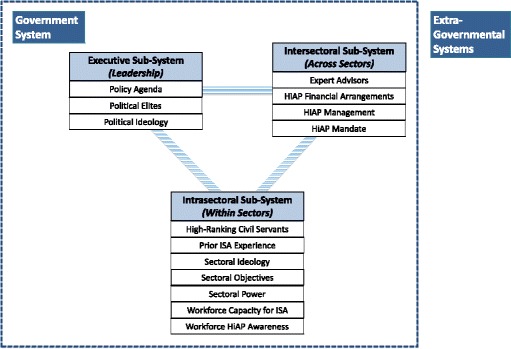
Results: We describe a system of 14 components within three subsystems of government. Subsystems include the executive (heads of state and their appointed political elites), intersectoral (the milieu of policy-makers and experts working with governance structures related to HiAP) and intrasectoral (policy-makers within policy sectors). Here, HiAP implementation is a process involving interactions between subsystems and their components that leads to the emergence of implementation outcomes, as well as effects on the system components themselves. We also describe the influence of extra-governmental systems, including (but not limited to) the academic sector, third sector, private sector and intergovernmental sector. Finally, we present a case study that applies this framework to understand the implementation of HiAP - the Health 2015 Strategy - in Finland, from 2001 onward.
Conclusions: This framework is useful for helping to explain how, why and under what circumstances HiAP has been successfully and unsuccessfully implemented in a sustainable manner. It serves as a tool for researchers to study this process, and for policy-makers and other public health actors to manage this process.
Keywords: Health equity; Health in all Policies; Intersectoral action; System framework.
Conflict of interest statement
Ethics approval and consent to participate
Research Ethics Board, St. Michaels Hospital, #10–162.
Consent for publication
Not applicable.
Competing interests
The authors declare that they have no competing interests.
Publisher’s Note
Springer Nature remains neutral with regard to jurisdictional claims in published maps and institutional affiliations.
Figures
References
-
- Solar O, Irwin A. A Conceptual Framework for Action on the Social Determinants of Health: Discussion paper for the Commission on Social Determinants of Health. Geneva: World Health Organization; 2007.
-
- Fafard P. Health in All Meets Horizontal Government. Grenoble: First International Conference on Public Policy; 2013.
-
- Shankardass K, Solar O, Murphy K, Freiler A, Bobbili S, Bayoumi A, O’Campo P. Health in All Policies: Results of a Realist-Informed Scoping Review of the Literature. In: Getting Started With Health in All Policies: A Report to the Ontario Ministry of Health and Long Term Care. Toronto: Centre for Research on Inner City Health; 2011. http://www.stmichaelshospital.com/crich/wp-content/uploads/Health-in-All.... Accessed 24 Feb 2018.
-
- Health in All Policies (HiAP) framework for country action. Health Promot Int. 2014;29:i19–28. - PubMed
MeSH terms
Grants and funding
LinkOut - more resources
Full Text Sources
Other Literature Sources
