


The impact of depression medications on oral antidiabetic drug adherence in patients with diabetes and depression
- PMID: 29544744
- PMCID: PMC5920707
- DOI: 10.1016/j.jdiacomp.2017.12.008
The impact of depression medications on oral antidiabetic drug adherence in patients with diabetes and depression
Abstract
Aims: To compare adherence and persistence to oral antidiabetic drugs (OAD) between patients who are new users of second generation antipsychotics (SGA) versus new users of other depression therapies in adults with type 2 diabetes mellitus (T2DM) and major depressive disorder (MDD).
Methods: Adults 18-64 years with previously-treated T2DM and MDD (past OAD and SSRI/SNRI use) who are new users of SGA or non-SGA therapies (bupropion, lithium, mirtazapine, thyroid hormone, tricyclic antidepressant) were identified in the 2009-2015 MarketScan® Commercial Claims and Encounters database. Multivariate regression models were used to determine the odds of a ≥10% decline in OAD adherence over 180- and 365-days, and time to OAD discontinuation, adjusting for differences between groups.
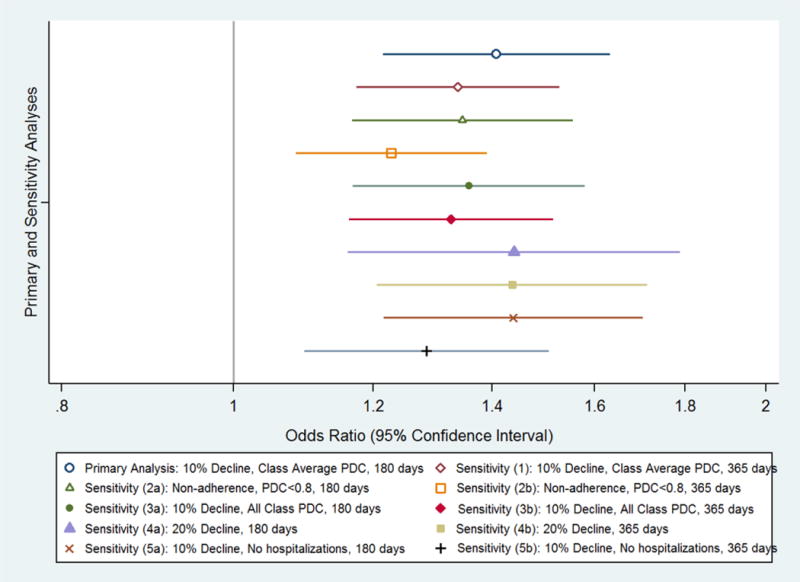
Results: A total of 8664 (21.5% SGA), 8311 (22.1% SGA), and 17,524 (21.3% SGA) patients met inclusion criteria for the 180-day adherence, 365-day adherence, and persistence cohorts, respectively. Over 180-days, 16.6% of SGA and 13.3% of non-SGA initiators had a ≥10% decline in OAD adherence (adjusted odds ratio [OR] = 1.41, 95% CI 1.21-1.63). Over 365-days, 22.3% of SGA and 18.9% of non-SGA initiators had a ≥ 10% decline (OR = 1.34, 95% CI 1.17-1.53). Time to OAD discontinuation was similar between groups (adjusted hazard ratio = 1.03, 95% CI 0.94-1.12).
Conclusion: Use of SGA was associated with a 1.3-1.4 times higher odds of a ≥10% decline in OAD adherence. Adherence to OAD is critical for optimal diabetes control and reductions in this magnitude may impact A1C. Close monitoring of OAD adherence after SGA initiation is warranted.
Keywords: Antidepressants; Antipsychotics; Depression; Healthcare administration claims; Medication adherence; Type 2 diabetes mellitus.
Copyright © 2018 Elsevier Inc. All rights reserved.
Conflict of interest statement
The other authors have no conflicts of interest to declare.
Figures
References
-
- Al-Ruthia YS, Hong SH, Solomon D. Do depressed patients on adjunctive atypical antipsychotics demonstrate a better quality of life compared to those on antidepressants only? A comparative cross-sectional study of a nationally representative sample of the US population. Research in Social & Administrative Pharmacy: RSAP. 11(2):228–40. (n.d.) https://doi.org/10.1016/j.sapharm.2014.06.001. - DOI - PubMed
-
- Pharmacy Quality Alliance. Technical Specifications for PQA Approved Measures. 2014 Retrieved February 28, 2017 from http://www.nbch.org/nbch/files/ccLibraryFiles/Filename/000000003537/1_Ju....
-
- American Diabetes Association, American Psychiatric Association, American Association of Clinical Endocrinologists, & North American Society of Obesity. Consensus Development Conference on Antipsychotic Drugs and Obesity. J Clin Psychiatry. 2004;65(2):267–272. https://doi.org/10.2337/diacare.27.2.596. - DOI - PubMed
-
- American Diabetes Association, American Psychiatric Association, American Association of Clinical Endocrinologists, & North American Association for the Study of Obesity. Consensus development conference on antipsychotic drugs and obesity and diabetes. Diabetes Care. 2004;27(2):596–601. Retrieved from http://www.ncbi.nlm.nih.gov/pubmed/14747245. - PubMed
-
- Balkrishnan R, Rajagopalan R, Camacho FT, Huston SA, Murray FT, Anderson RT. Predictors of Medication Adherence and Associated Health Care Costs in an Older Population with Type 2 Diabetes Mellitus: A Longitudinal Cohort Study. Clinical Therapeutics. 2003;25(11):2958–2971. https://doi.Org/10.1016/S0149-2918(03)80347-8. - DOI - PubMed
Publication types
MeSH terms
Substances
Grants and funding
LinkOut - more resources
Full Text Sources
Other Literature Sources
Medical
Miscellaneous
