


Repeat lactate level predicts mortality better than rate of clearance
- PMID: 29544906
- PMCID: PMC6423536
- DOI: 10.1016/j.ajem.2018.03.012
Repeat lactate level predicts mortality better than rate of clearance
Abstract
Background: Lactate clearance has been developed into a marker of resuscitation in trauma, but no study has compared the predictive power of the various clearance calculations. Our objective was to determine which method of calculating lactate clearance best predicted 24-hour and in-hospital mortality after injury.
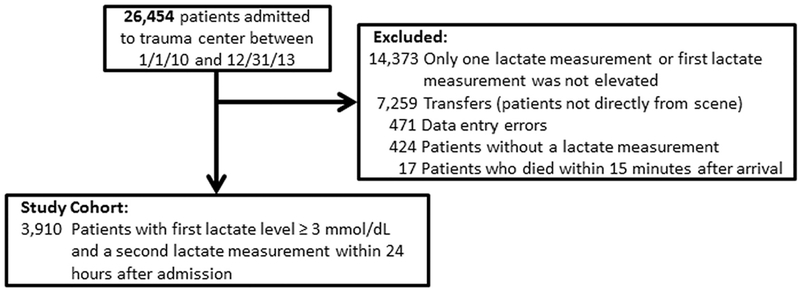
Study design: Retrospective chart review of patients admitted to a Level-1 trauma center directly from the scene of injury from 2010 to 2013 who survived >15min, had an elevated lactate at admission (≥3mmol/L), followed by another measurement within 24h of admission. Lactate clearance was calculated using five models: actual value of the repeat level, absolute clearance, relative clearance, absolute rate, and relative rate. Models were compared using the areas under the respective receiver operating curves (AUCs), with an endpoint of death at 24h and in-hospital mortality.
Results: 3910 patients had an elevated admission lactate concentration on admission (mean=5.6±3.0mmol/L) followed by a second measurement (2.7±1.8mmol/L). Repeat absolute measurement best predicted 24-hour (AUC=0.85, 95% CI: 0.84-0.86) and in-hospital death (AUC=0.77; 95% CI, 0.76-0.78). Relative clearance was the best model of lactate clearance (AUC=0.77, 95% CI: 0.75-0.78 and AUC=0.705, 95% CI: 0.69-72, respectively) (p<0.0001 for each). A sensitivity analysis using a range of initial lactate measures yielded similar results.
Conclusions: The absolute value of the repeat lactate measurement had the greatest ability to predict mortality in injured patients undergoing resuscitation.
Keywords: Calculation; Clearance; Lactate; Resuscitation; Survival; Trauma.
Published by Elsevier Inc.
Figures
References
-
- Centers for Disease Control and Prevention. Injury: The Leading Cause of Death Among Persons Ages 1–44. Available online at: www.cdc.gov/injury/index.html. (Accessed on September 11, 2015).
-
- Shackelford SA, Colton K, Stansbury LG, et al. Early identification of uncontrolled hemorrhage after trauma: current status and future direction. J Trauma Acute Care Surg 2014;77(3 suppl 2):S222–7. - PubMed
-
- Basel KJ, Guse C, Gentilello LM, Nirula R. Heart rate: is it truly a vital sign? J Trauma 2007;62:812–7. - PubMed
-
- Heffernan DS, Thakkar RK, Monaghan SF, et al. Normal presenting vital signs are unreliable in geriatric blunt trauma victims. J Trauma 2010;69:813–20. - PubMed
-
- Zarzaur BL, Croce MA, Magnotti LJ, et al. Identifying life-threatening shock in the older injured patient: an analysis of the National Trauma Data Bank. J Trauma 2010;68:1134–8. - PubMed
Publication types
MeSH terms
Substances
Grants and funding
LinkOut - more resources
Full Text Sources
Other Literature Sources
Medical
