


Plasmodium Gametocytes in Field Studies: Do We Measure Commitment to Transmission or Detectability?
- PMID: 29544966
- PMCID: PMC5924719
- DOI: 10.1016/j.pt.2018.02.009
Plasmodium Gametocytes in Field Studies: Do We Measure Commitment to Transmission or Detectability?
Abstract
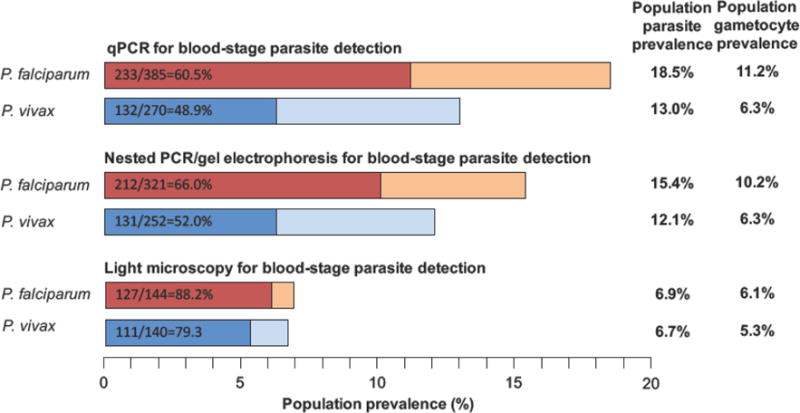
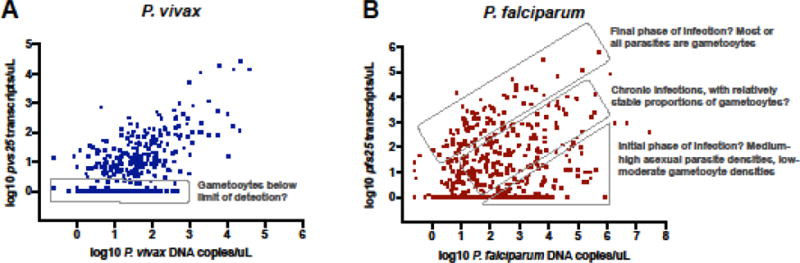
The proportion of Plasmodium spp. infections carrying gametocytes, and gametocyte densities, are often reported as surrogate markers for transmission potential. It remains unclear whether parasites under natural conditions adjust commitment to transmission depending on external factors. Population-based surveys comprising mostly asymptomatic low-density infections are always impacted by the sensitivity of the assays used to diagnose infections and detect gametocytes. Asexual parasite density is an important predictor for the probability of detecting gametocytes, and in many cases it can explain patterns in gametocyte carriage without the need for an adjustment of the gametocyte conversion rate. When reporting gametocyte data, quantification of blood-stage parasitemia and its inclusion as a confounder in multivariable analyses is essential.
Keywords: gametocyte conversion rate; gametocyte density; limit of detection; malaria transmission; molecular gametocyte detection; population gametocyte prevalence.
Copyright © 2018 Elsevier Ltd. All rights reserved.
Figures
Comment in
-
Premature Rejection of Plasticity in Conversion.Trends Parasitol. 2018 Aug;34(8):633-634. doi: 10.1016/j.pt.2018.06.004. Epub 2018 Jun 23. Trends Parasitol. 2018. PMID: 29945759 No abstract available.
-
Complex Determination of the Gametocyte Conversion Rate.Trends Parasitol. 2018 Aug;34(8):634-635. doi: 10.1016/j.pt.2018.06.005. Epub 2018 Jul 14. Trends Parasitol. 2018. PMID: 30017651 Free PMC article. No abstract available.
References
Publication types
MeSH terms
Grants and funding
LinkOut - more resources
Full Text Sources
Other Literature Sources
Miscellaneous
