


Evaluating Patients' Expectations From a Novel Patient-Centered Perspective Predicts Knee Arthroplasty Outcome
- PMID: 29544972
- PMCID: PMC6005343
- DOI: 10.1016/j.arth.2018.02.026
Evaluating Patients' Expectations From a Novel Patient-Centered Perspective Predicts Knee Arthroplasty Outcome
Abstract
Background: One-in-five patients are dissatisfied following knee arthroplasty and <50% have fulfilled expectations. The relationship between knee-arthroplasty expectations and surgical outcome remains unclear.
Purpose: Are expectations regarding the impact of pain on postoperative life predictive of one-year outcome? Does the impact of pain on preoperative quality of life (QOL) influence this relationship?
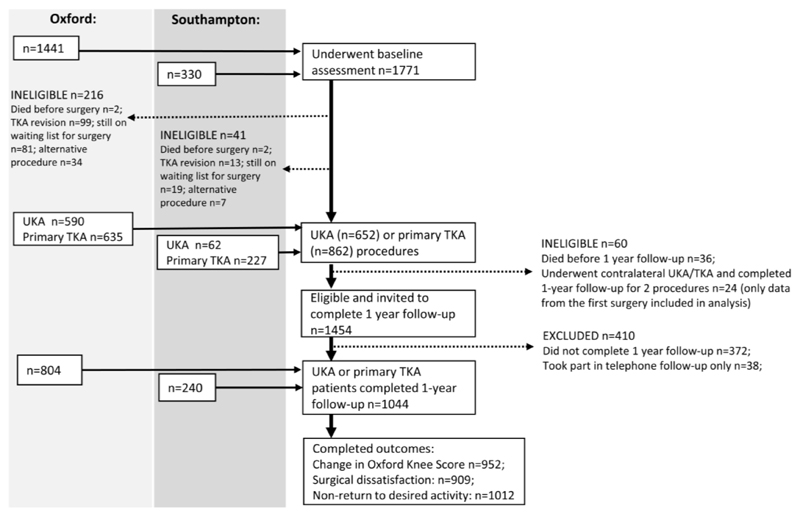
Methods: Longitudinal cohort of 1044 uni-compartmental (43%) or total knee-arthroplasty (57%) (UKA or TKA) patients, aged mean 69 ± 9 years. Preoperatively, patients reported the impact of pain on QOL and expected impact of pain on life one-year post-arthroplasty. One-year postoperative outcomes: non-return to desired activity, surgical dissatisfaction, not achieving Oxford Knee Score minimal important change (OKS <MIC). Logistic regression including covariates was performed for all patients and subgroups (better vs worse pre-operative pain-related QOL; UKA vs TKA).
Results: Expecting moderate-to-extreme pain (vs no pain) predicted non-return to activity (odds ratio [95% confidence interval], 2.3 [1.3, 4.1]), dissatisfaction (4.0 [1.7, 9.3]), OKS <MIC (3.1 [1.5, 6.3]). Expecting mild pain (vs no pain) predicted worse outcomes for patients with better preoperative pain-related QOL (non-return to activity: 2.7 [1.5, 4.8], OKS <MIC: 2.5 [1.1, 5.5]). Expecting moderate-to-extreme pain (vs. no pain) predicted worse outcomes for patients with worse preoperative pain-related QOL (non-return to activity: 2.4 [1.1, 5.5], dissatisfaction: 5.0 [1.7, 14.8], OKS <MIC: 3.4 [1.4, 8.6]). The odds of a poor outcome in people with worse expectations was higher for UKA patients.
Conclusions: Expecting a worse outcome predicted surgical dissatisfaction, less clinical improvement and non-return to desired activity. Patients expecting a more optimistic outcome relative to preoperative status achieved better surgical outcomes.
Keywords: optimism; pain; patient-reported outcomes; quality of life; satisfaction.
Copyright © 2018 Elsevier Inc. All rights reserved.
References
-
- Quintana JM, Escobar A, Arostegui I, Bilbao A, Azkarate J, Goenaga JI, Arenaza JC. Health-related quality of life and appropriateness of knee or hip joint replacement. Arch Intern Med. 2006;166(2):220. - PubMed
-
- Gandhi R, Davey JR, Mahomed N. Patient expectations predict greater pain relief with joint arthroplasty. J Arthroplasty. 2009;24(5):716. - PubMed
-
- Scott CE, Bugler KE, Clement ND, MacDonald D, Howie CR, Biant LC. Patient expectations of arthroplasty of the hip and knee. J Bone Joint Surg Br. 2012;94(7):974. - PubMed
Publication types
MeSH terms
Grants and funding
LinkOut - more resources
Full Text Sources
Other Literature Sources
Medical
