Review
. 2018 May;14(5):272-284.
doi: 10.1038/nrneurol.2018.20. Epub 2018 Mar 16.

Complex regional pain syndrome - phenotypic characteristics and potential biomarkers

Affiliations
Review

Complex regional pain syndrome - phenotypic characteristics and potential biomarkers

Frank Birklein et al. Nat Rev Neurol. 2018 May.

Abstract

Complex regional pain syndrome (CRPS) is a pain condition that usually affects a single limb, often following an injury. The underlying pathophysiology seems to be complex and probably varies between patients. Clinical diagnosis is based on internationally agreed-upon criteria, which consider the reported symptoms, presence of signs and exclusion of alternative causes. Research into CRPS biomarkers to support patient stratification and improve diagnostic certainty is an important scientific focus, and recent progress in this area provides an opportunity for an up-to-date topical review of measurable disease-predictive, diagnostic and prognostic parameters. Clinical and biochemical attributes of CRPS that may aid diagnosis and determination of appropriate treatment are delineated. Findings that predict the development of CRPS and support the diagnosis include trauma-related factors, neurocognitive peculiarities, psychological markers, and local and systemic changes that indicate activation of the immune system. Analysis of signatures of non-coding microRNAs that could predict the treatment response represents a new line of research. Results from the past 5 years of CRPS research indicate that a single marker for CRPS will probably never be found; however, a range of biomarkers might assist in clinical diagnosis and guide prognosis and treatment.


Conflict of interest statement

Competing interests

The authors declare no competing interests.

Figures
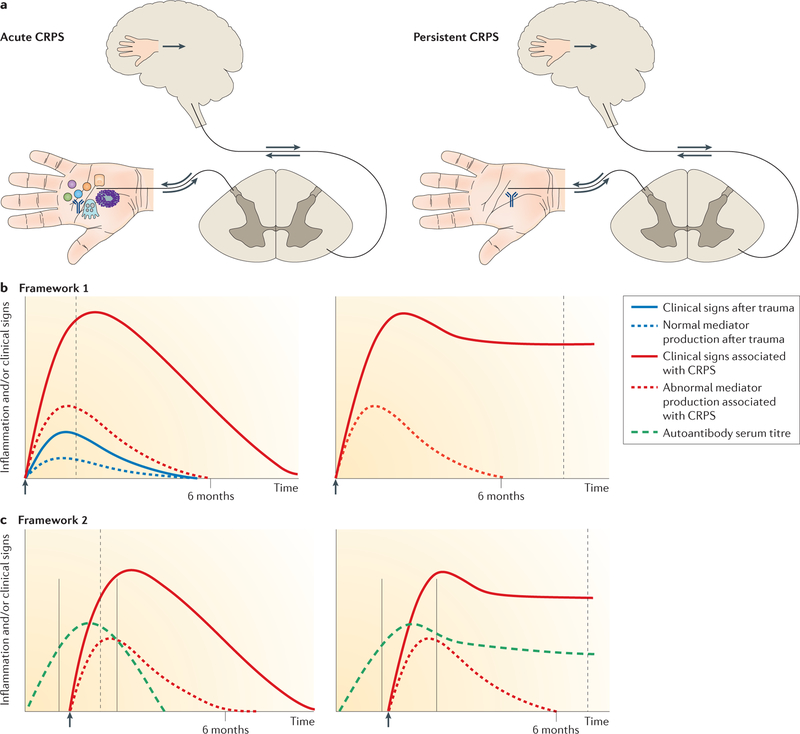
Figure 1
Figure 1. Hypothetical conceptual frameworks for CRPS.
a | Schematic representations of acute and persistent complex regional pain syndrome (CRPS). Proximally pointing arrows indicate signalling in response to distal excitation, and distally pointing arrows indicate descending signals leading to neuropeptide secretion and neurogenic inflammation. The depicted events correspond to the time points indicated by dashed grey lines in the graphs. b | Framework 1: augmented (neuro) immune activation. After injury (arrow), inflammatory mediators are produced by mast cells, sensory nerves, keratinocytes and osteocytes (represented by symbols in part a). In acute CRPS, mediator production is temporarily increased, triggering augmented post-traumatic clinical signs and primary afferent sensitization and leading to segmental spinal cord dorsal horn sensitization and sometimes a shift in the cortical representation of the affected limb with abnormal limb perception. Mediators and clinical signs normalize by about 6 months. In persistent CRPS, local production of inflammatory mediators at the affected limb normalizes and CNS changes now drive the clinical picture. In this framework, CRPS-associated autoantibodies might contribute to some clinical signs, such as sweating, but do not explain the main symptoms of pain and hypersensitivity. c | Framework 2: autoantibodies. If distal limb trauma is sustained during a time window of vulnerability characterized by high autoantibody production (solid grey lines), an enhanced trauma-induced inflammatory response renders these antibodies locally pathogenic, resulting in augmented post-traumatic signs. Autoantibodies might bind to neurons, causing afferent sensitization through changes in the transduction or transmission properties of these cells, or to perineural cells, which then release pronociceptive molecules (not shown). These autoantibodies are noninflammatory; that is, they neither activate complement nor attract immune cells. Acute CRPS resolves after cessation of autoantibody production. A small group of patients develops persistent CRPS, in which autoantibody production continues at a reduced rate that is still sufficient to sustain the clinical phenotype.
Figure 2
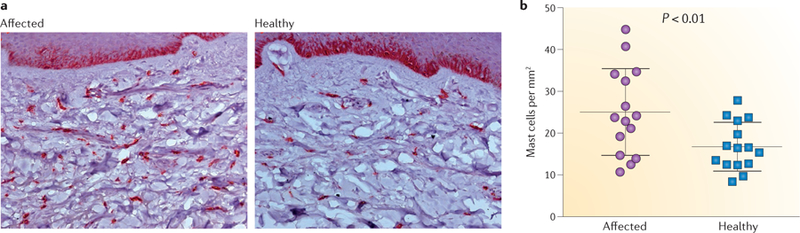
Figure 2. Mast cell accumulation in CRPS.
a | CD117-positive mast cells, which are stained dark red, in skin biopsy samples from the affected limb and a corresponding site on the unaffected limb of a patient with complex regional pain syndrome (CRPS). b | The number of mast cells per square millimetre in the subcutaneous tissue is significantly increased in the affected skin of patients with acute CRPS (≤6 months after diagnosis).
Figure 3
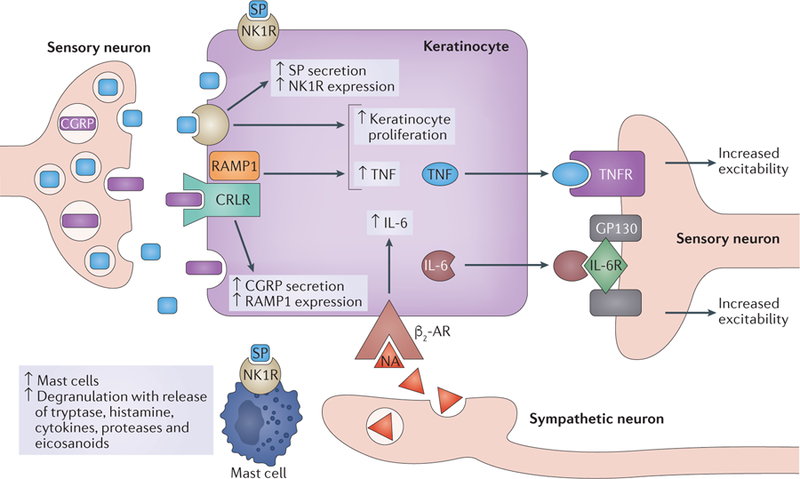
Figure 3. The possible role of keratinocytes in CRPS pathophysiology.
In complex regional pain syndrome (CRPS), activation of peptidergic nociceptors not only causes pain but also leads to release of neuropeptides (substance P (SP) and calcitonin gene-related peptide (CGRP)). Both of these peptides activate keratinocytes and promote their proliferation. In turn, the keratinocytes secrete cytokines, which sensitize the peptidergic nociceptors for forthcoming stimuli. The resulting facilitated release of SP from primary afferent neurons leads to activation of mast cells via specific receptors. Mast cells also release inflammatory mediators, which sensitize nociceptors and further activate keratinocytes. Pain activates the sympathetic nervous system, releasing noradrenaline (NA) that also activates keratinocytes. Consequently, a vicious circle might be established. This figure is based on the findings of a series of studies on tibia fracture models in rodents and research in patients with CRPS. β2-AR, β2-adrenergic receptor; CRLR, calcitonin receptor-like receptor; GP130, membrane glycoprotein 130; IL-6R, IL-6 receptor; NK1R, neurokinin 1 receptor (also known as SPR); RAMP1, receptor activity-modifying protein 1; TNF, tumour necrosis factor; TNFR, TNF receptor. Figure adapted with permission from REF. , Elsevier.

References

    1. Marinus J et al. Clinical features and pathophysiology of complex regional pain syndrome. Lancet Neurol 10, 637–648 (2011). - PMC - PubMed
    1. Birklein F, O’Neill D & Schlereth T Complex regional pain syndrome: an optimistic perspective. Neurology 84, 89–96 (2015). - PubMed
    1. Parkitny L et al. Inflammation in complex regional pain syndrome: a systematic review and meta-analysis. Neurology 80, 106–117 (2013). - PMC - PubMed
    1. Harden RN et al. Validation of proposed diagnostic criteria (the “Budapest Criteria”) for Complex Regional Pain Syndrome. Pain 150, 268–274 (2010). - PMC - PubMed
    1. Beerthuizen A et al. Demographic and medical parameters in the development of complex regional pain syndrome type 1 (CRPS1): prospective study on 596 patients with a fracture. Pain 153, 1187–1192 (2012). - PubMed

Publication types

MeSH terms