


Care Values in Dementia: Patterns of Perception and Incongruence Among Family Care Dyads
- PMID: 29546327
- PMCID: PMC6524475
- DOI: 10.1093/geront/gny008
Care Values in Dementia: Patterns of Perception and Incongruence Among Family Care Dyads
Abstract
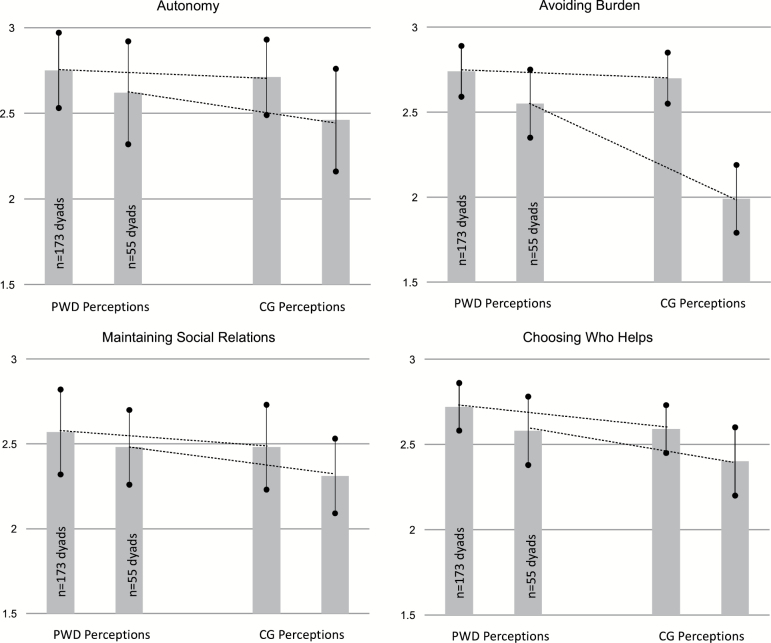
Background and objectives: Persons with dementia (PWDs) often place greater importance on their care values (i.e., maintaining autonomy and social relations, choosing caregivers, avoiding being a burden) than family caregivers (CGs) perceive, which can detract from dementia care planning (e.g., care arrangements or surrogate decisions). Notable variability has been found across family care dyads (PWD and CG) in their perceptions of care values, suggesting that there may be multiple patterns of perception. The purpose of this study was to characterize distinct patterns of perception of care values in family care dyads.
Design and methods: Using cross-sectional data from 228 community-dwelling family care dyads, we quantified dyads' average perceptions and incongruence in perceptions of the importance of everyday care values using multilevel modeling. These scores were then used in a latent class analysis to identify distinct patterns of perception, with the dyad as the unit of analysis.
Results: Two distinct patterns of care value perception were identified. 25% of dyads were labeled as "CG underestimating" due to lower average estimations of the importance of PWDs' care values, and a significant amount of dyadic incongruence. Underestimating dyads were characterized by a confirmed diagnosis of dementia, lower cognitive function, and younger age in PWDs, and higher relationship strain in the dyad.
Implications: Care dyads that fall into an underestimating pattern may be at greater risk for inadequate dementia care planning. Interventions to improve care planning in this higher-risk group may include care values identification with the PWD, strategies for alleviating relationship strain, early-stage planning, and disease education.
Keywords: Care Values; Caregiving – Informal; Dementia; Family issues; dyadic analysis.
© The Author(s) 2018. Published by Oxford University Press on behalf of The Gerontological Society of America. All rights reserved. For permissions, please e-mail: journals.permissions@oup.com.
Figures
References
-
- Aneshensel C. S., Pearlin L. I., Mullan J. T., Zarit S. H., & Whitlatch C. J (1995). Profiles in caregiving: The unexpected career. San Diego, CA: Academic Press.
-
- Aspinwall L. G. (2005). The pscyhology of future-oriented thinking: From achievement to proactive coping, adaptation, and aging. Motivation and Emotion, 29, 203–235. doi:10.1007/s11031-006-9013-1
-
- Bangerter L. R., Griffin J. M., Zarit S. H., & Havyer R (2017). Measuring the needs of family caregivers of people with dementia: An assessment of current methodological strategies and key recommendations. Journal of Applied Gerontology, 1–15. doi:10.1177/0733464817705959 - PubMed
-
- Buckley T., Fauth E. B., Morrison A., Tschanz J., Rabins P. V., Piercy K. W., …Lyketsos C. G (2012). Predictors of quality of life ratings for persons with dementia simultaneously reported by patients and their caregivers: the Cache County (Utah) Study. International Psychogeriatrics, 24, 1094–1102. doi:10.1017/S1041610212000063 - PMC - PubMed
-
- Carpenter B. D., Kissel E. C., & Lee M. M (2007). Preferences and life evaluations of older adults with and without dementia: Reliability, stability, and proxy knowledge. Psychology and Aging, 22, 650–655. doi:10.1037/0882-7974.22.3.650 - PubMed
Publication types
MeSH terms
Grants and funding
LinkOut - more resources
Full Text Sources
Other Literature Sources
Medical
