Review
. 2018 Mar 16;19(3):880.
doi: 10.3390/ijms19030880.

The Target of Rapamycin and Mechanisms of Cell Growth

Affiliations
Review

The Target of Rapamycin and Mechanisms of Cell Growth

Andrew R Tee. Int J Mol Sci. .

Abstract

Mammalian target of rapamycin (mTOR, now referred to as mechanistic target of rapamycin) is considered as the master regulator of cell growth. A definition of cell growth is a build-up of cellular mass through the biosynthesis of macromolecules. mTOR regulation of cell growth and cell size is complex, involving tight regulation of both anabolic and catabolic processes. Upon a growth signal input, mTOR enhances a range of anabolic processes that coordinate the biosynthesis of macromolecules to build cellular biomass, while restricting catabolic processes such as autophagy. mTOR is highly dependent on the supply of nutrients and energy to promote cell growth, where the network of signalling pathways that influence mTOR activity ensures that energy and nutrient homeostasis are retained within the cell as they grow. As well as maintaining cell size, mTOR is fundamental in the regulation of organismal growth. This review examines the complexities of how mTOR complex 1 (mTORC1) enhances the cell's capacity to synthesis de novo proteins required for cell growth. It also describes the discovery of mTORC1, the complexities of cell growth signalling involving nutrients and energy supply, as well as the multifaceted regulation of mTORC1 to orchestrate ribosomal biogenesis and protein translation.

Keywords: cell growth; mTOR; protein translation; rapamycin; ribosomal biogenesis.


Conflict of interest statement

The authors declare no conflict of interest.

Figures
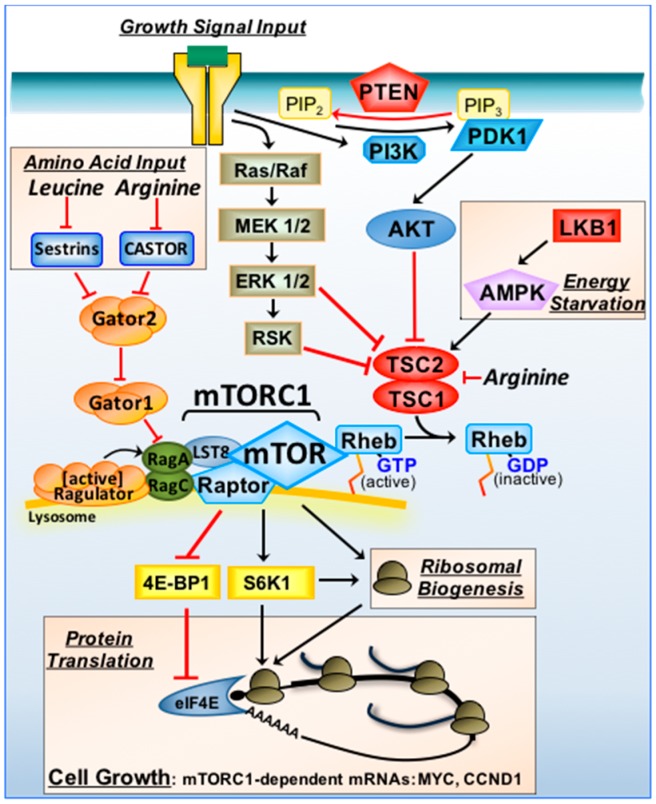
Figure 1
Figure 1
mTORC1 signal transduction and tumour suppressors. Growth signals via plasma membrane bound receptors activate the Ras/Raf/MAPK/ERK/RSK and PI3K/AKT signalling pathways. Tumour suppressors upstream of TSC1/TSC2 include PTEN and LKB1 (indicated in red). Through these pathways, TSC1/TSC2 is inactivated, converting Rheb to an active GTP-bound state to promote mTORC1 (when associated with the “Ragulator complex” on lysosomal membranes). When nutrients are sufficient, Rag GTPase heterodimers recruit mTORC1 to the “Ragulator complex”. Arginine inhibits both TSC1/TSC2 and CASTOR. Leucine activates GATOR2 indirectly via sestrins. Under energy deprivation, LKB1/AMPK activates TSC1/TSC2 to switch mTORC1 off. mTORC1 drives cell growth (in part) by increasing the efficiency of mRNA translation of mTORC1-sensitive mRNAs (that include MYC and CCND1). mTORC1 regulates protein synthesis via 4E-BP1/eIF4E and S6K1.

References

    1. Sehgal S.N., Baker H., Vézina C. Rapamycin (AY-22,989), a new antifungal antibiotic. II. Fermentation, isolation and characterization. J. Antibiot. 1975;28:727–732. doi: 10.7164/antibiotics.28.727. - DOI - PubMed
    1. Park S.R., Yoo Y.J., Ban Y.H., Yoon Y.J. Biosynthesis of rapamycin and its regulation: Past achievements and recent progress. J. Antibiot. 2010;63:434–441. doi: 10.1038/ja.2010.71. - DOI - PubMed
    1. Vézina C., Kudelski A., Sehgal S.N. Rapamycin (AY-22,989), a new antifungal antibiotic. I. Taxonomy of the producing streptomycete and isolation of the active principle. J. Antibiot. 1975;28:721–726. doi: 10.7164/antibiotics.28.721. - DOI - PubMed
    1. Heitman J., Movva N.R., Hall M.N. Targets for cell cycle arrest by the immunosuppressant rapamycin in yeast. Science. 1991;253:905–909. doi: 10.1126/science.1715094. - DOI - PubMed
    1. Sehgal S.N. Sirolimus: Its discovery, biological properties, and mechanism of action. Transplant. Proc. 2003;35:7S–14S. doi: 10.1016/S0041-1345(03)00211-2. - DOI - PubMed

Substances

LinkOut - more resources
