. 2018 Mar 16;9(3):166.
doi: 10.3390/genes9030166.

Evolutionary Mechanisms of Varying Chromosome Numbers in the Radiation of Erebia Butterflies

Affiliations

Evolutionary Mechanisms of Varying Chromosome Numbers in the Radiation of Erebia Butterflies

Kay Lucek. Genes (Basel). .

Abstract

The evolution of intrinsic barriers to gene flow is a crucial step in the process of speciation. Chromosomal changes caused by fusion and fission events are one such barrier and are common in several groups of Lepidoptera. However, it remains unclear if and how chromosomal changes have contributed to speciation in this group. I tested for a phylogenetic signal of varying chromosome numbers in Erebia butterflies by combining existing sequence data with karyological information. I also compared different models of trait evolution in order to infer the underlying evolutionary mechanisms. Overall, I found significant phylogenetic signals that are consistent with non-neutral trait evolution only when parts of the mitochondrial genome were included, suggesting cytonuclear discordances. The adaptive evolutionary model tested in this study consistently outperformed the neutral model of trait evolution. Taken together, these results suggest that, unlike other Lepidoptera groups, changes in chromosome numbers may have played a role in the diversification of Erebia butterflies.

Keywords: Erebia; Lepidoptera; adaptive radiation; chromosomal rearrangement; intrinsic barriers.


Conflict of interest statement

The author declares no conflict of interest.

Figures
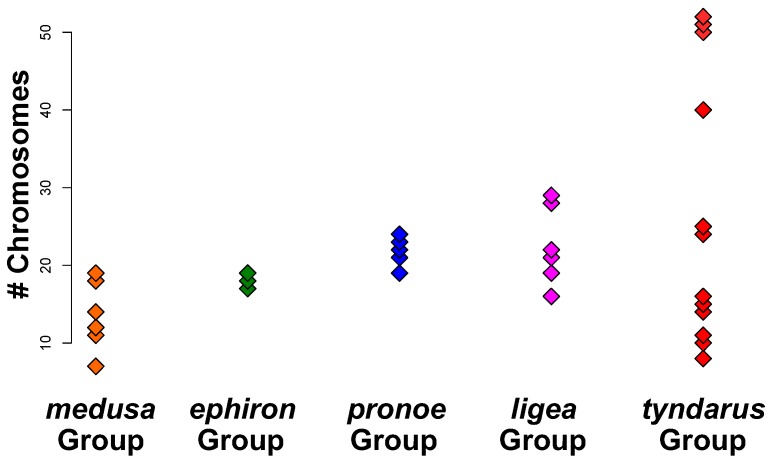
Figure 1
Figure 1
Dot plot summarizing the variation in haploid chromosome numbers among the five European Erebia groups according to [26]. Data is from [22]. Erebia medusa group (orange), E. ephiron group (green), E. pronoe group (blue), E. ligea group (pink), E. tyndarus group (red).
Figure 2
Figure 2
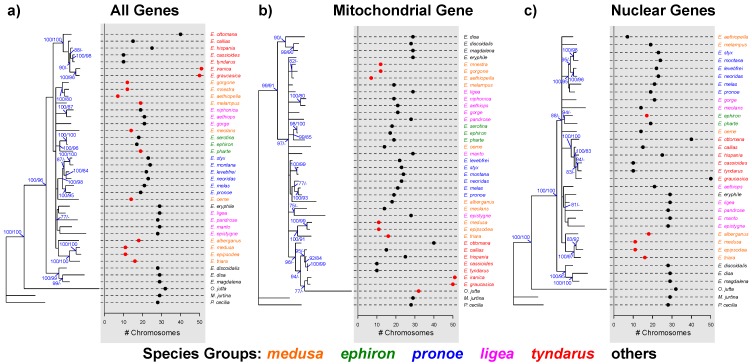
Majority rule consensus phylograms, each based on 1000 post burn-in trees using either (a) all four genes combined (n = 40 taxa), (b) the mitochondrial COI gene (n = 40 taxa), and (c) sequences of three nuclear genes (glyceraldehyde-3-phosphate dehydrogenase (GAPDH), ribosomal protein S5 (RpS5), wingless (WG)) combined (n = 35 taxa). Numbers at each node indicate the posterior Bayesian probabilities followed by the bootstrap support for maximum likelihood trees. Only support values ≥75% are indicated. The haploid chromosome number is indicated for each species. Red dots highlight cases with a significant local Moran’s I based on 1000 permutations. Species label colors designate different Erebia groups (see also Figure 1).
Figure 3
Figure 3
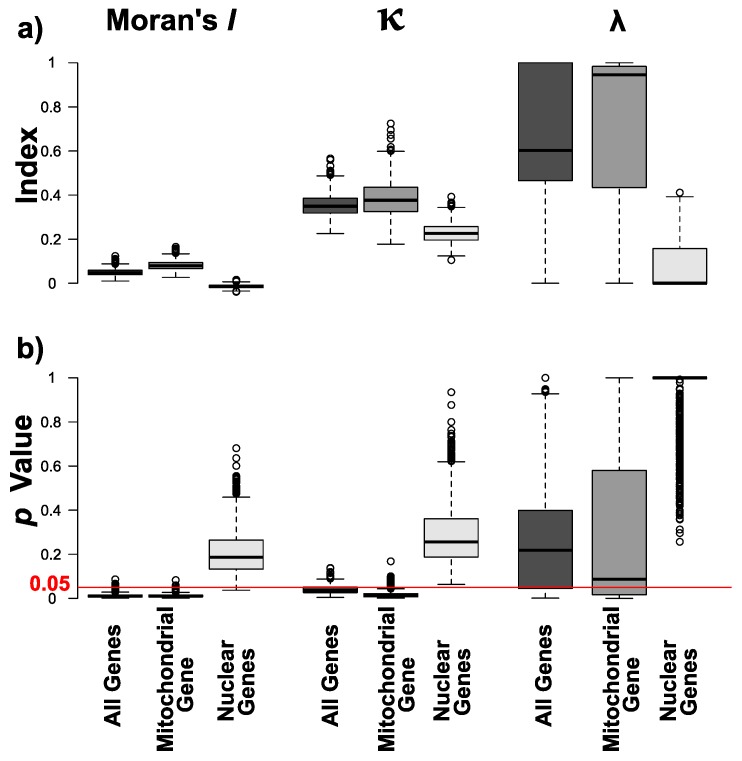
Summary of phylogenetic estimates across 1000 post burn-in trees for each dataset. Boxplots depict (a) the observed estimates for Moran’s I, Blomberg’s κ and Pagel’s λ with their (b) associated p values. The red line highlights a p value cut-off of 0.05.
Figure 4
Figure 4
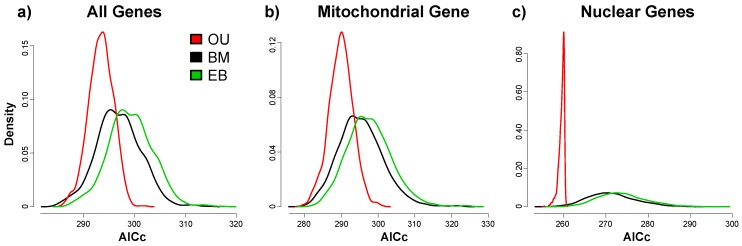
Density distributions for Akaike’s information criterion, corrected for finite sample sizes (AICc) estimated for three different models across the 1000 post burn-in trees for each dataset: black —Brownian motion (BM), red—Ornstein-Uhlenbeck (OU), green—early burst (EB).

References

    1. Hendry A.P. Ecological speciation! Or the lack thereof? Can. J. Fish. Aquat. Sci. 2009;66:1383–1398. doi: 10.1139/F09-074. - DOI
    1. Nosil P. Ecological Speciation. Oxford University Press; Oxford, UK: 2012.
    1. Seehausen O., Butlin R.K., Keller I., Wagner C.E., Boughman J.W., Hohenlohe P.A., Peichel C.L., Saetre G.-P., Bank C., Brännström Å., et al. Genomics and the origin of species. Nat. Rev. Genet. 2014;15:176–192. doi: 10.1038/nrg3644. - DOI - PubMed
    1. Nosil P., Harmon L.J., Seehausen O. Ecological explanations for (incomplete) speciation. Trends Ecol. Evol. 2009;24:145–156. doi: 10.1016/j.tree.2008.10.011. - DOI - PubMed
    1. Butlin R.K. Recombination and speciation. Mol. Ecol. 2005;14:2621–2635. doi: 10.1111/j.1365-294X.2005.02617.x. - DOI - PubMed

LinkOut - more resources