


No differences in objective dynamic instability during acceleration of the knee with or without subjective instability post-total knee arthroplasty
- PMID: 29547641
- PMCID: PMC5856396
- DOI: 10.1371/journal.pone.0194221
No differences in objective dynamic instability during acceleration of the knee with or without subjective instability post-total knee arthroplasty
Abstract
Introduction: Instability after total knee arthroplasty is a critical problem. The purpose of this study was to clarify the stability of implanted knees during walking by comparing differences in dynamic instability during knee acceleration between individuals with or without previously experienced subjective instability, as measured by self-reported questionnaire.
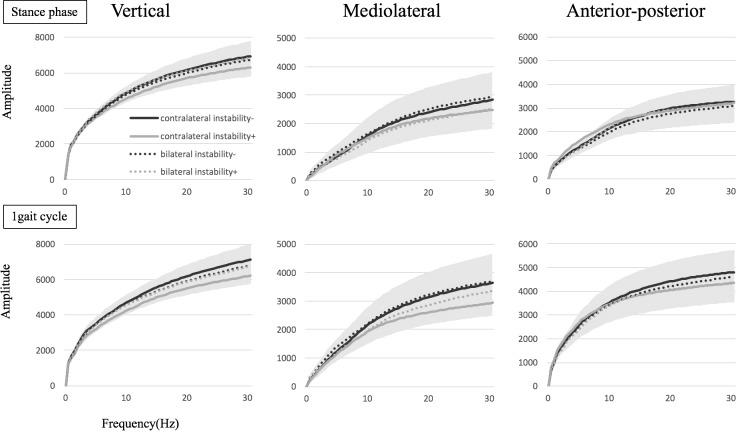
Materials and methods: We examined 92 knees with medial pivot implants. Mean patient age and follow-up duration were 78.4 years and 32.8 months, respectively. An accelerometer was used to investigate the accelerations along three axes; that is, vertical (VT), mediolateral (ML), and anteroposterior (AP) directions in 3-dimensional (3D) space. The analysis in the stance phase and gait cycle was performed by: (1) root mean square (RMS) values of acceleration and (2) frequency domain analysis using fast Fourier transformation (FFT). A self-reported knee instability score was used for the subjective feeling of instability.
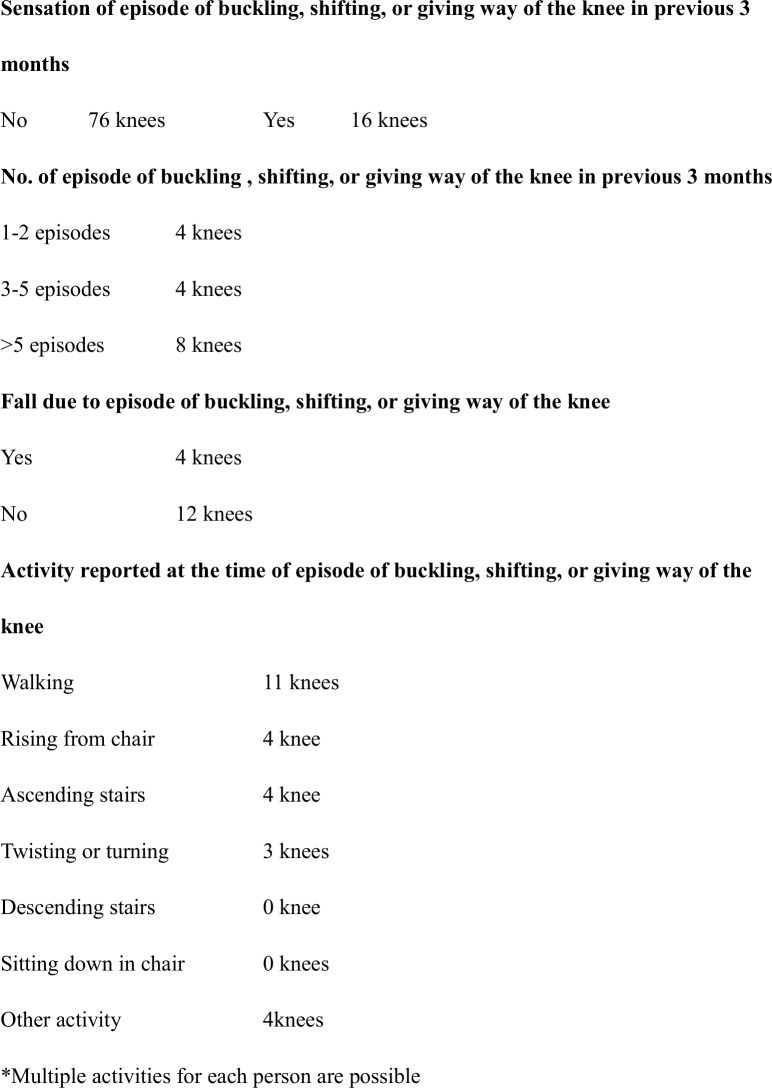
Results: A total of 76 knees did not feel unstable (group 0), but 16 knees felt unstable (group 1) in patients during activities of daily living. Regarding the RMS, there were no differences in each direction between the groups. For FFT, the cumulative amplitude in the frequency < 30 Hz also showed no significant differences in all directions between the groups during the stance phase (VT, p = 0.335; ML, p = 0.219; AP, p = 0.523) or gait cycle (VT, p = 0.077; ML, p = 0.082; AP, p = 0.499).
Discussion: Gait analysis based on the acceleration data showed that there were no between-group differences in objective dynamic instability during acceleration of the knee, with or without reports of previously experienced subjective instability, as assessed by the self-reported questionnaire.
Conflict of interest statement
Figures


References
-
- Colizza WA, Insall JN, Scuderi GR. The posterior-stabilized knee prosthesis: assessment of polyethylene damage and osteolysis after a ten-year minimum follow-up. J Bone Joint Surg Am. 1995;77:1713–20. - PubMed
-
- Emmerson KP, Moran CG, Pinder IM. Survivorship analysis of the kinematic stabilizer total knee replacement: a 10–14 year follow-up. J Bone Joint Surg Br. 1996;78:441–5. - PubMed
-
- Fort-Rodriquez DE, Scuderi GR, Insall JN. Survivorship of cemented total knee arthroplasty. Clin Orthop Relat Res. 1997;345:79–86. - PubMed
-
- Pagnano MW, Hanssen AD, Lewallen DG, Stuart ML. Flexion instability after primary posterior cruciate retaining total knee arthroplasty. Clin Orthop Relat Res. 1998;356:39–46. - PubMed
-
- Mochizuki T, Tanifuji O, Sato T, Hijikata H, Koga H, Watanabe S, et al. Association between anteroposterior laxity in mid-range flexion and subjective healing of instability after total knee arthroplasty. Knee Surg Sports Traumatol Arthrosc. 2017;25:3543–8. doi: 10.1007/s00167-016-4375-8 - DOI - PubMed
Publication types
MeSH terms
LinkOut - more resources
Full Text Sources
Other Literature Sources
Medical
