


Comparing dedicated and designated models of integrating mental health into chronic disease care: study protocol for a cluster randomized controlled trial
- PMID: 29548302
- PMCID: PMC5857135
- DOI: 10.1186/s13063-018-2568-9
Comparing dedicated and designated models of integrating mental health into chronic disease care: study protocol for a cluster randomized controlled trial
Abstract
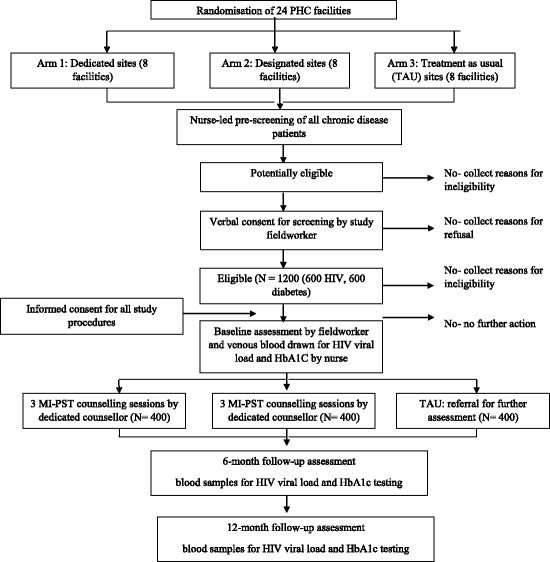
Background: In low- and middle-income countries (LMIC), it is uncertain whether a "dedicated" approach to integrating mental health care (wherein a community health worker (CHW) has the sole responsibility of delivering mental health care) or a "designated" approach (wherein a CHW provides this service in addition to usual responsibilities) is most effective and cost-effective. This study aims to compare the effectiveness and cost-effectiveness of these two models of service integration relative to treatment as usual (TAU) for improving mental health and chronic disease outcomes among patients with HIV or diabetes.
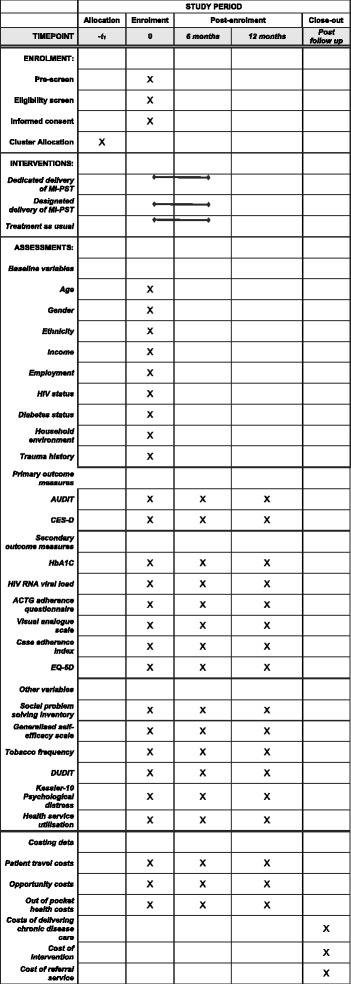
Methods/design: This is a cluster randomised trial. We will randomise 24 primary health care facilities in the Western Cape Province of South Africa to one of three study arms. Within each cluster, we will recruit 25 patients from HIV and 25 from diabetes services for a total sample of 1200 participants. Eligible patients will be aged 18 years or older, take medication for HIV or diabetes, and screen positive on the Alcohol Use Disorder Identification Test for hazardous/harmful alcohol use or depression on the Centre for Epidemiology Scale on Depression. Participants recruited in clinics assigned to the designated or dedicated approach will receive three sessions of motivational interviewing and problem-solving therapy, while those recruited at TAU-assigned clinics will be referred for further assessment. Participants will complete an interviewer-administered questionnaire at baseline, and at 6 and 12 months post-enrolment to assess change in self-reported outcomes. At these end points, we will test HIV RNA viral load for participants with HIV and HbA1c levels for participants with diabetes. Primary outcomes are reductions in self-reported hazardous/harmful alcohol use and risk of depression. Secondary outcomes are improvements in adherence to chronic disease treatment, biomarkers of chronic disease outcomes, and health-related quality of life. Mixed-effect linear regression models will model the effect of the interventions on primary and secondary outcomes. The cost-effectiveness of each approach will be assessed using incremental cost-effectiveness ratios.
Discussion: Study findings will guide decision-making around how best to integrate mental health counselling into chronic disease care in a LMIC setting.
Trial registration: Pan African Clinical Trials Registry, Trial registration number: ACTR201610001825403 . Registered 17 October 2016.
Keywords: Chronic disease care; Common mental disorders; Integrated treatment; South Africa.
Conflict of interest statement
Ethics approval and consent to participate
The South African Medical Research Council (EC 004–2/2015), the University of Cape Town (089/2015), and Oxford University (OxTREC 2–17) provided ethical approval for this study. All participants will provide consent to participate in the trial.
Consent for publication
Not applicable.
Competing interests
The authors declare that they have no competing interests.
Publisher’s Note
Springer Nature remains neutral with regard to jurisdictional claims in published maps and institutional affiliations.
Figures
References
-
- Seedat S, Stein DJ, Herman A, Kessler R, Sonnega J, Heeringa S, et al. Twelve-month treatment of psychiatric disorders in the South African Stress and Health Study (World Mental Health Survey Initiative) Soc Psychiatry Psychiatr Epidemiol. 2008;43:889–897. doi: 10.1007/s00127-008-0399-9. - DOI - PMC - PubMed
Publication types
MeSH terms
Grants and funding
LinkOut - more resources
Full Text Sources
Other Literature Sources
Medical
