


Production-scale fibronectin nanofibers promote wound closure and tissue repair in a dermal mouse model
- PMID: 29549768
- PMCID: PMC6859458
- DOI: 10.1016/j.biomaterials.2018.03.006
Production-scale fibronectin nanofibers promote wound closure and tissue repair in a dermal mouse model
Abstract
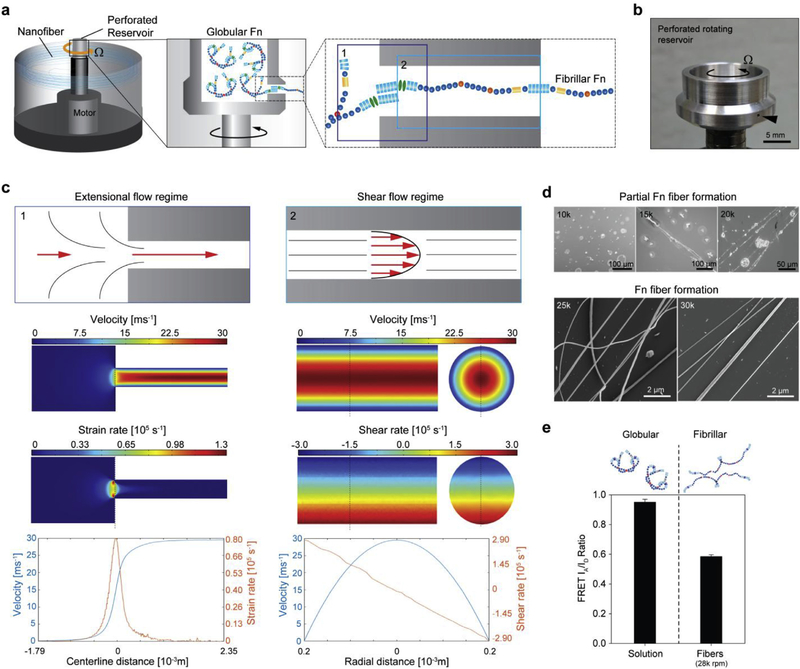
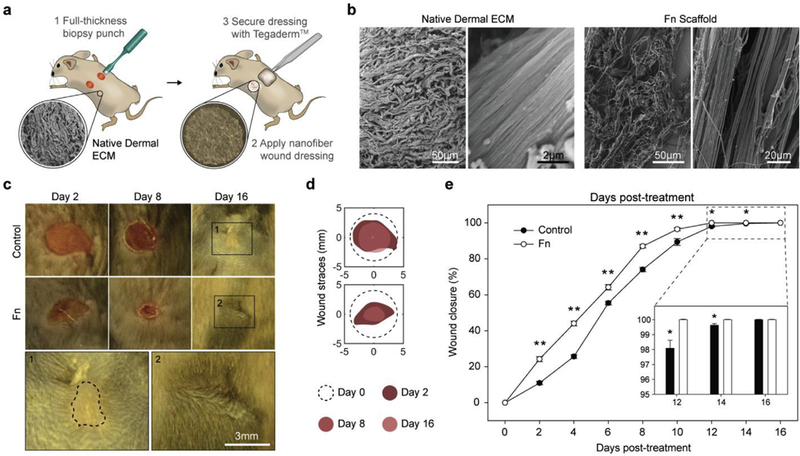
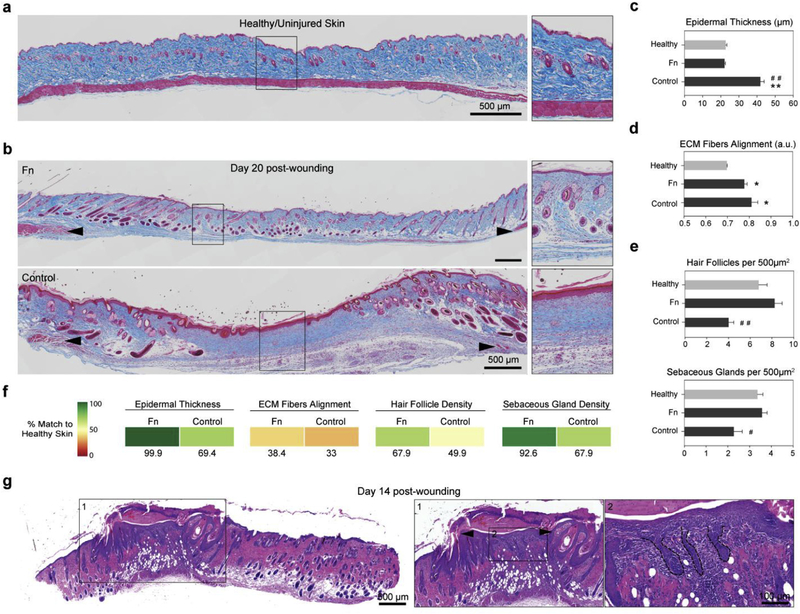
Wounds in the fetus can heal without scarring. Consequently, biomaterials that attempt to recapitulate the biophysical and biochemical properties of fetal skin have emerged as promising pro-regenerative strategies. The extracellular matrix (ECM) protein fibronectin (Fn) in particular is believed to play a crucial role in directing this regenerative phenotype. Accordingly, Fn has been implicated in numerous wound healing studies, yet remains untested in its fibrillar conformation as found in fetal skin. Here, we show that high extensional (∼1.2 ×10⁵ s-1) and shear (∼3 ×10⁵ s-1) strain rates in rotary jet spinning (RJS) can drive high throughput Fn fibrillogenesis (∼10 mL/min), thus producing nanofiber scaffolds that are used to effectively enhance wound healing. When tested on a full-thickness wound mouse model, Fn nanofiber dressings not only accelerated wound closure, but also significantly improved tissue restoration, recovering dermal and epidermal structures as well as skin appendages and adipose tissue. Together, these results suggest that bioprotein nanofiber fabrication via RJS could set a new paradigm for enhancing wound healing and may thus find use in a variety of regenerative medicine applications.
Keywords: Fibrillogenesis; Fibronectin; Hair follicle; Nanofiber; Rotary jet spinning; Wound healing.
Copyright © 2018 Elsevier Ltd. All rights reserved.
Conflict of interest statement
Conflict of Interest
The authors declare no competing financial interests.
Figures
References
-
- Gurtner GC, Werner S, Barrandon Y, Longaker MT, Wound repair and regeneration, Nature 453 (2008) 314–321. - PubMed
-
- Martin P, Wound healing—aiming for perfect skin regeneration, Science 276 (1997) 75–81. - PubMed
-
- Corr DT, Gallant-Behm CL, Shrive NG, Hart DA, Biomechanical behavior of scar tissue and uninjured skin in a porcine model, Wound Repair Regen. 17 (2009) 250–259. - PubMed
-
- Tomasek JJ, Gabbiani G, Hinz B, Chaponnier C, Brown RA, Myofibroblasts and mechano-regulation of connective tissue remodelling, Nat. Rev. Mol. Cell Biol. 3 (2002) 349–363. - PubMed
Publication types
MeSH terms
Substances
Grants and funding
LinkOut - more resources
Full Text Sources
Other Literature Sources
Miscellaneous
