


A shift from papillary to reticular fibroblasts enables tumour-stroma interaction and invasion
- PMID: 29551776
- PMCID: PMC5931114
- DOI: 10.1038/s41416-018-0024-y
A shift from papillary to reticular fibroblasts enables tumour-stroma interaction and invasion
Abstract
Background: Tumour stroma consists of a heterogeneous population of fibroblasts and related mesenchymal cells, collectively dubbed cancer-associated fibroblasts (CAFs). These CAFs are key players in cancer invasion of cutaneous squamous cell carcinoma (SCC). As we have shown earlier, papillary and reticular fibroblasts (Pfs and Rfs, respectively) have distinct effects on epidermal and dermal homeostasis, but their role in cancer invasion and epithelial-to-mesenchymal transition (EMT) remains to be determined.
Methods: We used 3D cultures of human skin equivalents (HSEs) to analyse the effects of Pfs and Rfs on the invasive behaviour of SCC and EMT.
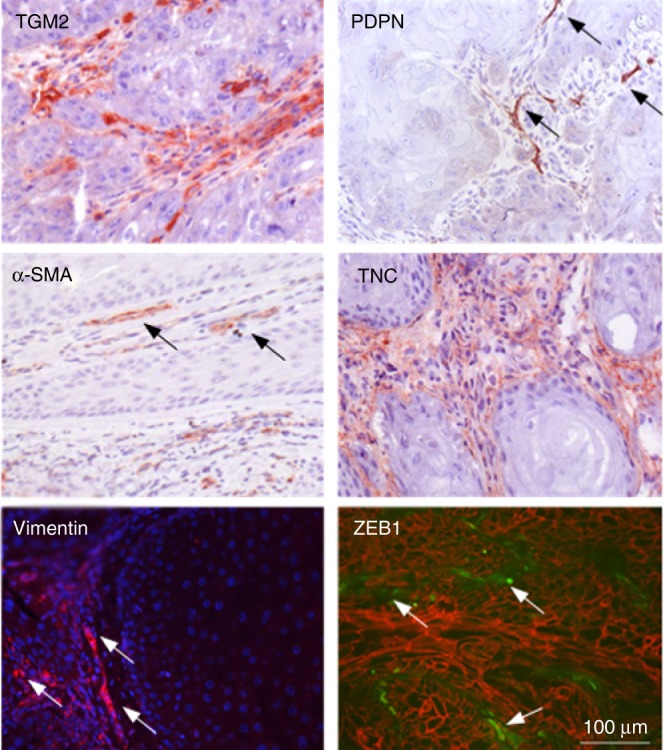
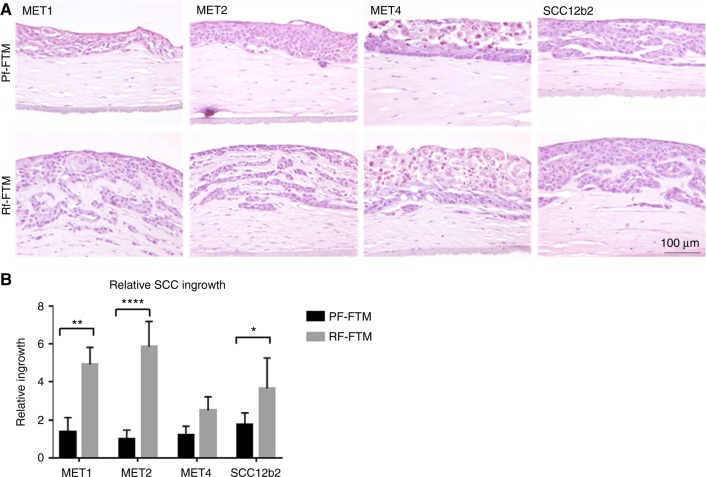
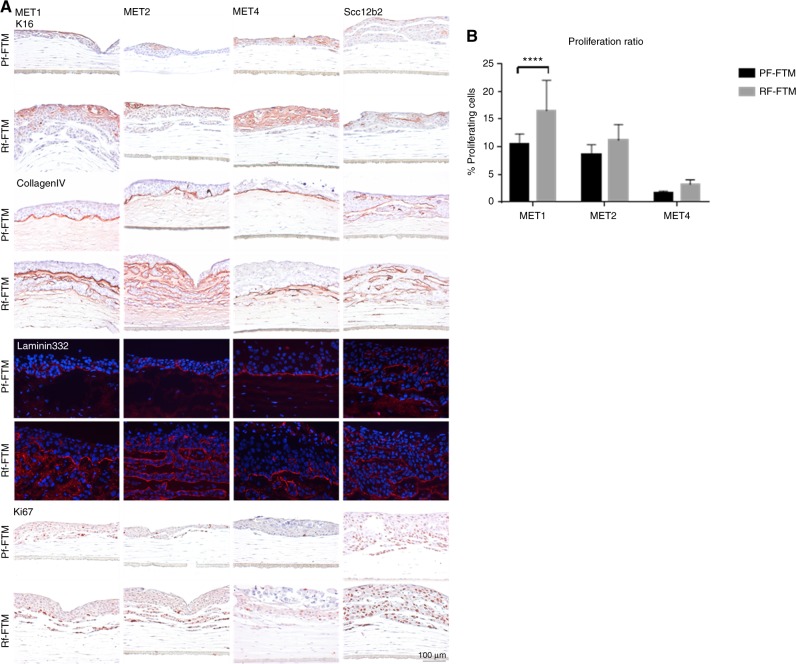
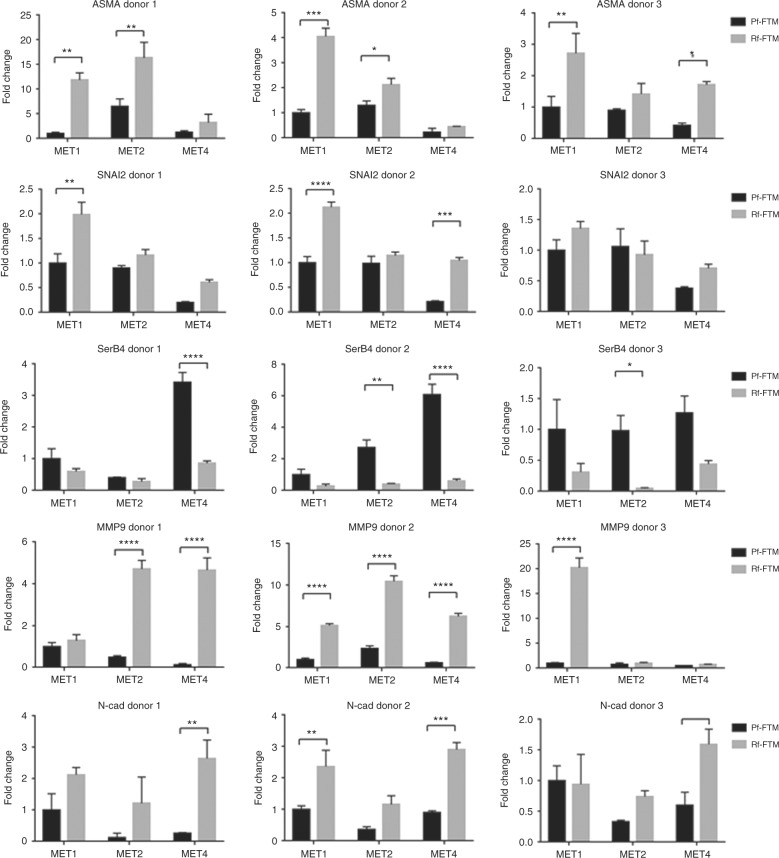
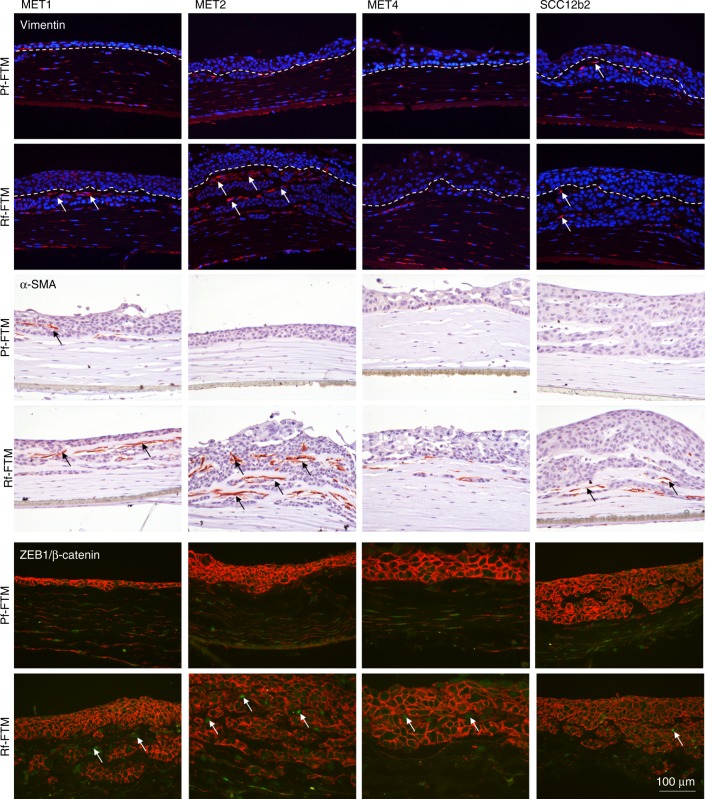
Results: We reveal for the first time the importance of Pfs versus Rfs in SCC invasion and EMT. Cell lines from different stages of SCC showed significantly more extensive invasion into a dermis composed of Rfs than of Pfs. In addition, Rfs-based HSEs showed increased cell activation and stained positive for CAF biomarkers α-SMA and vimentin. Further analysis revealed that invasively growing cancer cells in Rf-HSEs express markers of EMT transition, like SNAIL2, N-cadherin and ZEB1.
Conclusions: Conversely, our results show that Pfs contain cancer cells more within the epidermis. Rfs are clearly predisposed to differentiate into CAFs upon SCC signals, assisting invasion and EMT.
Conflict of interest statement
The authors declare no competing interests.
Figures
Similar articles
-
Human Papillary and Reticular Fibroblasts Show Distinct Functions on Tumor Behavior in 3D-Organotypic Cultures Mimicking Melanoma and HNSCC.Int J Mol Sci. 2022 Oct 1;23(19):11651. doi: 10.3390/ijms231911651. Int J Mol Sci. 2022. PMID: 36232952 Free PMC article.
-
A role for cancer-associated fibroblasts in inducing the epithelial-to-mesenchymal transition in human tongue squamous cell carcinoma.J Oral Pathol Med. 2014 Sep;43(8):585-92. doi: 10.1111/jop.12172. Epub 2014 Mar 20. J Oral Pathol Med. 2014. PMID: 24645915
-
Analysis of cancer-associated fibroblasts and the epithelial-mesenchymal transition in cutaneous basal cell carcinoma, squamous cell carcinoma, and malignant melanoma.Hum Pathol. 2018 Sep;79:1-8. doi: 10.1016/j.humpath.2018.03.006. Epub 2018 Mar 16. Hum Pathol. 2018. PMID: 29555579
-
Tumour suppressor gene function in carcinoma-associated fibroblasts: from tumour cells via EMT and back again?J Pathol. 2014 Feb;232(3):283-8. doi: 10.1002/path.4298. J Pathol. 2014. PMID: 24254977 Free PMC article. Review.
-
The Role of Epithelial-to-Mesenchymal Transition in Cutaneous Squamous Cell Carcinoma : Epithelial-to-Mesenchymal Transition in Cutaneous SCC.Curr Treat Options Oncol. 2020 Apr 30;21(6):47. doi: 10.1007/s11864-020-00735-x. Curr Treat Options Oncol. 2020. PMID: 32350682 Review.
Cited by
-
A tEMTing target? Clinical and experimental evidence for epithelial-mesenchymal transition in the progression of cutaneous squamous cell carcinoma (a scoping systematic review).Discov Oncol. 2022 Jun 6;13(1):42. doi: 10.1007/s12672-022-00510-4. Discov Oncol. 2022. PMID: 35666359 Free PMC article.
-
Cancer-Associated Fibroblasts Facilitate Squamous Cell Carcinoma Lung Metastasis in Mice by Providing TGFβ-Mediated Cancer Stem Cell Niche.Front Cell Dev Biol. 2021 Aug 30;9:668164. doi: 10.3389/fcell.2021.668164. eCollection 2021. Front Cell Dev Biol. 2021. PMID: 34527666 Free PMC article.
-
The development of in vitro organotypic 3D vulvar models to study tumor-stroma interaction and drug efficacy.Cell Oncol (Dordr). 2024 Jun;47(3):883-896. doi: 10.1007/s13402-023-00902-w. Epub 2023 Dec 7. Cell Oncol (Dordr). 2024. PMID: 38057628
-
Influence of Tumor Microenvironment and Fibroblast Population Plasticity on Melanoma Growth, Therapy Resistance and Immunoescape.Int J Mol Sci. 2021 May 17;22(10):5283. doi: 10.3390/ijms22105283. Int J Mol Sci. 2021. PMID: 34067929 Free PMC article. Review.
-
TGFβ1 is essential for MSCs-CAFs differentiation and promotes HCT116 cells migration and invasion via JAK/STAT3 signaling.Onco Targets Ther. 2019 Jul 5;12:5323-5334. doi: 10.2147/OTT.S178618. eCollection 2019. Onco Targets Ther. 2019. PMID: 31308702 Free PMC article.
References
MeSH terms
LinkOut - more resources
Full Text Sources
Other Literature Sources
Medical
Research Materials
