


A review of computational tools for design and reconstruction of metabolic pathways
- PMID: 29552648
- PMCID: PMC5851934
- DOI: 10.1016/j.synbio.2017.11.002
A review of computational tools for design and reconstruction of metabolic pathways
Abstract
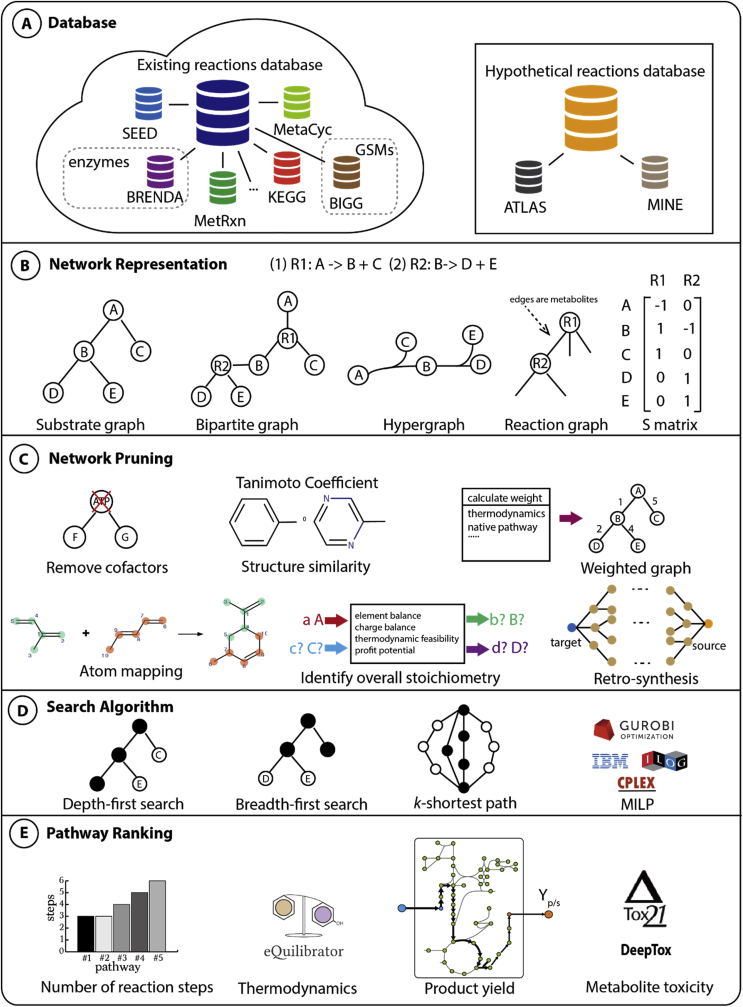
Metabolic pathways reflect an organism's chemical repertoire and hence their elucidation and design have been a primary goal in metabolic engineering. Various computational methods have been developed to design novel metabolic pathways while taking into account several prerequisites such as pathway stoichiometry, thermodynamics, host compatibility, and enzyme availability. The choice of the method is often determined by the nature of the metabolites of interest and preferred host organism, along with computational complexity and availability of software tools. In this paper, we review different computational approaches used to design metabolic pathways based on the reaction network representation of the database (i.e., graph or stoichiometric matrix) and the search algorithm (i.e., graph search, flux balance analysis, or retrosynthetic search). We also put forth a systematic workflow that can be implemented in projects requiring pathway design and highlight current limitations and obstacles in computational pathway design.
Figures
References
-
- Wood H.G. Life with Co or Co2 and H2 as a source of carbon and energy. Faseb J. 1991;5(2):156–163. - PubMed
-
- Moura M. Evaluating enzymatic synthesis of small molecule drugs. Metab Eng. 2016;33:138–147. - PubMed
-
- Yim H. Metabolic engineering of Escherichia coli for direct production of 1,4-butanediol. Nat Chem Biol. 2011;7(7):445–452. - PubMed
Publication types
LinkOut - more resources
Full Text Sources
Other Literature Sources
