


Improving acarbose production and eliminating the by-product component C with an efficient genetic manipulation system of Actinoplanes sp. SE50/110
- PMID: 29552655
- PMCID: PMC5851932
- DOI: 10.1016/j.synbio.2017.11.005
Improving acarbose production and eliminating the by-product component C with an efficient genetic manipulation system of Actinoplanes sp. SE50/110
Abstract
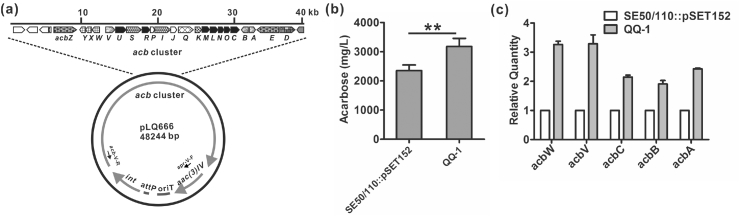
The α-glucosidase inhibitor acarbose is commercially produced by Actinoplanes sp. and used as a potent drug in the treatment of type-2 diabetes. In order to improve the yield of acarbose, an efficient genetic manipulation system for Actinoplanes sp. was established. The conjugation system between E. coli carrying ØC31-derived integrative plasmids and the mycelia of Actinoplanes sp. SE50/110 was optimized by adjusting the parameters of incubation time of mixed culture (mycelia and E. coli), quantity of recipient cells, donor-to-recipient ratio and the concentration of MgCl2, which resulted in a high conjugation efficiency of 29.4%. Using this integrative system, a cloned acarbose biosynthetic gene cluster was introduced into SE50/110, resulting in a 35% increase of acarbose titer from 2.35 to 3.18 g/L. Alternatively, a pIJ101-derived replicating plasmid combined with the counter-selection system CodA(sm) was constructed for gene inactivation, which has a conjugation frequency as high as 0.52%. Meanwhile, almost all 5-flucytosine-resistant colonies were sensitive to apramycin, among which 75% harbored the successful deletion of targeted genes. Using this replicating vector, the maltooligosyltrehalose synthase gene treY responsible for the accumulation of component C was inactivated, and component C was eliminated as detected by LC-MS. Based on an efficient genetic manipulation system, improved acarbose production and the elimination of component C in our work paved a way for future rational engineering of the acarbose-producing strains.
Keywords: Acarbose; Actinoplanes sp.; Component C; Conjugation; Genetic manipulation.
Figures

References
-
- Wehmeier U.F., Piepersberg W. Biotechnology and molecular biology of the α-glucosidase inhibitor acarbose. Appl Microbiol Biotechnol. 2004;63:613–625. - PubMed
-
- Ahr H.J., Boberg M., Krause H.P., Maul W., Müller F.O., Ploschke H.J. Pharmacokinetics of acarbose. Part I: absorption, concentration in plasma, metabolism and excretion after single administration of 14C acarbose to rats, dogs and man. Arzneimittelforschung. 1989;39:1254–1260. - PubMed
-
- Whiting D.R., Guariguata L., Weil C., Shaw J. IDF diabetes atlas: global estimates of the prevalence of diabetes for 2011 and 2030. Diabetes Res Clin Pract. 2011;94:311–321. - PubMed
-
- Feng Z.H., Wang Y.S., Zheng Y.G. A new microtiter plate-based screening method for microorganisms producing α-amylase inhibitors. Biotechnol Bioproc E. 2011;16:894–900.
-
- Sun L.H., Li M.G., Wang Y.S., Zheng Y.G. Significantly enhanced production of acarbose in fed-batch fermentation with the addition of S-adenosylmethionine. J Microbiol Biotechnol. 2012;22:826–831. - PubMed
LinkOut - more resources
Full Text Sources
Other Literature Sources
