Artemisinin-Resistant Plasmodium falciparum with High Survival Rates, Uganda, 2014-2016

Mie Ikeda et al. Emerg Infect Dis. 2018 Apr.

Abstract

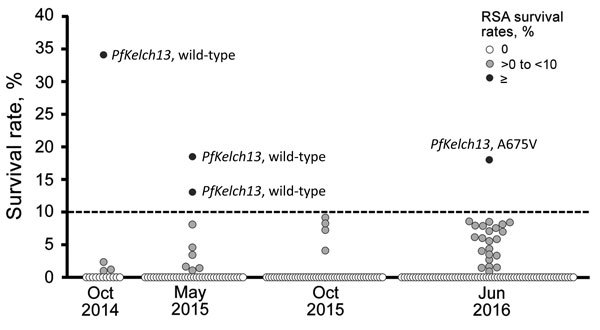
Because ≈90% of malaria cases occur in Africa, emergence of artemisinin-resistant Plasmodium falciparum in Africa poses a serious public health threat. To assess emergence of artemisinin-resistant parasites in Uganda during 2014-2016, we used the recently developed ex vivo ring-stage survival assay, which estimates ring-stage-specific P. falciparum susceptibility to artemisinin. We conducted 4 cross-sectional surveys to assess artemisinin sensitivity in Gulu, Uganda. Among 194 isolates, survival rates (ratio of viable drug-exposed parasites to drug-nonexposed controls) were high (>10%) for 4 isolates. Similar rates have been closely associated with delayed parasite clearance after drug treatment and are considered to be a proxy for the artemisinin-resistant phenotype. Of these, the PfKelch13 mutation was observed in only 1 isolate, A675V. Population genetics analysis suggested that these possibly artemisinin-resistant isolates originated in Africa. Large-scale surveillance of possibly artemisinin-resistant parasites in Africa would provide useful information about treatment outcomes and help regional malaria control.

Keywords: Artemisinin; Plasmodium falciparum; Uganda; antimicrobial resistance; drug resistance; malaria; parasites.


Figures
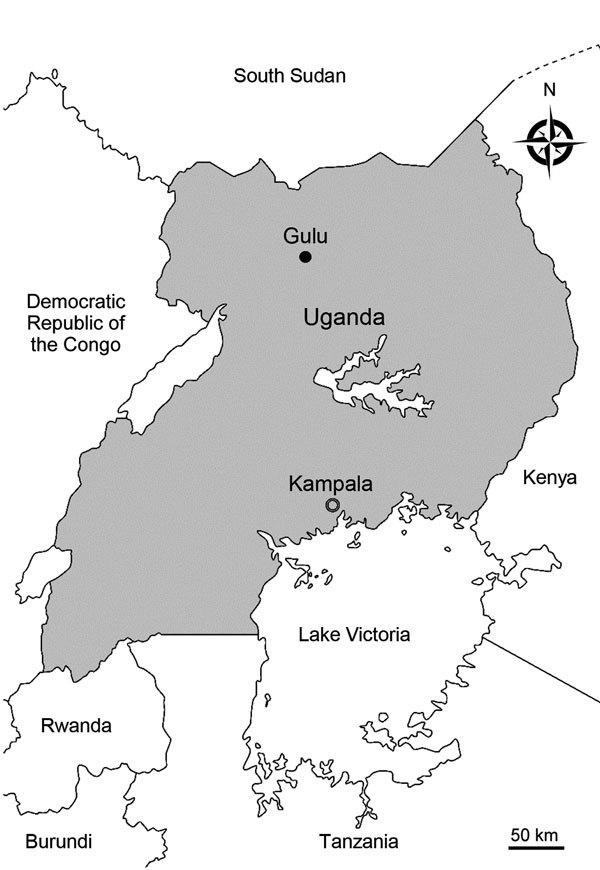
Figure 1
Figure 1
Site of study of ex vivo ring-stage Plasmodium falciparum survival rates, Gulu (black circle), northern Uganda, 2014–2016.
Figure 2
Figure 2
Distribution of ex vivo ring-stage Plasmodium falciparum survival rates, by RSA during each study period, 2014–2016. Susceptibility to dihydroartemisinin was determined by using ex vivo RSA survival rates. Survival rate was calculated as follows: (parasitemia at 700 nmol/L dihydroartemisinin exposed/parasitemia at 0 nmol/L control) × 100. Broken line indicates the cutoff value for what we consider to be high ex vivo RSA survival rates (>10%). RSA, ring-stage survival assay.
Figure 3
Figure 3
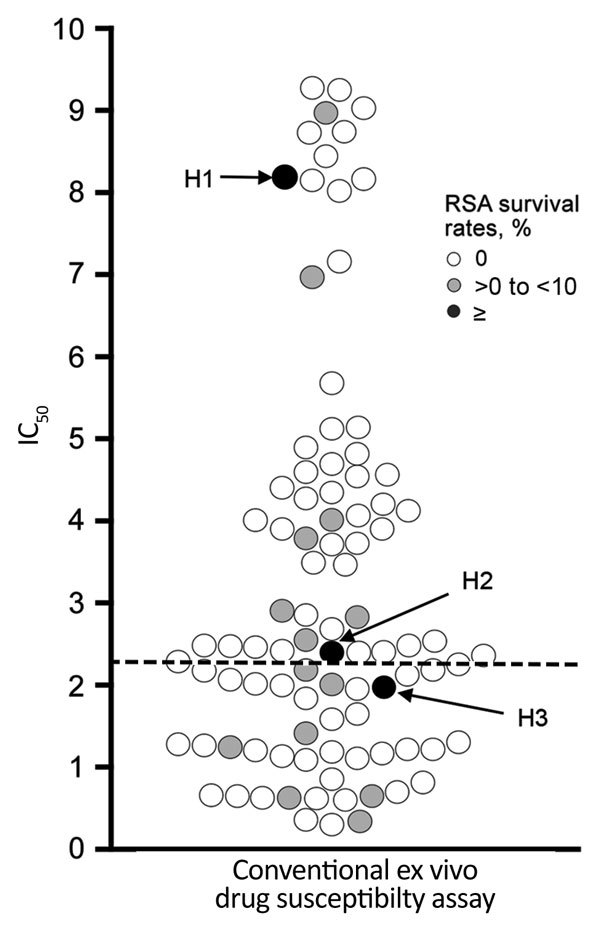
Distribution of IC50 of Plasmodium falciparum values by dihydroartemisinin in conventional ex vivo drug susceptibility assay. IC50 values to dihydroartemisinin in conventional ex vivo drug susceptibility assay are plotted. Geometric mean IC50 values in isolates with survival rates of 0, >0 to <10%, and >10% (high RSA survival) were 3.0 nmol/L (n = 74), 1.9 nmol/L (n = 14), and 3.3 nmol/L (n = 3), respectively. In the conventional ex vivo drug susceptibility assay, replication of parasites was monitored after continuous exposure to dihydroartemisinin for 72 h. Dashed line indicates geometric mean IC50 value of all isolates (2.25 nmol/L). IC50, concentration needed to inhibit 50% growth; RSA, ring-stage survival assay.
Figure 4
Figure 4
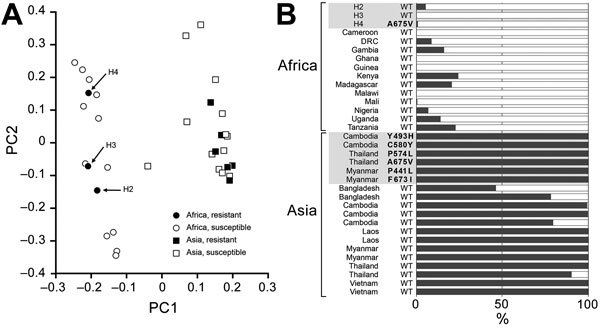
Potential lineage of ring-stage Plasmodium falciparum isolates with high survival rates according to ring-stage assay (RSA) in Uganda. Principal component analysis (A) and STRUCTURE (34) analysis (B) suggested an indigenous emergence of parasites with high survival rates by RSA (H2, H3, and H4) in Africa. P. falciparum isolates (n = 31) that originated from Asia (n = 19), including 6 isolates with PfKelch13 mutation, or from Africa (n = 12) were obtained from Sequence Read Archive in National Center for Biotechnology Information (https://www.ncbi.nlm.nih.gov/sra). DRC, Democratic Republic of the Congo; PC1, first principal component; PC2, second principal component; WT, wild-type.

References

    1. World Health Organization. World malaria report 2017. Geneva: The Organization; 2017.
    1. Noedl H, Se Y, Schaecher K, Smith BL, Socheat D, Fukuda MM; Artemisinin Resistance in Cambodia 1 (ARC1) Study Consortium. Evidence of artemisinin-resistant malaria in western Cambodia. N Engl J Med. 2008;359:2619–20. 10.1056/NEJMc0805011 - DOI - PubMed
    1. Dondorp AM, Nosten F, Yi P, Das D, Phyo AP, Tarning J, et al. Artemisinin resistance in Plasmodium falciparum malaria. N Engl J Med. 2009;361:455–67. 10.1056/NEJMoa0808859 - DOI - PMC - PubMed
    1. Ashley EA, Dhorda M, Fairhurst RM, Amaratunga C, Lim P, Suon S, et al.; Tracking Resistance to Artemisinin Collaboration (TRAC). Spread of artemisinin resistance in Plasmodium falciparum malaria. N Engl J Med. 2014;371:411–23. 10.1056/NEJMoa1314981 - DOI - PMC - PubMed
    1. Amaratunga C, Lim P, Suon S, Sreng S, Mao S, Sopha C, et al. Dihydroartemisinin-piperaquine resistance in Plasmodium falciparum malaria in Cambodia: a multisite prospective cohort study. Lancet Infect Dis. 2016;16:357–65. 10.1016/S1473-3099(15)00487-9 - DOI - PMC - PubMed

Publication types

MeSH terms

LinkOut - more resources