Impact of Pretreatment Change on Mechanism of Behavior Change Research: An Applied Example Using Alcohol Abstinence Self-Efficacy
- PMID: 29553349
- PMCID: PMC6019774
- DOI: 10.15288/jsad.2018.79.223
Impact of Pretreatment Change on Mechanism of Behavior Change Research: An Applied Example Using Alcohol Abstinence Self-Efficacy
Abstract
Objective: With the growing recognition that, for some, significant changes in drinking occur before the first treatment session (i.e., pretreatment change), researchers have called for the careful assessment of when change occurs and its potential impact on mechanism of behavior change (MOBC) research. Using a commonly hypothesized MOBC variable, alcohol abstinence self-efficacy, the primary aim of this study was to examine the effect of pretreatment change on the study of MOBCs.
Method: Sixty-three individuals diagnosed with alcohol dependence were recruited to participate in a 12-week cognitive-behavioral treatment. Participants completed weekly assessments of self-efficacy and drinking behaviors.
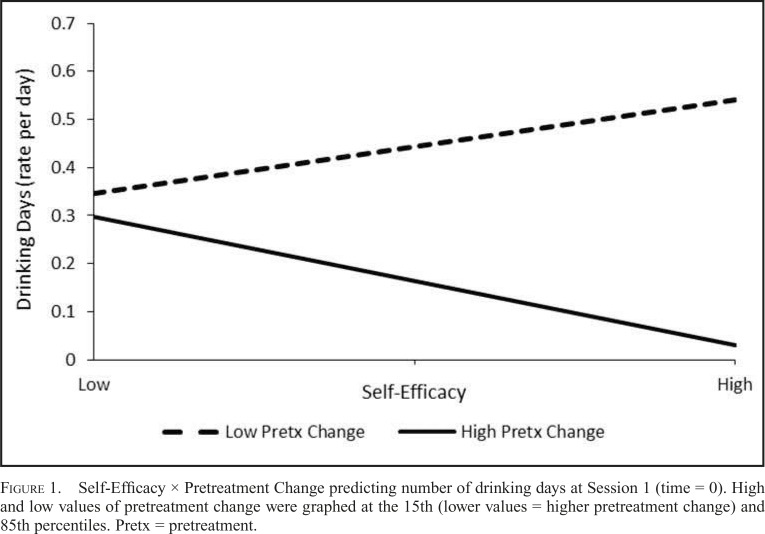
Results: Multilevel time-lagged regression models indicated that pretreatment change significantly moderated the effect of self-efficacy on the number of drinking days, such that among those higher on pretreatment change, higher self-efficacy ratings predicted lower rates of drinking days in the week until the next treatment session. In contrast, pretreatment change did not moderate the effect of self-efficacy on the rate of heavy drinking days.
Conclusions: Results from the current study add to a small but growing body of research highlighting the importance of pretreatment change when studying MOBCs. Further, these results provide important insights into the conditions in which self-efficacy may play an important role in treatment outcomes.
Figures
References
-
- Adamson S. J., Sellman J. D., Frampton C. M. Patient predictors of alcohol treatment outcome: A systematic review. Journal of Substance Abuse Treatment. 2009;36:75–86. doi:10.1016/j.jsat.2008.05.007. - PubMed
-
- American Psychiatric Association. 4th ed. Washington, DC: Author; 1994. Diagnostic and statistical manual of mental disorders.
-
- Bandura A. Self-efficacy: Toward a unifying theory of behavioral change. Psychological Review. 1977;84:191–215. doi:10.1037/0033-295X.84.2.191. - PubMed
-
- Bandura A., Locke E. A. Negative self-efficacy and goal effects revisited. Journal of Applied Psychology. 2003;88:87–99. doi:10.1037/0021-9010.88.1.87. - PubMed
-
- Blume A. W., Schmaling K. B., Marlatt A. G. Predictors of change in binge drinking over a 3-month period. Addictive Behaviors. 2003;28:1007–1012. doi:10.1016/S0306-4603(01)00287-8. - PubMed
Publication types
MeSH terms
Grants and funding
LinkOut - more resources
Full Text Sources
Medical