Rapid forgetting of social learning in the Ts65Dn mouse model of Down syndrome: New evidence for hippocampal dysfunction
- PMID: 29553775
- PMCID: PMC5938627
- DOI: 10.1037/bne0000227
Rapid forgetting of social learning in the Ts65Dn mouse model of Down syndrome: New evidence for hippocampal dysfunction
Abstract
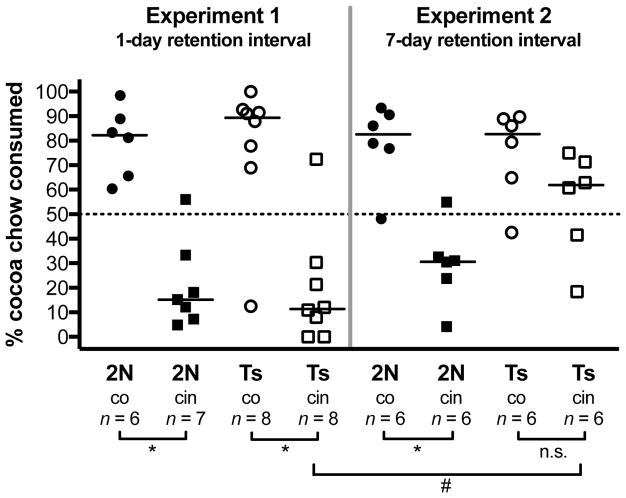
The Ts65Dn mouse model of Down syndrome recapitulates the hallmark areas of dysfunction that characterize the human disorder, including impaired performance in tasks designed to tap hippocampus-dependent learning and memory. Unfortunately, performance in the water maze tasks most commonly used for this purpose can be affected by behavioral and/or physiological abnormalities characteristic of Ts65Dn mice (e.g., thigmotaxis, susceptibility to hypothermia, stress reactivity), which complicates interpretation of impaired performance. The current study assessed hippocampal function in Ts65Dn mice using the social transmission of food preference (STFP) paradigm, which does not entail water escape or aversive reinforcement, and thus avoids these interpretive confounds. We tested Ts65Dn mice and disomic controls on this task using 1- and 7-day retention intervals. The Ts65Dn mice exhibited normal learning and memory following the 1-day retention interval, but rapid forgetting of the socially acquired information, evidenced by impaired performance following the 7-day retention interval. The STFP paradigm can be a valuable tool for studies using the Ts65Dn mouse model to evaluate potential therapies that may ameliorate hippocampal dysfunction and aging-related cognitive decline in Down syndrome. (PsycINFO Database Record
(c) 2018 APA, all rights reserved).
Figures
References
-
- Begenisic T, Sansevero G, Baroncelli L, Cioni G, Sale A. Early environmental therapy rescues brain development in a mouse model of Down syndrome. Neurobiol Dis. 2015;82:409–419. - PubMed
-
- Bimonte-Nelson HA, Hunter CL, Nelson ME, Granholm AC. Frontal cortex BDNF levels correlate with working memory in an animal model of Down syndrome. Behav Brain Res. 2003;139(1–2):47–57. - PubMed
-
- Bunsey M, Eichenbaum H. Selective damage to the hippocampal region blocks long-term retention of a natural and nonspatial stimulus-stimulus association. Hippocampus. 1995;5(6):546–556. - PubMed
MeSH terms
Grants and funding
LinkOut - more resources
Full Text Sources
Other Literature Sources
Medical
Miscellaneous