. 2018 Apr;10(3):453-462.
doi: 10.1080/19420862.2018.1433974. Epub 2018 Mar 19.

Reformatting palivizumab and motavizumab from IgG to human IgA impairs their efficacy against RSV infection in vitro and in vivo

Affiliations

Reformatting palivizumab and motavizumab from IgG to human IgA impairs their efficacy against RSV infection in vitro and in vivo

Shamir R Jacobino et al. MAbs. 2018 Apr.

Abstract

Respiratory syncytial virus (RSV) infection is a leading cause of hospitalization and mortality in young children. Protective therapy options are limited. Currently, palivizumab, a monoclonal IgG1 antibody, is the only licensed drug for RSV prophylaxis, although other IgG antibody candidates are being evaluated. However, at the respiratory mucosa, IgA antibodies are most abundant and act as the first line of defense against invading pathogens. Therefore, it would be logical to explore the potential of recombinant human IgA antibodies to protect against viral respiratory infection, but very little research on the topic has been published. Moreover, it is unknown whether human antibodies of the IgA isotype are better suited than those of the IgG isotype as antiviral drugs to combat respiratory infections. To address this, we generated various human IgA antibody formats of palivizumab and motavizumab, two well-characterized human IgG1 anti-RSV antibodies. We evaluated their efficacy to prevent RSV infection in vitro and in vivo and found similar, but somewhat decreased efficacy for different IgA subclasses and formats. Thus, reformatting palivizumab or motavizumab into IgA reduces the antiviral potency of either antibody. Moreover, our results indicate that the efficacy of intranasal IgA prophylaxis against RSV infection in human FcαRI transgenic mice is independent of Fc receptor expression.

Keywords: Fc receptor; IgG; RSV; antibody glycosylation; dIgA; fusion protein; mIgA; motavizumab; neutralizing antibodies; palivizumab; sIgA.


Figures
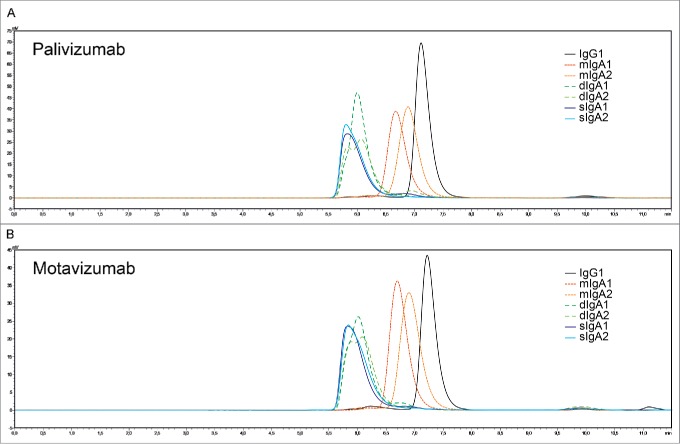
Figure 1.
Figure 1.
(A) Palivizumab and (B) motavizumab recombinant antibodies were analyzed by HPSEC. All antibody formats, except dIgA2, showed a main single peak. dIgA2 showed a characteristic double peak. The purity of all tested antibodies was >95%.
Figure 2.
Figure 2.
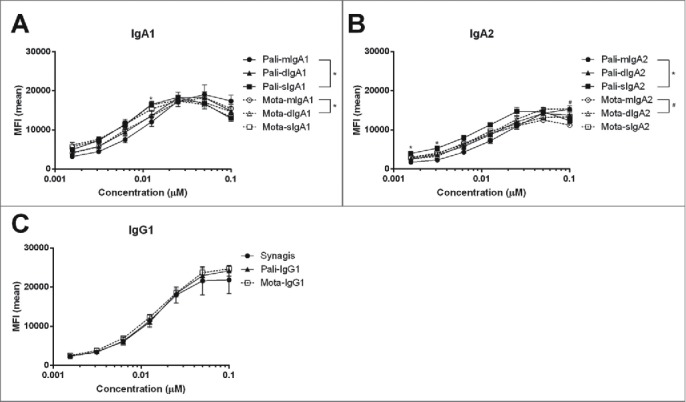
Binding of RSV-specific human IgA and IgG to RSV-infected HEp-2 cells. RSV-infected HEp-2 cells were stained with a dilution series of IgG and IgA variants of palivizumab (pali) and motavizumab (mota) and then analyzed by flow cytometry. (A) IgA1, (B) IgA2, and (C) IgG1 recombinant antibodies. Synagis: commercially available palivizumab. Data represent the mean ± SEM of duplicate measurements. Kruskal-Wallis test, #/*P < 0.05.
Figure 3.
Figure 3.
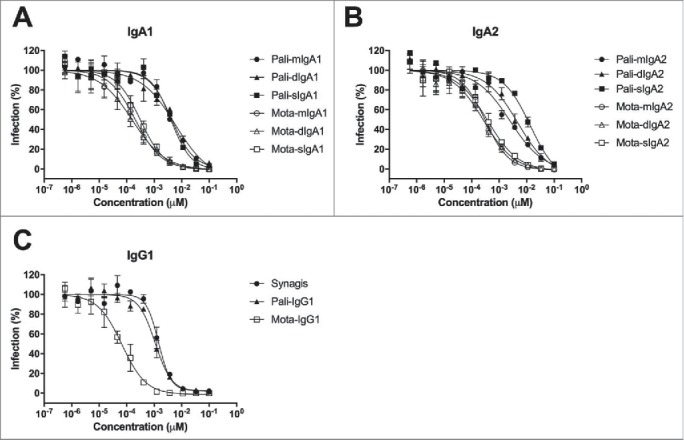
RSV neutralizing activity of human IgG and IgA variants of palivizumab and motavizumab. RSV-GFP was preincubated with a dilution series of recombinant IgG and IgA variants of palivizumab (pali) and motavizumab (mota) before infection of HEp-2 cells. GFP fluorescence of the infected cells was analyzed by flow cytometry. Graphs show the neutralizing activity of (A) IgA1, (B) IgA2, and (C) IgG1 recombinant antibodies. Synagis: commercially available palivizumab. Data represent the mean ± SEM of triplicate measurements.
Figure 4.
Figure 4.
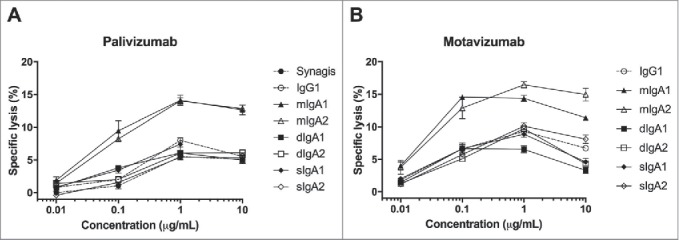
Neutrophils mediate ADCC of RSV-infected HEp-2 cells with RSV-specific IgA. Purified human blood neutrophils were incubated with 51Cr-labeled RSV-infected HEp-2 cells in the presence of IgA (solid lines) and IgG (dashed lines) variants of (A) palivizumab and (B) motavizumab. Radioactivity in the cell supernatant was measured after 4 hours to determine the percentage of cell lysis. Synagis: commercially available palivizumab. Data represent the mean ± SEM of triplicate measurements from one representative donor out of three. Kruskal-Wallis test, results were not significant.
Figure 5.
Figure 5.
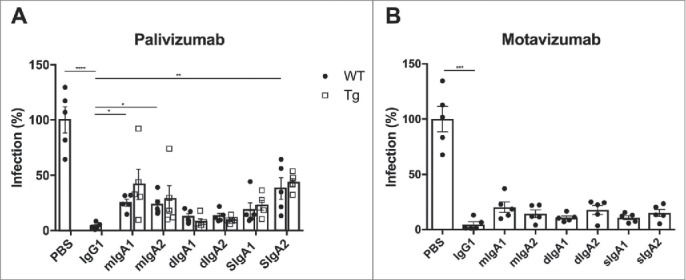
In vivo protection against RSV infection by intranasally administered RSV-specific IgA and IgG. RSV load was determined in bronchoalveolar fluid from wild-type (WT; closed circles) and human FcαRI transgenic (Tg; open squares) BALB/c mice prophylactically treated with recombinant IgA and IgG variants of (A) palivizumab and (B) motavizumab. Graphs show the percentage of RSV infection; the mean RSV load of the PBS-treated group was set to 100% infection. N=5 mice per group. Data represent the mean ± SEM. Kruskal-Wallis test, * P < 0.05, ** P < 0.01, *** P < 0.001, **** P < 0.0001.

References

    1. Woof JM, Russell MW. Structure and function relationships in IgA. Mucosal Immunol. 2011;4:590–7. doi: 10.1038/mi.2011.39. PMID:21937984. - DOI - PubMed
    1. Mattu TS, Pleass RJ, Willis AC, Kilian M, Wormald MR, Lellouch AC, Rudd PM, Woof JM, Dwek RA. The glycosylation and structure of human serum IgA1, Fab, and Fc regions and the role of N-glycosylation on Fcalpha receptor interactions. J Biol Chem. 1998;273:2260–72. doi: 10.1074/jbc.273.4.2260. PMID:9442070. - DOI - PubMed
    1. Johansen FE, Kaetzel CS. Regulation of the polymeric immunoglobulin receptor and IgA transport: new advances in environmental factors that stimulate pIgR expression and its role in mucosal immunity. Mucosal Immunol. 2011;4:598–602. doi: 10.1038/mi.2011.37. PMID:21956244. - DOI - PMC - PubMed
    1. Strugnell RA, Wijburg OL. The role of secretory antibodies in infection immunity. Nat Rev Microbiol. 2010;8:656–67. doi: 10.1038/nrmicro2384. PMID:20694027. - DOI - PubMed
    1. Brandsma AM, Jacobino SR, Meyer S, ten Broeke T, Leusen JH. Fc receptor inside-out signaling and possible impact on antibody therapy. Immunol Rev. 2015;268:74–87. doi: 10.1111/imr.12332. PMID:26497514. - DOI - PubMed

Publication types

MeSH terms