


Correlating the King-Devick Test With Vestibular/Ocular Motor Screening in Adolescent Patients With Concussion: A Pilot Study
- PMID: 29553882
- PMCID: PMC6044119
- DOI: 10.1177/1941738118765450
Correlating the King-Devick Test With Vestibular/Ocular Motor Screening in Adolescent Patients With Concussion: A Pilot Study
Abstract
Background: The King-Devick (K-D) test is a rapid number-naming task that has been well validated as a sensitive sideline performance measure for concussion detection. Patients with concussion take significantly longer to complete the K-D test than healthy controls. Previous research suggests that ocular motor deficits, specifically saccadic abnormalities, may be an underlying factor for the prolonged time. However, these findings have not been studied at length.
Hypothesis: K-D testing time of concussed adolescents at the initial clinical concussion visit will positively correlate with vestibular/ocular motor screening (VOMS) total scores.
Study design: Case series.
Level of evidence: Level 3.
Methods: A total of 71 patient charts were retrospectively analyzed between October 1, 2016, and January 31, 2017. Included charts consisted of patients between the ages of 10 and 18 years with a diagnosis of concussion and who had completed K-D testing and VOMS assessment at the initial physician visit. Univariate correlation between K-D testing time and the 7 VOMS items was assessed using Pearson correlation coefficients.
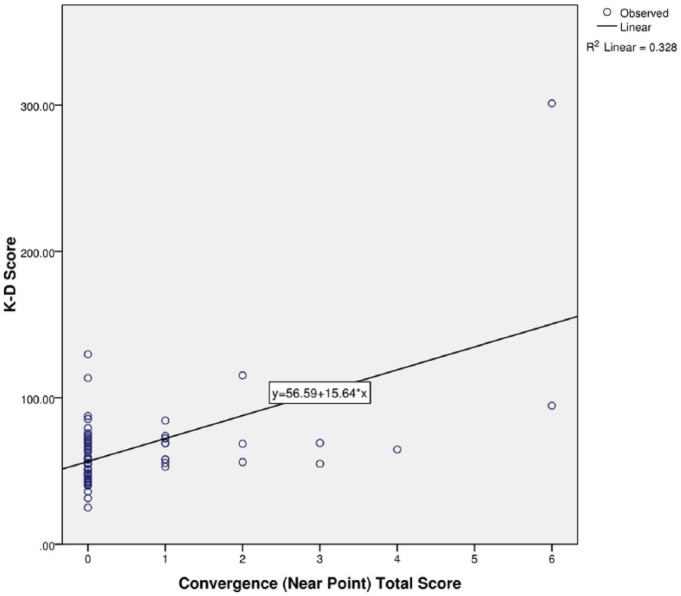
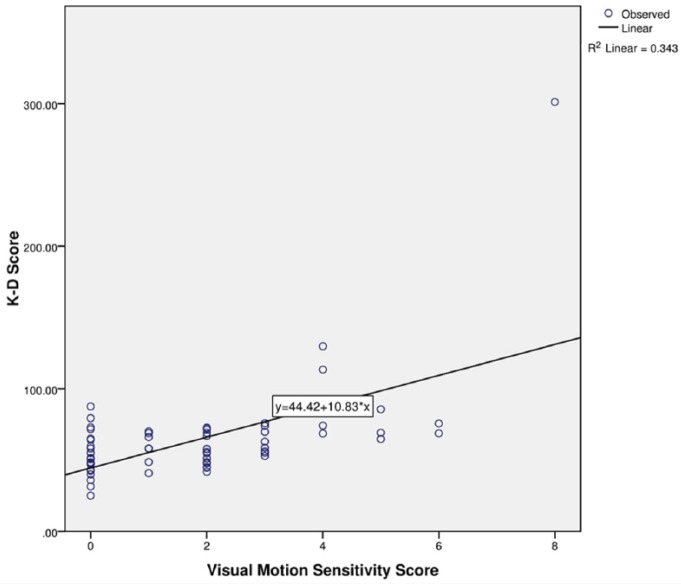
Results: K-D testing time strongly correlated with all 7 VOMS items ( r(69) = 0.325-0.585, P < 0.01). In a linear regression model that accounted for each VOMS item, the convergence (near point) item and the visual motion sensitivity item significantly predicted K-D testing time (β = 0.387, t(63) = 2.81, P < 0.01 and β = 0.375, t(63) = 2.35, P = 0.02, respectively). Additionally, 37.5% of the 24 patients with worsening symptoms after K-D testing freely reported increased visual problems.
Conclusion: Our study suggests that prolonged K-D testing times in adolescents with concussion may be related to subtypes of vestibular/ocular motor impairment that extend beyond saccadic abnormalities.
Clinical relevance: Poor K-D testing performance of adolescents with concussion may indicate a range of vestibular/ocular motor deficits that need to be further identified and addressed to maximize recovery.
Keywords: King-Devick test; concussion; vestibular/ocular motor screening.
Conflict of interest statement
The authors report no potential conflicts of interest in the development and publication of this article.
Figures
Similar articles
-
Validity and Reliability of the Vestibular/Ocular Motor Screening and Associations With Common Concussion Screening Tools.Sports Health. 2017 Mar/Apr;9(2):174-180. doi: 10.1177/1941738116678411. Epub 2016 Nov 11. Sports Health. 2017. PMID: 27834667 Free PMC article.
-
Test Performance and Test-Retest Reliability of the Vestibular/Ocular Motor Screening and King-Devick Test in Adolescent Athletes During a Competitive Sport Season.Am J Sports Med. 2018 Jul;46(8):2004-2010. doi: 10.1177/0363546518768750. Epub 2018 May 9. Am J Sports Med. 2018. PMID: 29741916 Clinical Trial.
-
A Brief Vestibular/Ocular Motor Screening (VOMS) assessment to evaluate concussions: preliminary findings.Am J Sports Med. 2014 Oct;42(10):2479-86. doi: 10.1177/0363546514543775. Epub 2014 Aug 8. Am J Sports Med. 2014. PMID: 25106780 Free PMC article.
-
Vestibulo-ocular dysfunction in mTBI: Utility of the VOMS for evaluation and management - A review.NeuroRehabilitation. 2022;50(3):279-296. doi: 10.3233/NRE-228012. NeuroRehabilitation. 2022. PMID: 35311725 Review.
-
Review of Vestibular and Oculomotor Screening and Concussion Rehabilitation.J Athl Train. 2017 Mar;52(3):256-261. doi: 10.4085/1062-6050-51.11.05. J Athl Train. 2017. PMID: 28387548 Free PMC article. Review.
Cited by
-
A COMPARISON OF THE PAPER AND COMPUTERIZED TABLET VERSION OF THE KING-DEVICK TEST IN COLLEGIATE ATHLETES AND THE INFLUENCE OF AGE ON PERFORMANCE.Int J Sports Phys Ther. 2020 Oct;15(5):688-697. doi: 10.26603/ijspt20200688. Int J Sports Phys Ther. 2020. PMID: 33110687 Free PMC article.
-
An assessment of current concussion identification and diagnosis methods in sports settings: a systematic review.BMC Sports Sci Med Rehabil. 2022 Jul 10;14(1):125. doi: 10.1186/s13102-022-00514-1. BMC Sports Sci Med Rehabil. 2022. PMID: 35818048 Free PMC article.
-
Vestibular and Ocular/Oculomotor Assessment Strategies and Outcomes Following Sports-Related Concussion: A Scoping Review.Sports Med. 2021 Apr;51(4):737-757. doi: 10.1007/s40279-020-01409-2. Epub 2021 Jan 5. Sports Med. 2021. PMID: 33400218
-
Clinical characteristics of visual motion hypersensitivity: a systematic review.Exp Brain Res. 2023 Jul;241(7):1707-1719. doi: 10.1007/s00221-023-06652-3. Epub 2023 Jun 21. Exp Brain Res. 2023. PMID: 37341755 Free PMC article.
-
KNOWLEDGE OF VESTIBULAR OCULAR DYSFUNCTION AND UTILIZATION OF VESTIBULAR OCULAR MOTOR SCREENING (VOMS) TOOL COMPONENTS AMONG PROFESSIONAL SPORTS LEAGUE ATHLETIC TRAINERS.Int J Sports Phys Ther. 2020 Aug;15(4):603-610. Int J Sports Phys Ther. 2020. PMID: 33354393 Free PMC article.
References
-
- Anzalone AJ, Blueitt D, Case T, et al. A positive vestibular/ocular motor screening (VOMS) is associated with increased recovery time after sports-related concussion in youth and adolescent athletes. Am J Sports Med. 2017;45:474-479. - PubMed
-
- Capo-Aponte JE, Urosevich TG, Temme LA, Tarbett AK, Sanghera NK. Visual dysfunctions and symptoms during the subacute stage of blast-induced mild traumatic brain injury. Mil Med. 2012;177:804-813. - PubMed
-
- Carney N, Ghajar J, Jagoda A, et al. Concussion guidelines step 1: systematic review of prevalent indicators. Neurosurgery. 2014;75(suppl 1):S3-S15. - PubMed
-
- Ciuffreda KJ, Kapoor N, Rutner D, Suchoff IB, Han ME, Craig S. Occurrence of oculomotor dysfunctions in acquired brain injury: a retrospective analysis. J Am Optom Assoc. 2007;78:155-161. - PubMed
MeSH terms
LinkOut - more resources
Full Text Sources
Other Literature Sources
Medical
Research Materials
