Memory instability as a gateway to generalization
- PMID: 29554094
- PMCID: PMC5875887
- DOI: 10.1371/journal.pbio.2004633
Memory instability as a gateway to generalization
Abstract
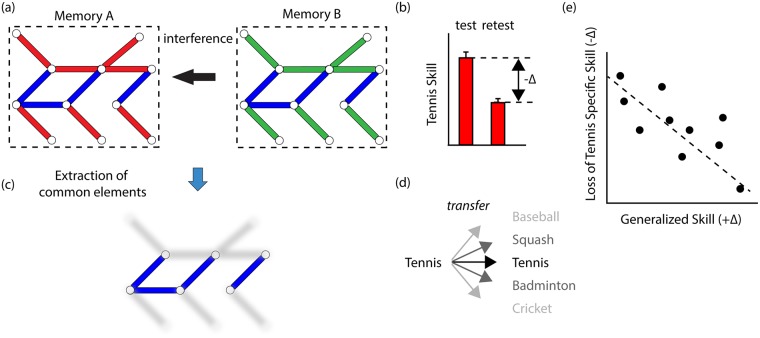
Our present frequently resembles our past. Patterns of actions and events repeat throughout our lives like a motif. Identifying and exploiting these patterns are fundamental to many behaviours, from creating grammar to the application of skill across diverse situations. Such generalization may be dependent upon memory instability. Following their formation, memories are unstable and able to interact with one another, allowing, at least in principle, common features to be extracted. Exploiting these common features creates generalized knowledge that can be applied across varied circumstances. Memory instability explains many of the biological and behavioural conditions necessary for generalization and offers predictions for how generalization is produced.
Conflict of interest statement
The author has declared that no competing interests exist.
Figures
References
-
- Tse D, Langston RF, Kakeyama M, Bethus I, Spooner PA, Wood ER, et al. Schemas and memory consolidation. Science. 2007;316(5821):76–82. doi: 10.1126/science.1135935 . - DOI - PubMed
-
- Abraham WC, Robins A. Memory retention—the synaptic stability versus plasticity dilemma. Trends in neurosciences. 2005;28(2):73–8. doi: 10.1016/j.tins.2004.12.003 . - DOI - PubMed
-
- Robertson EM. New insights in human memory interference and consolidation. Current biology: CB. 2012;22(2):R66–71. doi: 10.1016/j.cub.2011.11.051 - DOI - PMC - PubMed
-
- Mosha N, Robertson EM. Unstable Memories Create a High-Level Representation that Enables Learning Transfer. Current biology: CB. 2016;26(1):100–5. doi: 10.1016/j.cub.2015.11.035 . - DOI - PMC - PubMed
Publication types
MeSH terms
LinkOut - more resources
Full Text Sources
Other Literature Sources
Medical
Miscellaneous