. 2018 Mar 19;13(3):e0194220.
doi: 10.1371/journal.pone.0194220. eCollection 2018.

Influence of model assumptions about HIV disease progression after initiating or stopping treatment on estimates of infections and deaths averted by scaling up antiretroviral therapy

Affiliations

Influence of model assumptions about HIV disease progression after initiating or stopping treatment on estimates of infections and deaths averted by scaling up antiretroviral therapy

Kanes Sucharitakul et al. PLoS One. .

Abstract

Background: Many mathematical models have investigated the population-level impact of expanding antiretroviral therapy (ART), using different assumptions about HIV disease progression on ART and among ART dropouts. We evaluated the influence of these assumptions on model projections of the number of infections and deaths prevented by expanded ART.

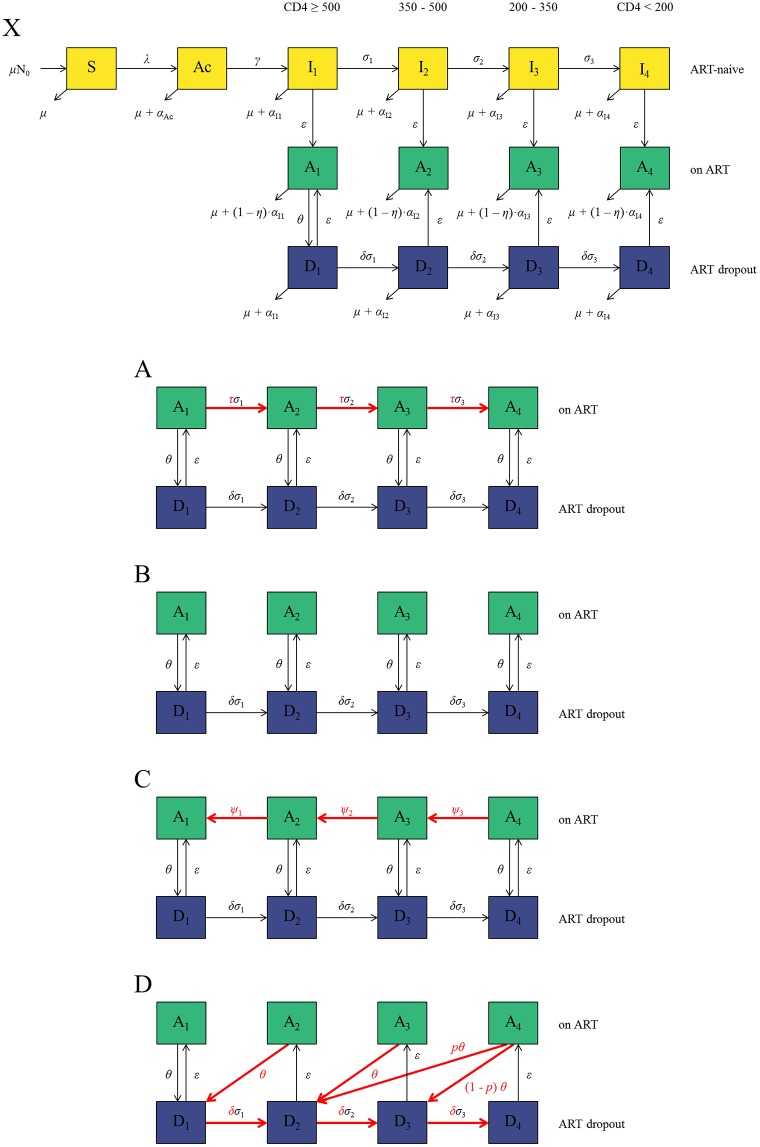
Methods: A new dynamic model of HIV transmission among men who have sex with men (MSM) was developed, which incorporated each of four alternative assumptions about disease progression used in previous models: (A) ART slows disease progression; (B) ART halts disease progression; (C) ART reverses disease progression by increasing CD4 count; (D) ART reverses disease progression, but disease progresses rapidly once treatment is stopped. The model was independently calibrated to HIV prevalence and ART coverage data from the United States under each progression assumption in turn. New HIV infections and HIV-related deaths averted over 10 years were compared for fixed ART coverage increases.

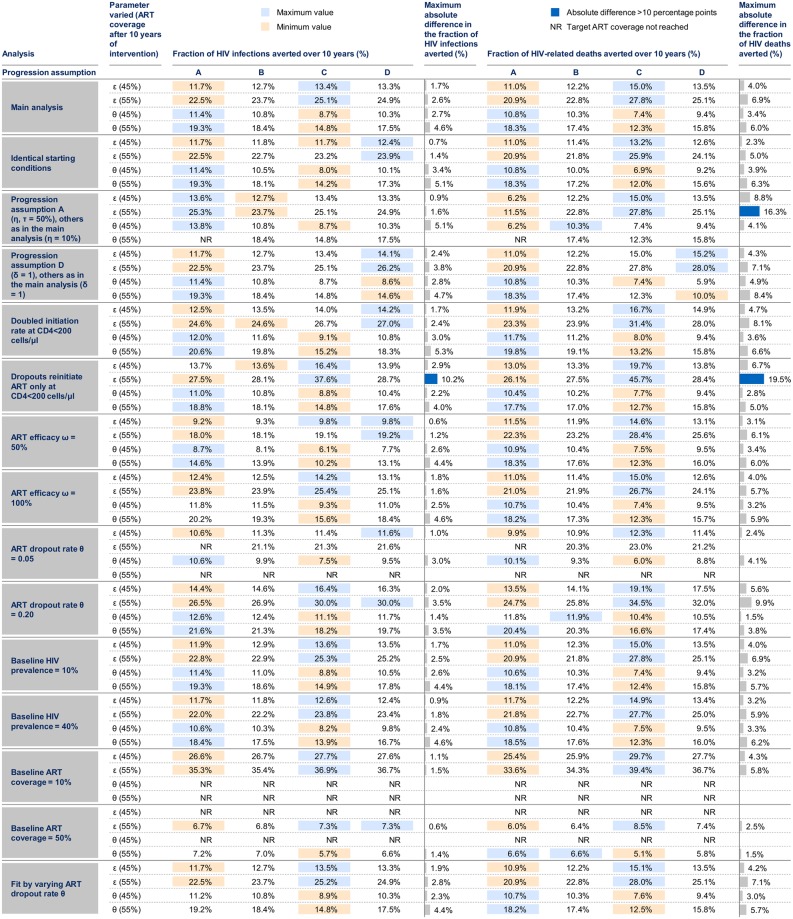
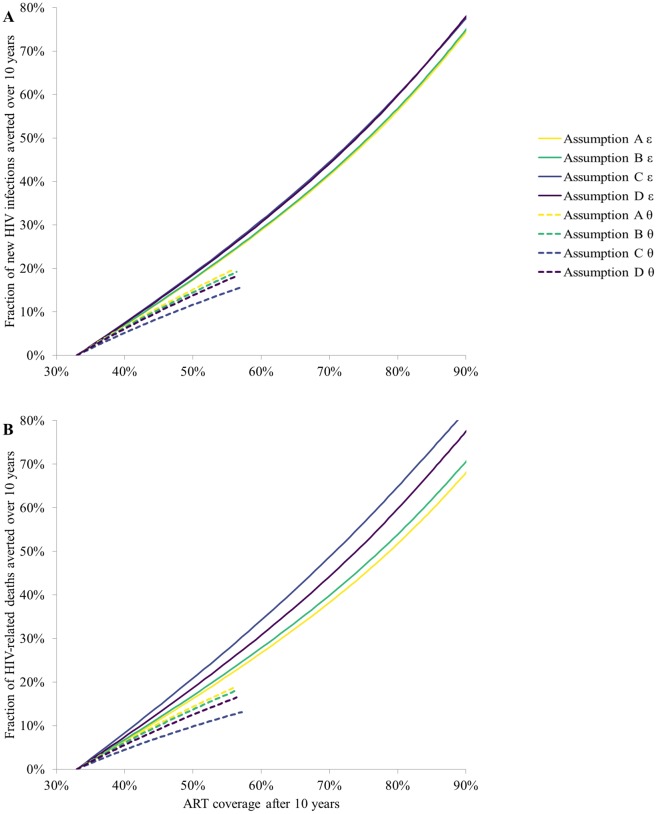
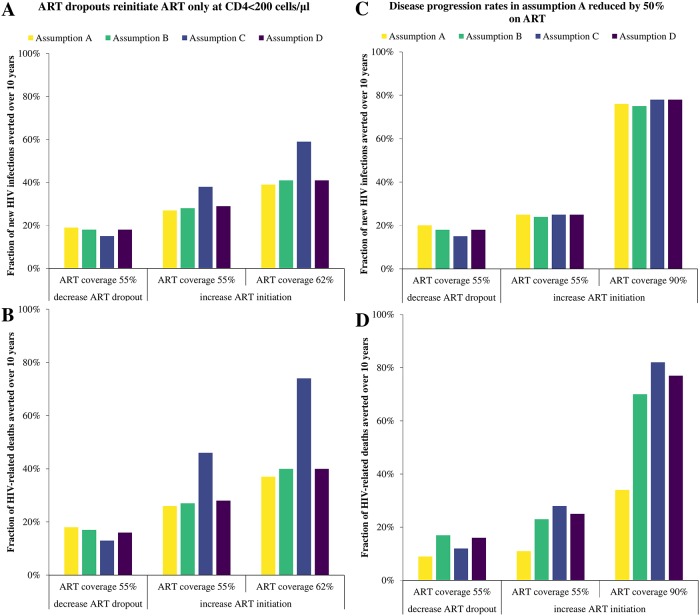
Results: Little absolute difference (<7 percentage points (pp)) in HIV infections averted over 10 years was seen between progression assumptions for the same increases in ART coverage (varied between 33% and 90%) if ART dropouts reinitiated ART at the same rate as ART-naïve MSM. Larger differences in the predicted fraction of HIV-related deaths averted were observed (up to 15pp). However, if ART dropouts could only reinitiate ART at CD4<200 cells/μl, assumption C predicted substantially larger fractions of HIV infections and deaths averted than other assumptions (up to 20pp and 37pp larger, respectively).

Conclusion: Different disease progression assumptions on and post-ART interruption did not affect the fraction of HIV infections averted with expanded ART, unless ART dropouts only re-initiated ART at low CD4 counts. Different disease progression assumptions had a larger influence on the fraction of HIV-related deaths averted with expanded ART.


Conflict of interest statement

Competing Interests: The authors have declared that no competing interests exist.

Figures

Fig 1
Fig 1. Model diagrams.
X) General model structure showing only what is consistent across all progression assumptions, A, B, C, and D. The following model diagrams show only the ART compartments (Ai) and ART dropout compartments (Di) and do not show mortality. Key differences are highlighted in red. A) Progression assumption A: ART reduces disease progression rate (σi) by a factor τ while ART dropouts progress at the same rate as ART-naive individuals (δ = 1). B) Progression assumption B: There is no movement between ART compartments; prognosis depends on CD4 at ART initiation. C) Progression assumption C: ART patients progress to higher CD4 categories over time at a per-capita rate ψi and the rest is as in progression assumption A. D) Progression assumption D: As in assumption B, there is no movement between ART compartments. However, upon dropping out of ART, individuals move to a higher CD4 category (reflecting improvement in CD4 count on ART) but then progress at an increased rate compared to ART-naive individuals (δ>1; reflecting the rapid CD4 decline which occurs after dropping out of ART).
Fig 2
Fig 2. Summary of results.
Each model reaches the specified ART coverage target (in brackets) 10 years after the intervention, which is achieved by either increasing the ART uptake rate (ε) or decreasing the ART dropout rate (θ). Maximum absolute differences are the differences between the minimum and maximum estimates across progression assumptions; these are only calculated when estimates are available for all 4 progression assumptions. Blue bars indicate that the absolute difference between progression assumptions in the fraction averted is greater than 10 percentage points. NR: the target ART coverage could not be reached for this progression assumption and the specified intervention.
Fig 3
Fig 3. Projections from progression assumptions A-D.
A) The fraction of HIV infections averted and B) The fraction of HIV-related deaths averted over the 10 year period when increasing ART uptake rate (ε, solid lines) or decreasing ART dropout rate (θ, dashed lines) to obtain final ART coverage shown.
Fig 4
Fig 4. Sensitivity analysis—ART dropouts reinitiate ART only at CD4<200 cells/μl.
A) The fraction of HIV infections averted and B) The fraction of HIV-related deaths averted over the 10 year period when ART initiation rate is increased or ART dropout rate is decreased to achieve a final ART coverage of 55% or 62%. HIV-attributable mortality and disease progression rates in assumption A reduced by 50% on ART vs. off ART instead of 90%: C) The fraction of HIV infections averted and D) The fraction of HIV-related deaths averted over the 10 year period when ART initiation rate is increased or ART dropout rate is decreased to achieve a final ART coverage of 55% or 90%.

References

    1. Samji H, Cescon A, Hogg RS, Modur SP, Althoff KN, Buchacz K, et al. Closing the Gap: Increases in Life Expectancy among Treated HIV-Positive Individuals in the United States and Canada. PloS one. 2013;8(12):e81355 10.1371/journal.pone.0081355 . - DOI - PMC - PubMed
    1. Cohen MS, Chen YQ, McCauley M, Gamble T, Hosseinipour MC, Kumarasamy N, et al. Prevention of HIV-1 infection with early antiretroviral therapy. The New England journal of medicine. 2011;365(6):493–505. 10.1056/NEJMoa1105243 . - DOI - PMC - PubMed
    1. Cohen MS, Chen YQ, McCauley M, Gamble T, Hosseinipour MC, Kumarasamy N, et al. Antiretroviral Therapy for the Prevention of HIV-1 Transmission. The New England Journal of Medicine. 2016;375(9):830–9. 10.1056/NEJMoa1600693 . - DOI - PMC - PubMed
    1. Rodger AJ, Cambiano V, Bruun T, Vernazza P, Collins S, Van Lunzen J, et al. Sexual activity without condoms and risk of hiv transmission in serodifferent couples when the hiv-positive partner is using suppressive antiretroviral therapy. The Journal of the American Medical Association. 2016;316(2):171–81. 10.1001/jama.2016.5148 - DOI - PubMed
    1. Granich RM, Gilks CF, Dye C, De Cock KM, Williams BG. Universal voluntary HIV testing with immediate antiretroviral therapy as a strategy for elimination of HIV transmission: a mathematical model. Lancet. 2009;373(9657):48–57. 10.1016/S0140-6736(08)61697-9 - DOI - PubMed

Publication types

Substances