Efficacy of Vaginal Estradiol or Vaginal Moisturizer vs Placebo for Treating Postmenopausal Vulvovaginal Symptoms: A Randomized Clinical Trial
- PMID: 29554173
- PMCID: PMC5885275
- DOI: 10.1001/jamainternmed.2018.0116
Efficacy of Vaginal Estradiol or Vaginal Moisturizer vs Placebo for Treating Postmenopausal Vulvovaginal Symptoms: A Randomized Clinical Trial
Abstract
Importance: Nearly half of postmenopausal women report bothersome vulvovaginal symptoms, but few data support the efficacy of 2 commonly recommended treatments.
Objective: To compare the efficacy of a low-dose vaginal estradiol tablet and a vaginal moisturizer, each vs placebo, for treatment of moderate-to-severe postmenopausal vulvovaginal symptoms.
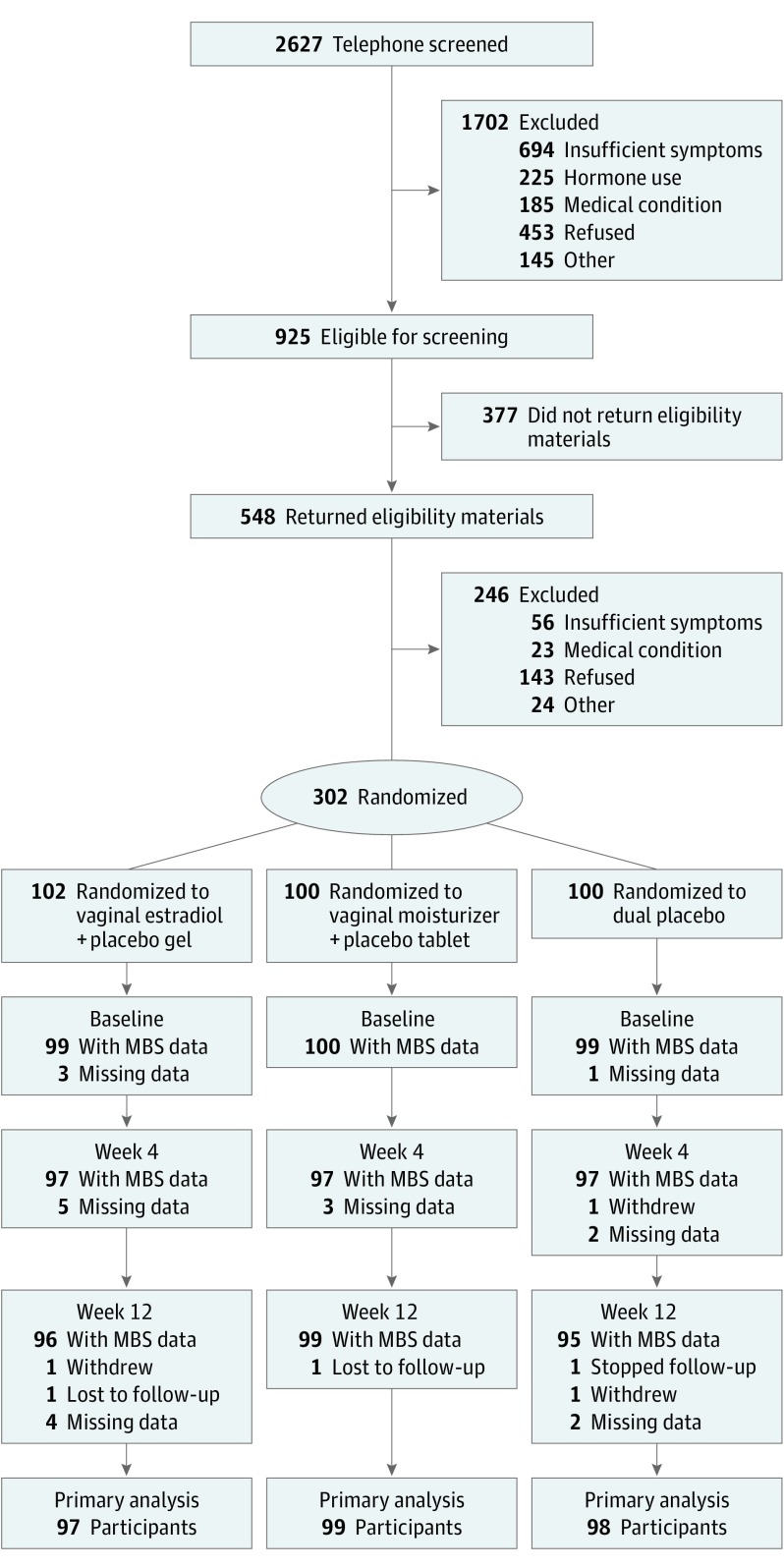
Design, setting, and participants: This 12-week multicenter randomized clinical trial enrolled postmenopausal women with moderate to severe symptoms of vulvovaginal itching, pain, dryness, irritation, or pain with penetration.
Interventions: Vaginal 10-μg estradiol tablet (daily for 2 weeks, then twice weekly) plus placebo gel (3 times a week) (n = 102) vs placebo tablet plus vaginal moisturizer (n = 100) vs dual placebo (n = 100).
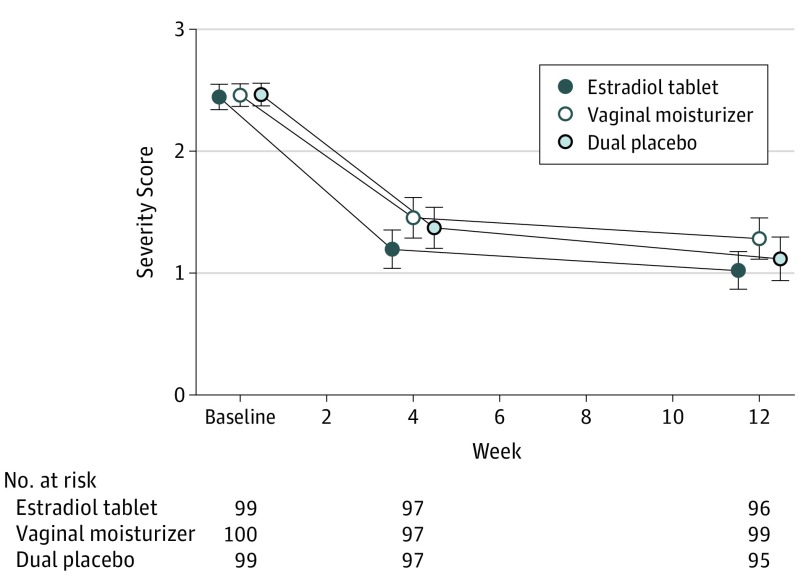
Main outcomes and measures: The main outcome was decrease in severity (0-3) of most bothersome symptom (MBS) between enrollment and 12 weeks. Additional measures included a composite vaginal symptom score, Female Sexual Function Index (FSFI) score (2-36), modified Female Sexual Distress Score-Revised item 1, treatment satisfaction and meaningful benefit, Vaginal Maturation Index, and vaginal pH.
Results: The 302 women had a mean (SD) age of 61 (4) years and were primarily white (267 [88%]), college educated (200 [66%]), and sexually active (245 [81%]). Most women (294 [97%]) provided data for the primary analysis. The most commonly reported MBS was pain with vaginal penetration (182 [60%]), followed by vulvovaginal dryness (63 [21%]). Mean baseline MBS severity was similar between treatment groups: estradiol, 2.4 (95% CI, 2.3 to 2.6); moisturizer, 2.5 (95% CI, 2.3 to 2.6); placebo, 2.5 (95% CI, 2.4 to 2.6). All treatment groups had similar mean reductions in MBS severity over 12 weeks: estradiol, -1.4 (95% CI, -1.6 to -1.2); moisturizer, -1.2 (95% CI, -1.4 to -1.0); and placebo, -1.3 (95% CI, -1.5 to -1.1). No significant differences were seen between estradiol (P = .25) or moisturizer (P = .31) compared with placebo. Mean total FSFI improvement was similar between estradiol (5.4; 95% CI, 4.0 to 6.9) and placebo (4.5; 95% CI, 2.8 to 6.1) (P = .64), and between moisturizer (3.1; 95% CI, 1.7 to 4.5) and placebo (P = .17).
Conclusions and relevance: Our results suggest that neither prescribed vaginal estradiol tablet nor over-the-counter vaginal moisturizer provides additional benefit over placebo vaginal tablet and gel in reducing postmenopausal vulvovaginal symptoms.
Trial registration: clinicaltrials.gov Identifier: NCT02516202.
Conflict of interest statement
Figures
Comment in
-
Rethinking the Approach to Managing Postmenopausal Vulvovaginal Symptoms.JAMA Intern Med. 2018 May 1;178(5):690-691. doi: 10.1001/jamainternmed.2018.0094. JAMA Intern Med. 2018. PMID: 29554180 No abstract available.
-
Treating vulvovaginal symptoms.Nat Rev Urol. 2018 Jun;15(6):336-337. doi: 10.1038/s41585-018-0010-4. Nat Rev Urol. 2018. PMID: 29662117 No abstract available.
-
Good Clinical Practice in Diagnosis of Vulvovaginal Symptoms.JAMA Intern Med. 2018 Aug 1;178(8):1135-1136. doi: 10.1001/jamainternmed.2018.2872. JAMA Intern Med. 2018. PMID: 30083733 No abstract available.
-
Good Clinical Practice in Diagnosis of Vulvovaginal Symptoms-Reply.JAMA Intern Med. 2018 Aug 1;178(8):1136-1137. doi: 10.1001/jamainternmed.2018.2856. JAMA Intern Med. 2018. PMID: 30083740 No abstract available.
-
Excerpts from the World Medical Literature.J Obstet Gynaecol Can. 2018 Oct;40(10):1277-1279. doi: 10.1016/j.jogc.2018.06.013. J Obstet Gynaecol Can. 2018. PMID: 30390941 No abstract available.
-
Re: Efficacy of Vaginal Estradiol or Vaginal Moisturizer vs Placebo for Treating Postmenopausal Vulvovaginal Symptoms:J Urol. 2019 Feb;201(2):232. doi: 10.1097/01.JU.0000553061.27785.95. J Urol. 2019. PMID: 30634346 No abstract available.
References
-
- DiBonaventura M, Luo X, Moffatt M, Bushmakin AG, Kumar M, Bobula J. The association between vulvovaginal atrophy symptoms and quality of life among postmenopausal women in the United States and western Europe. J Womens Health (Larchmt). 2015;24(9):713-722. - PubMed
-
- Minkin MJ, Reiter S, Maamari R. Prevalence of postmenopausal symptoms in North America and Europe. Menopause. 2015;22(11):1231-1238. - PubMed
-
- Santoro N, Komi J. Prevalence and impact of vaginal symptoms among postmenopausal women. J Sex Med. 2009;6(8):2133-2142. - PubMed
-
- Kingsberg SA, Wysocki S, Magnus L, Krychman ML. Vulvar and vaginal atrophy in postmenopausal women: findings from the REVIVE (Real Women’s Views of Treatment Options for Menopausal Vaginal Changes) survey. J Sex Med. 2013;10(7):1790-1799. - PubMed
-
- Nappi RE, Kokot-Kierepa M. Vaginal health: Insights, Views & Attitudes (VIVA)—results from an international survey. Climacteric. 2012;15(1):36-44. - PubMed
Publication types
MeSH terms
Substances
Associated data
Grants and funding
LinkOut - more resources
Full Text Sources
Other Literature Sources
Medical