


Prevalence and Correlates of Trichomonas vaginalis Infection Among Men and Women in the United States
- PMID: 29554238
- PMCID: PMC6031067
- DOI: 10.1093/cid/ciy079
Prevalence and Correlates of Trichomonas vaginalis Infection Among Men and Women in the United States
Abstract
Background: The epidemiology of Trichomonas vaginalis (TV) infection in the United States is poorly defined.
Methods: Males and females aged 18-59 years who participated in the 2013-2014 National Health and Nutrition Examination Survey and provided a urine specimen were tested for TV infection (n = 4057). Participants were also examined for Chlamydia trachomatis (CT) infection, genital human papillomavirus (HPV) infection, and herpes simplex virus type 2 serostatus. Weighted adjusted prevalence ratios (aPRs) were estimated by multivariable Poisson regression.
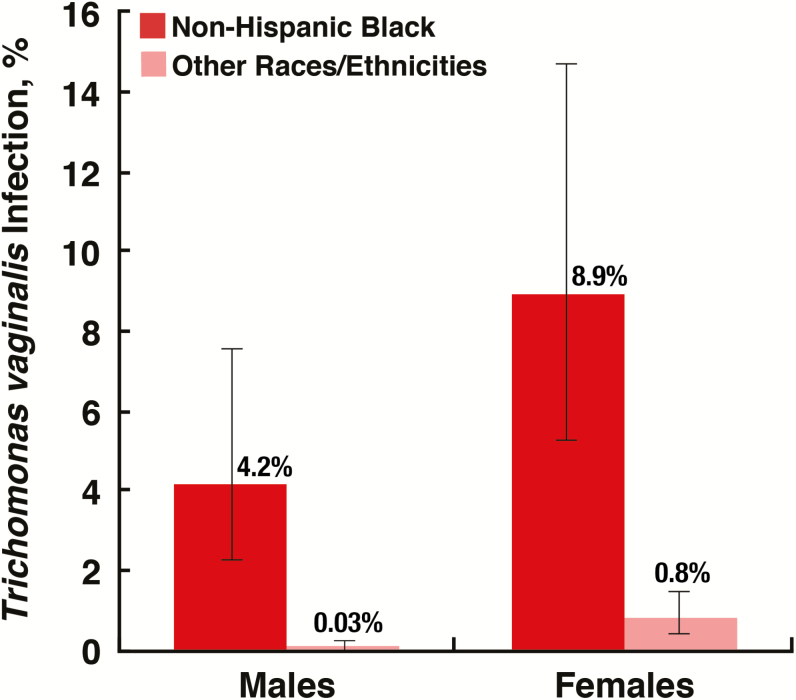
Results: TV infection prevalence was 0.5% and 1.8% among males and females, respectively. TV infection prevalence was 4.2% among black males, 8.9% among black females, and 0.03% and 0.8%, respectively, among males and females of other races/ethnicities. TV infection prevalence (aPR [95% confidence interval]) was positively associated with female sex (6.1 [3.3-11.3]), black race (vs other races/ethnicities; 7.9 [3.9-16.1]), older age (vs 18-24 years; 3.0 [1.2-7.1] for 25- to 39-year-olds and 3.5 [1.3-9.4] for 40- to 59-year-olds), having less than a high school education (vs completing high school or more; 2.0 [1.0-4.1]), being below the poverty level (vs at or above the poverty level; 4.0 [2.1-7.7]), and having ≥2 sexual partners in the past year (vs 0-1 sexual partners; 3.6 [2.0-6.6]). There were no TV and CT coinfections. Genital HPV detection was not independently associated with TV infection. Among persons aged 18-39 years, there was a significant racial disparity in all sexually transmitted infections examined, and this disparity was greatest for TV infection.
Conclusions: There is a high and disproportionate burden of urinary TV infection in the adult civilian, noninstitutionalized black population in the United States that warrants intervention.
Figures
Comment in
-
Why Does Trichomonas vaginalis Continue to be a "Neglected" Sexually Transmitted Infection?Clin Infect Dis. 2018 Jul 2;67(2):218-220. doi: 10.1093/cid/ciy085. Clin Infect Dis. 2018. PMID: 29554227 Free PMC article. No abstract available.
References
-
- World Health Organization. Sexually transmitted infections Available at: http://www.who.int/mediacentre/factsheets/fs110/en/. Accessed 29 August 2017.
-
- Sutton M, Sternberg M, Koumans EH, McQuillan G, Berman S, Markowitz L. The prevalence of Trichomonas vaginalis infection among reproductive-age women in the United States, 2001–2004. Clin Infect Dis 2007; 45:1319–26. - PubMed
Publication types
MeSH terms
Grants and funding
LinkOut - more resources
Full Text Sources
Other Literature Sources
Medical
Miscellaneous
