


Isoflurane but Not Halothane Prevents and Reverses Helpless Behavior: A Role for EEG Burst Suppression?
- PMID: 29554264
- PMCID: PMC6070045
- DOI: 10.1093/ijnp/pyy029
Isoflurane but Not Halothane Prevents and Reverses Helpless Behavior: A Role for EEG Burst Suppression?
Abstract
Background: The volatile anesthetic isoflurane may exert a rapid and long-lasting antidepressant effect in patients with medication-resistant depression. The mechanism underlying the putative therapeutic actions of the anesthetic have been attributed to its ability to elicit cortical burst suppression, a distinct EEG pattern with features resembling the characteristic changes that occur following electroconvulsive therapy. It is currently unknown whether the antidepressant actions of isoflurane are shared by anesthetics that do not elicit cortical burst suppression.
Methods: In vivo electrophysiological techniques were used to determine the effects of isoflurane and halothane, 2 structurally unrelated volatile anesthetics, on cortical EEG. The effects of anesthesia with either halothane or isoflurane were also compared on stress-induced learned helplessness behavior in rats and mice.
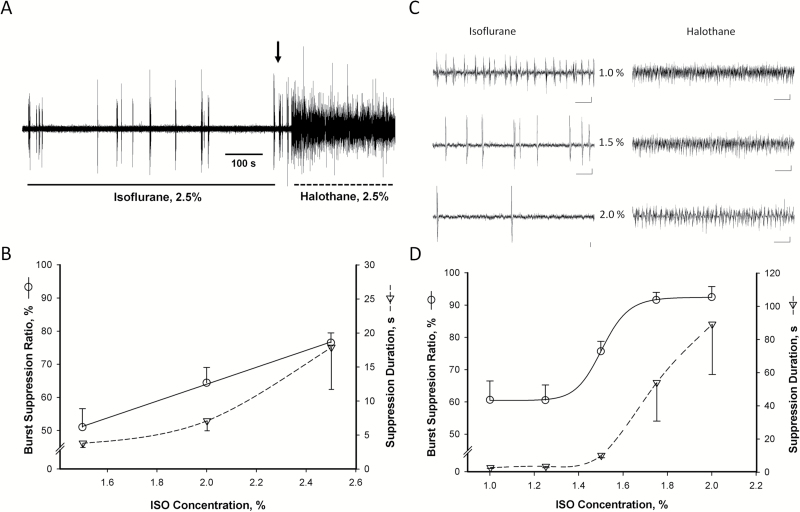
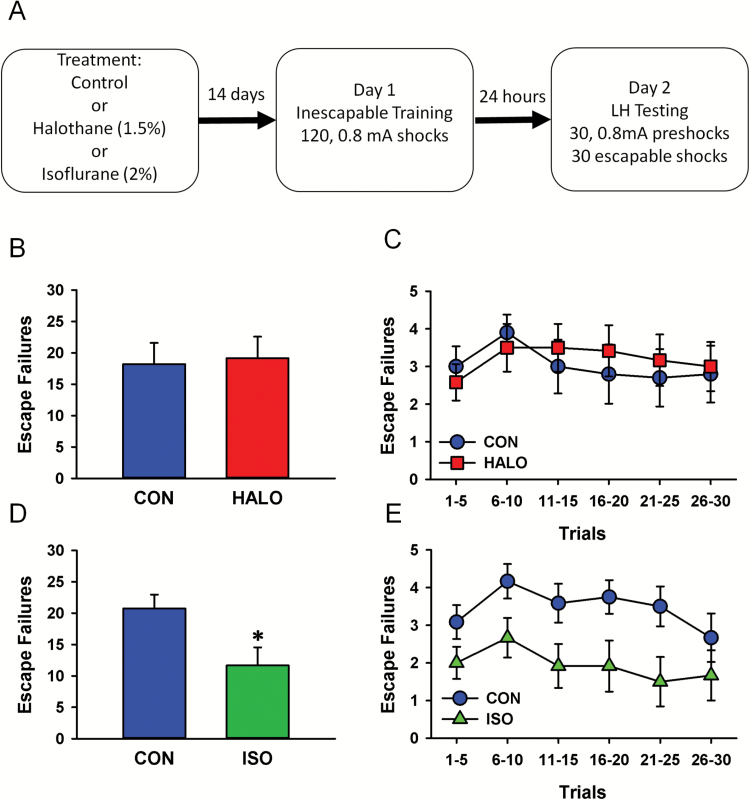
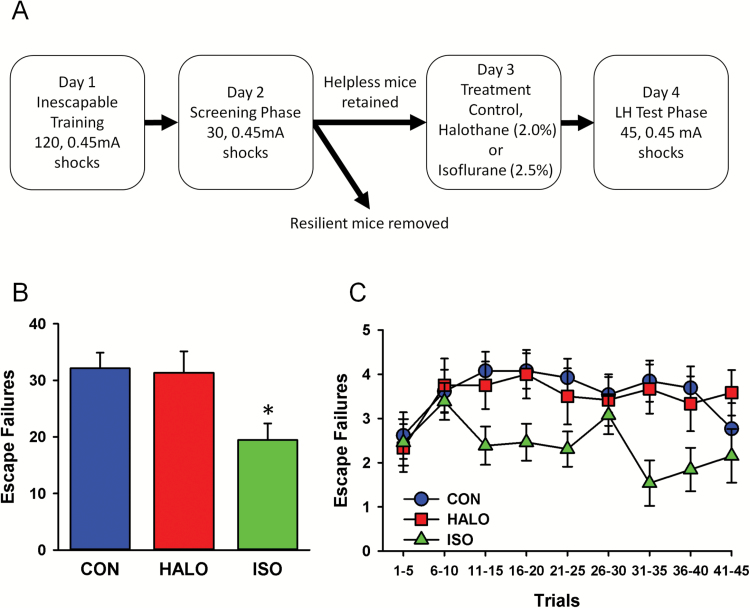
Results: Isoflurane, but not halothane, anesthesia elicited a dose-dependent cortical burst suppression EEG in rats and mice. Two hours of isoflurane, but not halothane, anesthesia reduced the incidence of learned helplessness in rats evaluated 2 weeks following exposure. In mice exhibiting a learned helplessness phenotype, a 1-hour exposure to isoflurane, but not halothane, reversed escape failures 24 hours following burst suppression anesthesia.
Conclusions: These results are consistent with a role for cortical burst suppression in mediating the antidepressant effects of isoflurane. They provide rationale for additional mechanistic studies in relevant animal models as well as a properly controlled clinical evaluation of the therapeutic benefits associated with isoflurane anesthesia in major depressive disorder.
Keywords: electroconvulsive therapy; fast-acting antidepressant; halothane; learned helplessness; treatment-resistant depression.
© The Author(s) 2018. Published by Oxford University Press on behalf of CINP.
Figures
References
-
- Algotsson L, Messeter K, Nordström CH, Ryding E(1988)Cerebral blood flow and oxygen consumption during isoflurane and halothane anesthesia in man. Acta Anaesthesiol Scand 32:15–20. - PubMed
-
- Amzica F, Kroeger D(2011)Cellular mechanisms underlying EEG waveforms during coma. Epilepsia 52:25–27. - PubMed
-
- Azuma H, Fujita A, Sato K, Arahata K, Otsuki K, Hori M, Mochida Y, Uchida M, Yamada T, Akechi T, Furukawa TA(2007)Postictal suppression correlates with therapeutic efficacy for depression in bilateral sine and pulse wave electroconvulsive therapy. Psychiatry Clin Neurosci 61:168–173. - PubMed
Publication types
MeSH terms
Substances
Grants and funding
LinkOut - more resources
Full Text Sources
Other Literature Sources
Medical
