


Impaired social behaviors and minimized oxytocin signaling of the adult mice deficient in the N-methyl-d-aspartate receptor GluN3A subunit
- PMID: 29554474
- PMCID: PMC5955859
- DOI: 10.1016/j.expneurol.2018.02.015
Impaired social behaviors and minimized oxytocin signaling of the adult mice deficient in the N-methyl-d-aspartate receptor GluN3A subunit
Abstract
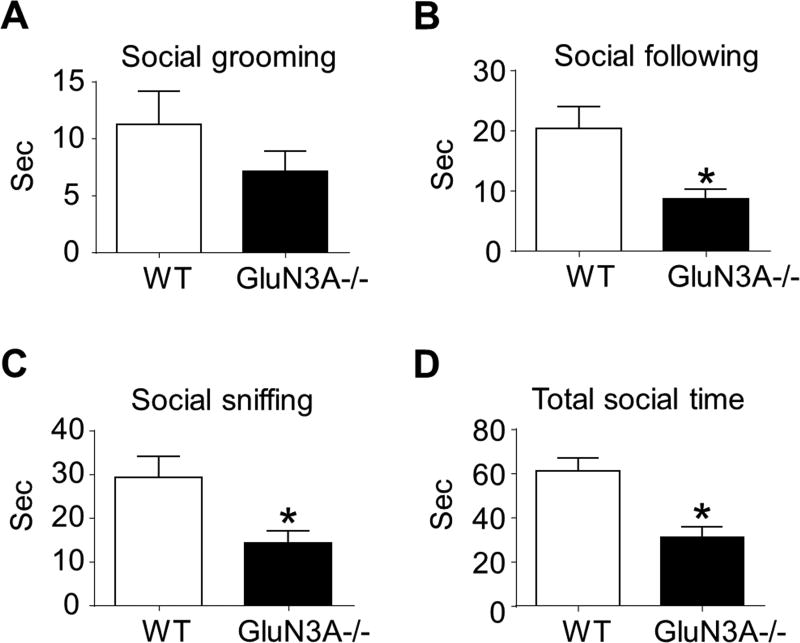
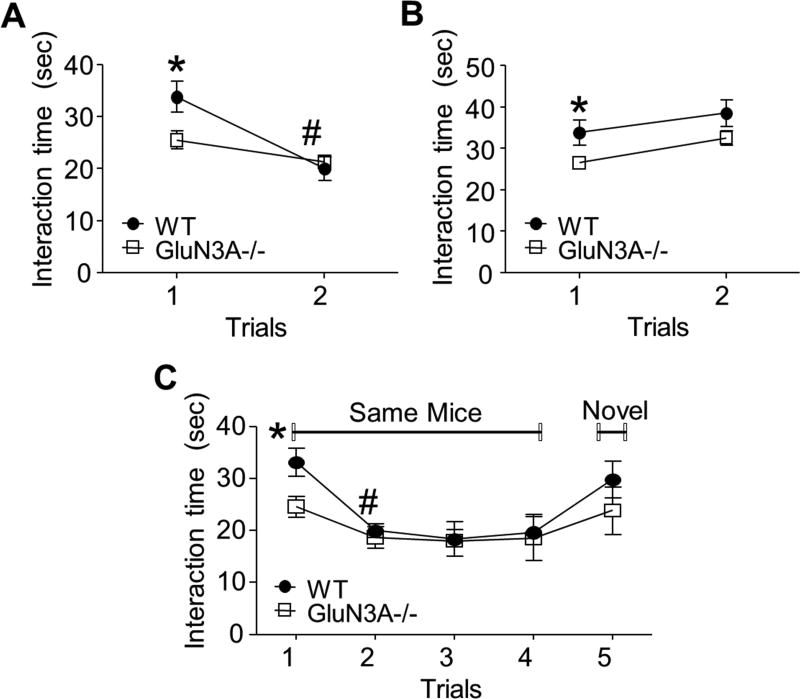
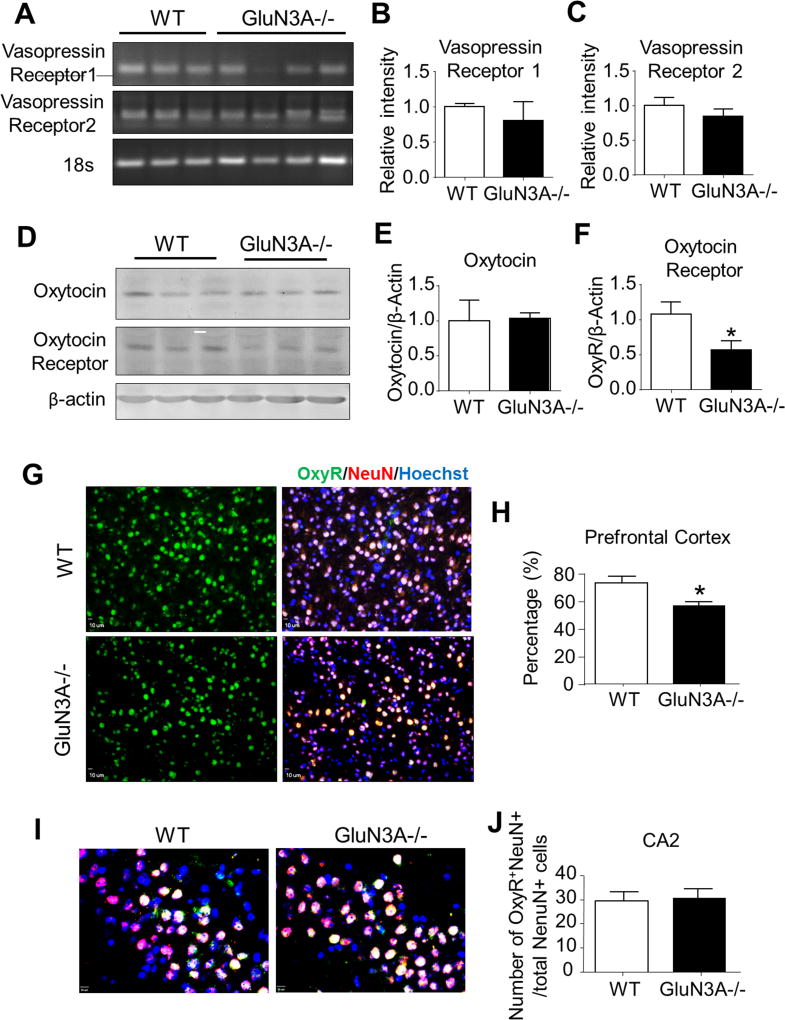
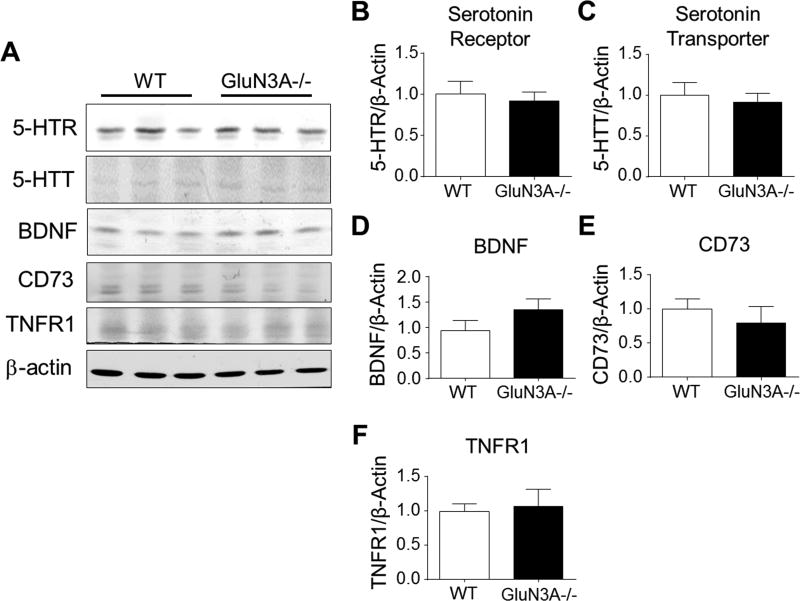
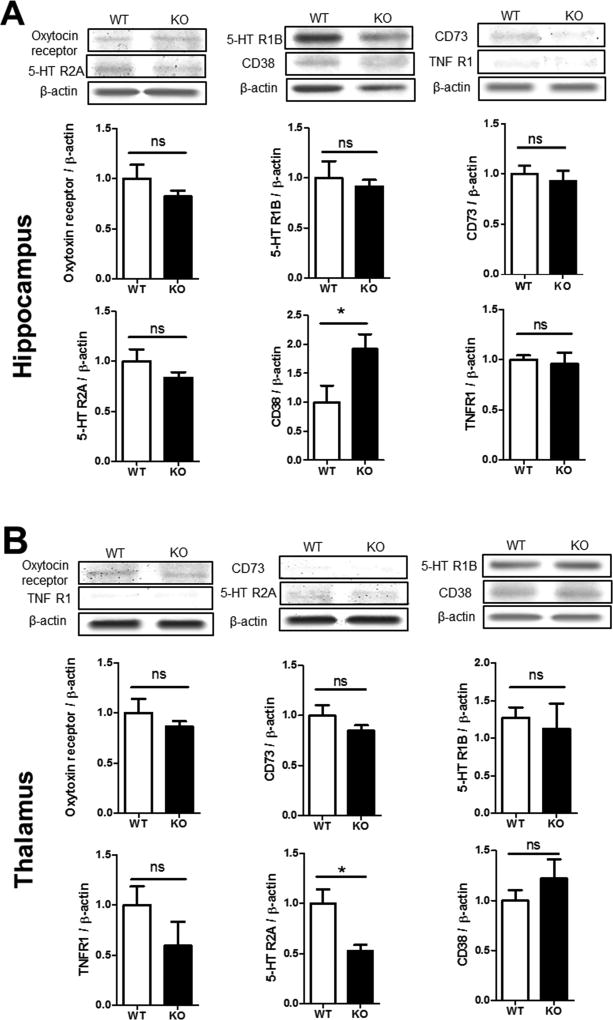
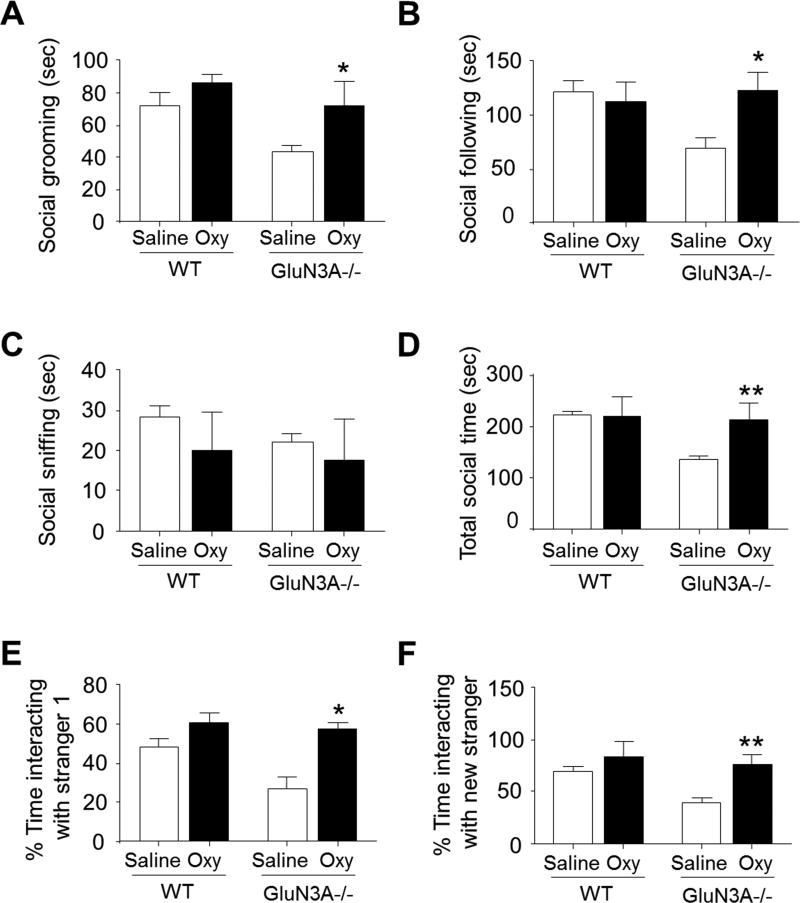
The N-methyl-d-aspartate receptor (NMDAR) has been implicated in the pathophysiology of neurological diseases, such as schizophrenia, autism spectrum disorders (ASD), and Alzheimer's disease (AD), whose unique clinical hallmark is a constellation of impaired social and/or cognitive behaviors. GluN3A (NR3A) is a unique inhibitory subunit in the NMDAR complex. The role of GluN3A in social behavioral activities is obscure. In this study, we sought to evaluate altered social activities in adult GluN3A knockout (KO) mice. GluN3A KO mice spent less time in reciprocal social interaction in the social interaction test compared to wild-type (WT) mice. A social approach test using a three-chamber system confirmed that mice lacking GluN3A had lower sociability and did not exhibit a preference for social novelty. GluN3A KO mice displayed abnormal food preference in the social transmission of food preference task and low social interaction activity in the five-trial social memory test, but without social memory deficits. Using a home cage monitoring system, we observed reduced social grooming behavior in GluN3A KO mice. Signaling genes that might mediate the altered social behaviors were examined in the prefrontal cortex, hippocampus, and thalamus. Among nine genes examined, the expression of the oxytocin receptor was significantly lower in the prefrontal cortex of GluN3A KO mice than that in WT mice. Oxytocin treatment rescued social activity deficits in GluN3A KO mice. These findings support a novel idea that a chronic state of moderate increases in NMDAR activities may lead to downregulation of the oxytocin signaling and impaired behavioral activities that are seen in psychiatric/neurodegenerative disorders.
Keywords: GluN3A; NR3A; Oxytocin signaling; Social behaviors.
Copyright © 2018 Elsevier Inc. All rights reserved.
Conflict of interest statement
Authors declare no conflict of interest associated with this investigation.
Figures

References
-
- Akillioglu K, Binokay S, Kocahan S. The effect of neonatal N-methyl-D-aspartate receptor blockade on exploratory and anxiety-like behaviors in adult BALB/c and C57BL/6 mice. Behav Brain Res. 2012;233:157–161. - PubMed
-
- Al-Hallaq RA, Jarabek BR, Fu Z, Vicini S, Wolfe BB, Yasuda RP. Association of NR3A with the N-methyl-D-aspartate receptor NR1 and NR2 subunits. Mol Pharmacol. 2002;62:1119–1127. - PubMed
-
- Alvarez P, Wendelken L, Eichenbaum H. Hippocampal formation lesions impair performance in an odor-odor association task independently of spatial context. Neurobiol Learn Mem. 2002;78:470–476. - PubMed
-
- Anderson SW, Bechara A, Damasio H, Tranel D, Damasio AR. Impairment of social and moral behavior related to early damage in human prefrontal cortex. Nature Neurosci. 1999;2:1032–1037. - PubMed
Publication types
MeSH terms
Substances
Grants and funding
LinkOut - more resources
Full Text Sources
Other Literature Sources
Molecular Biology Databases
Research Materials
