


Comparison of Septic Shock Due to Multidrug-Resistant Acinetobacter baumannii or Klebsiella pneumoniae Carbapenemase-Producing K. pneumoniae in Intensive Care Unit Patients
- PMID: 29555630
- PMCID: PMC5971575
- DOI: 10.1128/AAC.02562-17
Comparison of Septic Shock Due to Multidrug-Resistant Acinetobacter baumannii or Klebsiella pneumoniae Carbapenemase-Producing K. pneumoniae in Intensive Care Unit Patients
Abstract
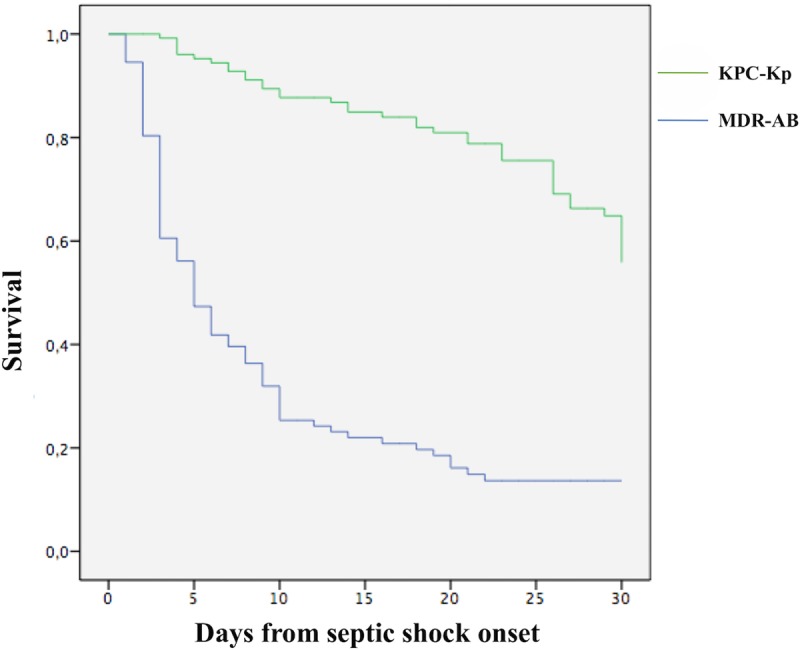
A significant cause of mortality in the intensive care unit (ICU) is multidrug-resistant (MDR) Gram-negative bacteria, such as MDR Acinetobacter baumannii (MDR-AB) and Klebsiella pneumoniae carbapenemase-producing K. pneumoniae (KPC-Kp). The aim of the present study was to compare the clinical features, therapy, and outcome of patients who developed septic shock due to either MDR-AB or KPC-Kp. We retrospectively analyzed patients admitted to the ICU of a teaching hospital from November 2010 to December 2015 who developed septic shock due to MDR-AB or KPC-Kp infection. Data from 220 patients were analyzed: 128 patients (58.2%) were diagnosed with septic shock due to KPC-Kp, and 92 patients (41.8%) were diagnosed with septic shock due to MDR-AB. The 30-day mortality rate was significantly higher for the MDR-AB group than the KPC-Kp group (84.8% versus 44.5%, respectively; P < 0.001). Steroid exposure and pneumonia were associated with MDR-AB infection, whereas hospitalization in the previous 90 days, primary bacteremia, and KPC-Kp colonization were associated with KPC-Kp infection. For patients with KPC-Kp infections, the use of ≥2 in vitro-active antibiotics as empirical or definitive therapy was associated with higher 30-day survival, while isolation of colistin-resistant strains was linked to mortality. Patients with MDR-AB infections, age >60 years, and a simplified acute physiology score II (SAPS II) of >45 points were associated with increased mortality rates. We concluded that septic shock due to MDR-AB infection is associated with very high mortality rates compared to those with septic shock due to KPC-Kp. Analysis of the clinical features of these critically ill patients might help physicians in choosing appropriate empirical antimicrobial therapy.
Keywords: Acinetobacter; Klebsiella; intensive care unit; multidrug resistant; septic shock.
Copyright © 2018 American Society for Microbiology.
Figures
References
-
- Levy MM, Artigas A, Phillips GS, Rhodes A, Beale R, Osborn T, Vincent JL, Townsend S, Lemeshow S, Dellinger RP. 2012. Outcomes of the Surviving Sepsis Campaign in intensive care units in the USA and Europe: a prospective cohort study. Lancet Infect Dis 12:919–924. doi: 10.1016/S1473-3099(12)70239-6. - DOI - PubMed
-
- Perez F, Endimiani A, Ray AJ, Decker BK, Wallace CJ, Hujer KM, Ecker DJ, Adams MD, Toltzis P, Dul MJ, Windau A, Bajaksouzian S, Jacobs MR, Salata RA, Bonomo RA. 2010. Carbapenem-resistant Acinetobacter baumannii and Klebsiella pneumoniae across a hospital system: impact of post-acute care facilities on dissemination. J Antimicrob Chemother 65:1807–1818. doi: 10.1093/jac/dkq191. - DOI - PMC - PubMed
MeSH terms
Substances
LinkOut - more resources
Full Text Sources
Other Literature Sources
