


Actions of pituitary hormones beyond traditional targets
- PMID: 29555849
- PMCID: PMC5924585
- DOI: 10.1530/JOE-17-0680
Actions of pituitary hormones beyond traditional targets
Abstract
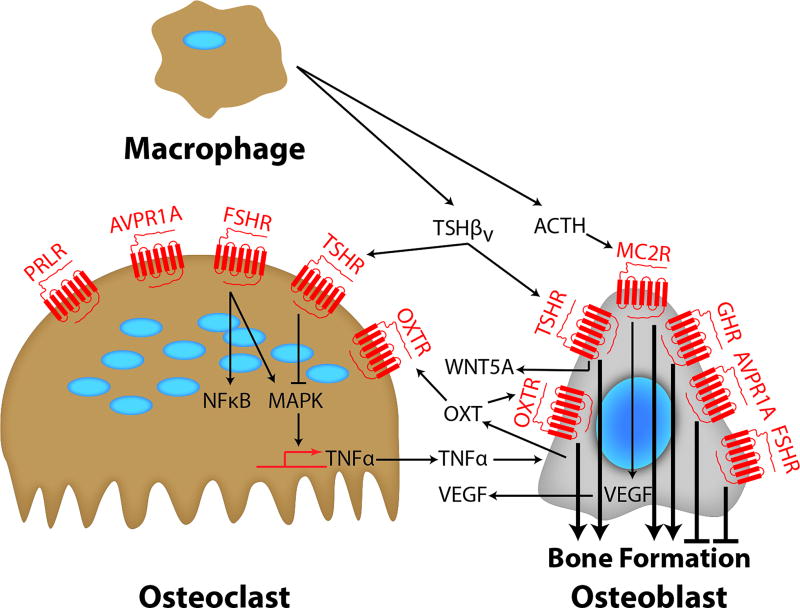
Studies over the past decade have challenged the long-held belief that pituitary hormones have singular functions in regulating specific target tissues, including master hormone secretion. Our discovery of the action of thyroid-stimulating hormone (TSH) on bone provided the first glimpse into the non-traditional functions of pituitary hormones. Here we discuss evolving experimental and clinical evidence that growth hormone (GH), follicle-stimulating hormone (FSH), adrenocorticotrophic hormone (ACTH), prolactin, oxytocin and arginine vasopressin (AVP) regulate bone and other target tissues, such as fat. Notably, genetic and pharmacologic FSH suppression increases bone mass and reduces body fat, laying the framework for targeting the FSH axis for treating obesity and osteoporosis simultaneously with a single agent. Certain 'pituitary' hormones, such as TSH and oxytocin, are also expressed in bone cells, providing local paracrine and autocrine networks for the regulation of bone mass. Overall, the continuing identification of new roles for pituitary hormones in biology provides an entirely new layer of physiologic circuitry, while unmasking new therapeutic targets.
Keywords: adrenocorticotropic hormone; follicle-stimulating hormone; growth hormone; oxytocin; vasopressin.
© 2018 Society for Endocrinology.
Figures
References
-
- Abe E, Marians RC, Yu W, Wu XB, Ando T, Li Y, Iqbal J, Eldeiry L, Rajendren G, Blair HC, et al. TSH is a negative regulator of skeletal remodeling. Cell. 2003;115:151–162. - PubMed
-
- Abrahamsen B, Jorgensen HL, Laulund AS, Nybo M, Bauer DC, Brix TH, Hegedus L. The excess risk of major osteoporotic fractures in hypothyroidism is driven by cumulative hyperthyroid as opposed to hypothyroid time: an observational register-based time-resolved cohort analysis. Journal of Bone and Mineral Research. 2015;30:898–905. - PubMed
-
- Abrahamsen B, Jorgensen HL, Laulund AS, Nybo M, Brix TH, Hegedus L. Low serum thyrotropin level and duration of suppression as a predictor of major osteoporotic fractures-the OPENTHYRO register cohort. Journal of Bone and Mineral Research. 2014;29:2040–2050. - PubMed
-
- Acar B, Ozay AC, Ozay OE, Okyay E, Sisman AR, Ozaksoy D. Evaluation of thyroid function status among postmenopausal women with and without osteoporosis. International Journal of Gynecology & Obstetrics. 2016;134:53–57. - PubMed
-
- Adami S, Bianchi G, Brandi ML, Giannini S, Ortolani S, DiMunno O, Frediani B, Rossini M. group Bs. Determinants of bone turnover markers in healthy premenopausal women. Calcified Tissue International. 2008;82:341–347. - PubMed
Publication types
MeSH terms
Substances
Grants and funding
LinkOut - more resources
Full Text Sources
Other Literature Sources
Miscellaneous
