


Pupil dilation tracks the dynamics of mnemonic interference resolution
- PMID: 29556091
- PMCID: PMC5859100
- DOI: 10.1038/s41598-018-23297-3
Pupil dilation tracks the dynamics of mnemonic interference resolution
Erratum in
-
Publisher Correction: Pupil dilation tracks the dynamics of mnemonic interference resolution.Sci Rep. 2020 Jan 10;10(1):317. doi: 10.1038/s41598-019-55183-x. Sci Rep. 2020. PMID: 31924804 Free PMC article.
Abstract
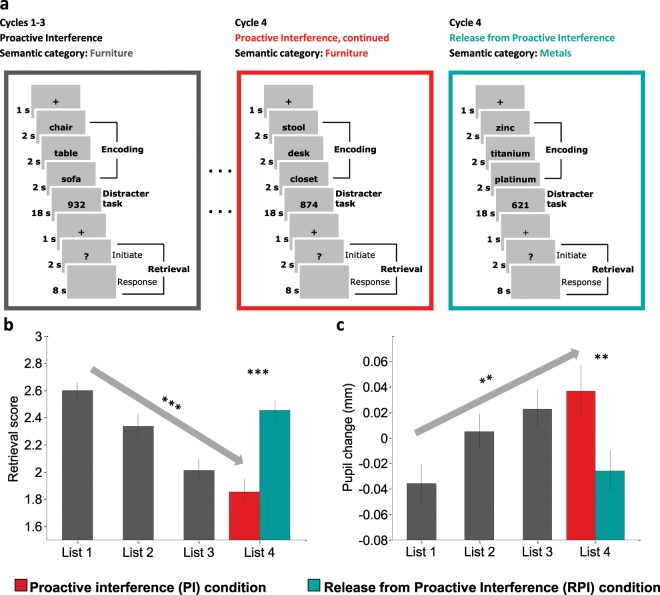
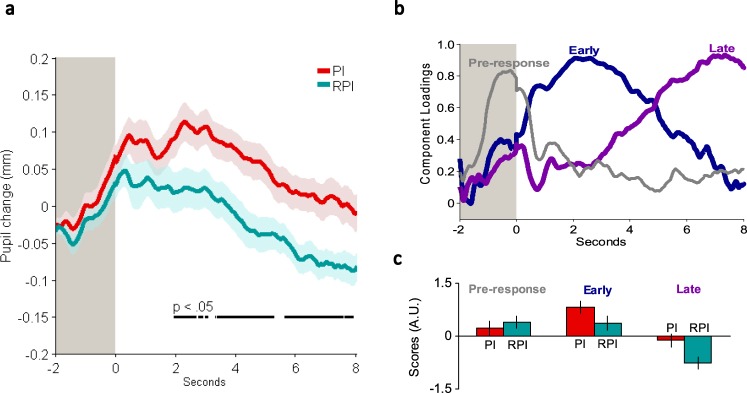
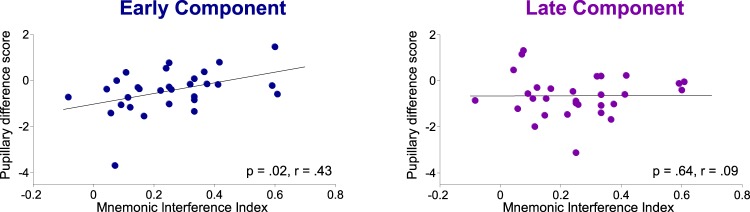
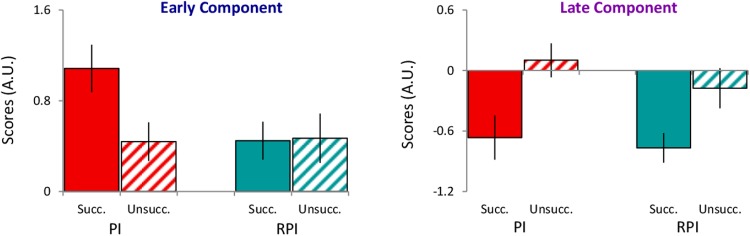
Mnemonic interference refers to the inability to retrieve a goal-relevant memory due to interference from goal-irrelevant memories. Understanding the causes of such interference and how it is overcome has been a central goal in the science of memory for more than a century. Here, we shed new light on this fundamental issue by tracking participants' pupil response when they encode and retrieve memories in the face of competing goal-irrelevant memories. We show that pupil dilation systematically increased in accordance with interference from competing memory traces when participants retrieved previously learned information. Moreover, our results dissociate two main components in the pupillary response signal: an early component, which peaked in a time window where the pupillary waveform on average had its maximum peak, and a late component, which peaked towards the end of the retrieval task. We provide evidence that the early component is specifically modulated by the cognitive effort needed to handle interference from competing memory traces whereas the late component reflects general task engagement. This is the first demonstration that mnemonic interference resolution can be tracked online in the pupil signal and offers novel insight into the underlying dynamics.
Conflict of interest statement
The authors declare no competing interests.
Figures
References
-
- Anderson, M. C. & Neely, J. H. Interference and inhibition in memory retrieval. Memory: Handbook of perception and cognition (eds. Bjork, E. L., & Bjork, R. A.) 237–™313 (Academic Press, 1996).
-
- Crowder, R. G. Principles of learning and memory (Erlbaum, 1976).
-
- Underwood BJ. Interference and forgetting. Psychol. Rev. 1957;64:49–60. - PubMed
-
- Wickens DD. Encoding categories of words: An empirical approach to meaning. Psychol. Rev. 1970;77:1–15.
-
- Watkins OC, Watkins MJ. Buildup of proactive inhibition as a cue-overload effect. J. Exp. Psychol. Hum. Learn. Mem. 1975;1:442–452.
Publication types
MeSH terms
LinkOut - more resources
Full Text Sources
Other Literature Sources
Medical
