Identification of sarilumab pharmacodynamic and predictive markers in patients with inadequate response to TNF inhibition: a biomarker substudy of the phase 3 TARGET study
- PMID: 29556418
- PMCID: PMC5856917
- DOI: 10.1136/rmdopen-2017-000607
Identification of sarilumab pharmacodynamic and predictive markers in patients with inadequate response to TNF inhibition: a biomarker substudy of the phase 3 TARGET study
Abstract
Introduction: Interleukin-6 (IL-6) orchestrates formation of an inflammatory pannus, leading to joint damage in rheumatoid arthritis (RA). Sarilumab is a human monoclonal antibody blocking the IL-6Rα. In TARGET (NCT01709578), a phase 3 study in adults with moderate-to-severe RA and inadequate response or intolerance to tumour necrosis factor inhibitors, subcutaneous sarilumab 200 mg or 150 mg every 2 weeks (q2w) plus conventional synthetic disease-modifying antirheumatic drugs (csDMARDs) significantly reduced disease activity versus placebo plus csDMARDs.
Methods: Circulating levels of biomarkers associated with synovial inflammation (matrix metalloproteinase 3 (MMP-3), collagen type I MMP-cleaved fragment (C1M), collagen type III MMP-cleaved fragment (C3M)), myeloid (soluble intercellular adhesion molecule 1 (sICAM-1), IL-8 and calprotectin) and lymphoid activation (chemokine, CXC motif, ligand 13 (CXCL13), CXCL10, B cell-activating factor) and bone remodelling (receptor activator of nuclear factor-κB ligand (RANKL), osteoprotegerin and osteocalcin) were evaluated in patients from a TARGET substudy.
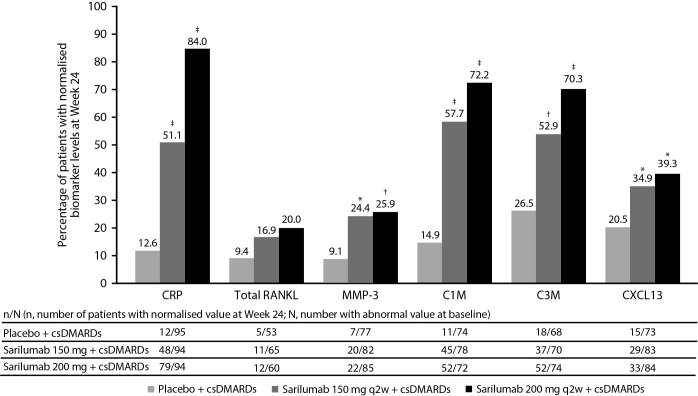
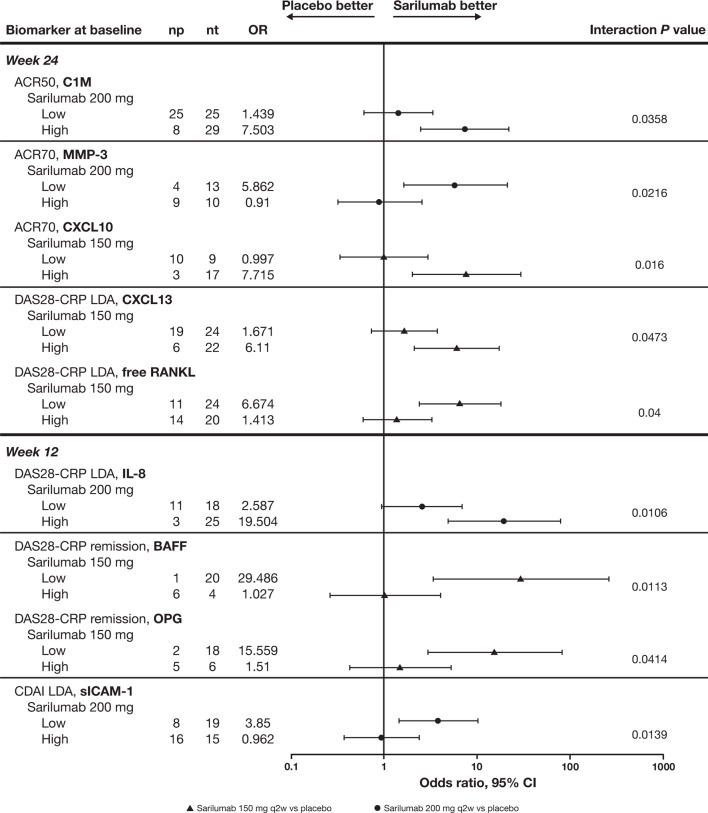
Results: Sarilumab significantly decreased C1M, C3M, CXCL13, MMP-3 and total RANKL levels at week 24 versus placebo; some markers were significantly suppressed at week 2 and normalised to levels in healthy controls. Levels of sICAM-1 were predictive of disease activity score by C-reactive protein and clinical disease activity index low disease activity (LDA) response in the sarilumab 200 mg q2w group at week 12. A trend was observed in which patients with lower sICAM-1 levels at baseline had better response compared with patients with higher sICAM-1.
Conclusions: Sarilumab plus csDMARDs decreased circulating biomarkers of synovial inflammation and bone resorption; sICAM-1 was predictive of achieving LDA with sarilumab.
Trial registration number: NCT01709578; Post-results.
Keywords: dmards (biologic); rheumatoid arthritis; treatment.
Conflict of interest statement
Competing interests: CG has received consulting fees from Roche, Merck, AbbVie, Pfizer, Bristol-Myers Squibb, Sanofi and AB2 Bio. JM, MZ and CP are employees of Sanofi R&D and may hold stock and/or stock options in the company. YL is an employee of Sanofi Genzyme and may hold stock and/or stock options in the company. NMHG and AB are employees of Regeneron Pharmaceuticals, Inc, and may hold stock and/or stock options in the company.
Figures

References
-
- Desgeorges A, Gabay C, Silacci P, et al. Concentrations and origins of soluble interleukin 6 receptor-alpha in serum and synovial fluid. J Rheumatol 1997;24:1510–6. - PubMed
-
- Usón J, Balsa A, Pascual-Salcedo D, et al. Soluble interleukin 6 (IL-6) receptor and IL-6 levels in serum and synovial fluid of patients with different arthropathies. J Rheumatol 1997;24:2069–75. - PubMed
Associated data
LinkOut - more resources
Full Text Sources
Other Literature Sources
Medical
Research Materials
Miscellaneous