


Dose-dependent effects on rat liver miRNAs 200a/b and 429: potential early biomarkers of liver carcinogenesis
- PMID: 29556478
- PMCID: PMC5856664
- DOI: 10.1016/j.toxrep.2018.02.004
Dose-dependent effects on rat liver miRNAs 200a/b and 429: potential early biomarkers of liver carcinogenesis
Erratum in
-
Erratum regarding missing Declaration of Competing Interest statements in previously published articles.Toxicol Rep. 2020 Dec 25;8:62-63. doi: 10.1016/j.toxrep.2020.12.008. eCollection 2021. Toxicol Rep. 2020. PMID: 33391998 Free PMC article.
Abstract
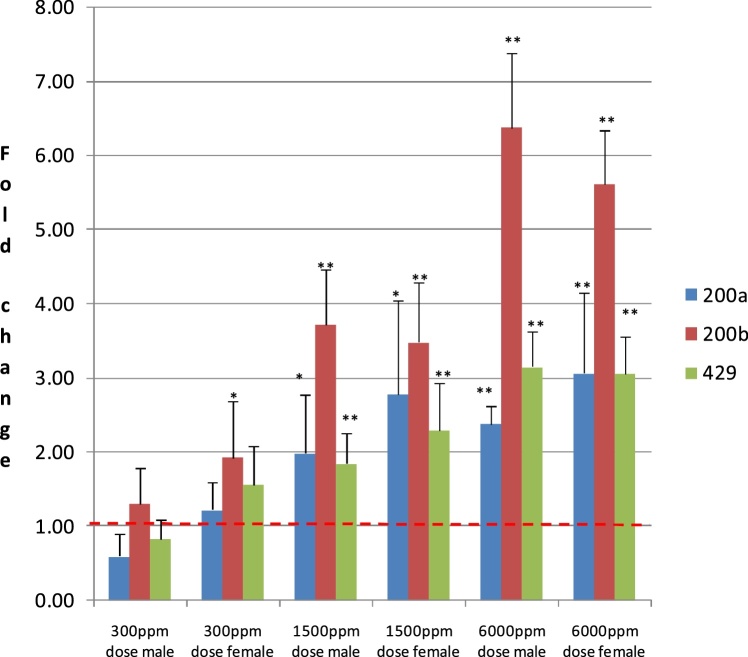
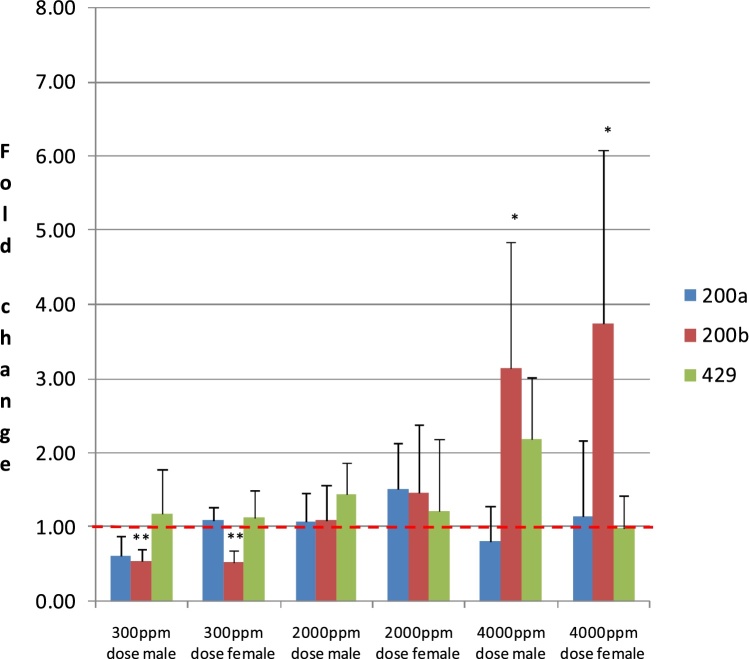
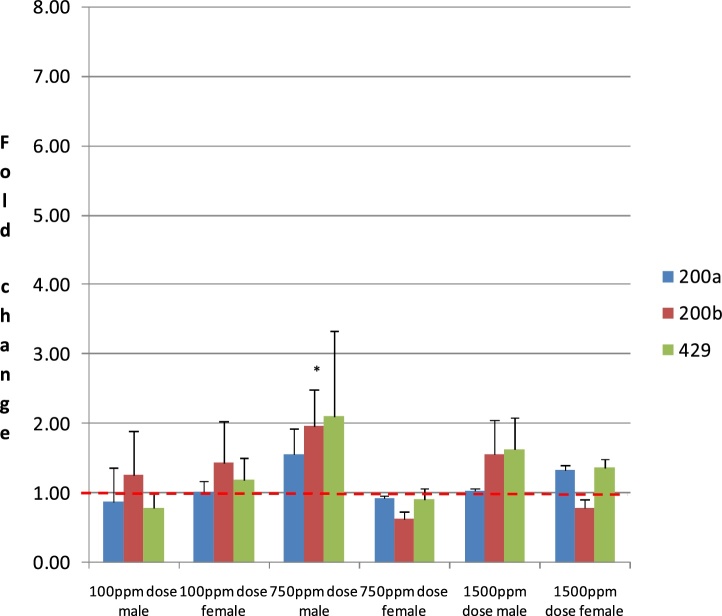
An increased incidence of liver tumours in the long term rodent bioassay is not an uncommon finding, invariably as a result of a non-genotoxic mode of action. Non-genotoxic liver carcinogenesis has been found to involve activation of certain nuclear hormone receptors (NHR) including the constitutive androstane receptor (CAR), peroxisome proliferator activated receptor alpha (PPARalpha) and arylhydrocarbon receptor (AHR) and more recently the induction of specific microRNAs (miRs), has also been demonstrated following CAR activation in studies up to 90 days (Koufaris et al., 2012). The stable induction of these tissue specific miRs, namely miR200a, 200b and 429, by liver non-genotoxic carcinogens may serve as early predictors (biomarkers) of heptocarcinogenic potential. To test this hypothesis we used RT-PCR to measure the levels of these miRs in the livers from Wistar rats treated with two rat hepatocarcinogenic and one non hepatocarcinogenic pyrazole carboxamide succinate dehydrogenase inhibitors, Isopyrazam, Sedaxane and Benzovindiflupyr, respectively. The miRs were quantified by RT-PCR in liver RNA samples from three 90 day repeat dose toxicity studies performed at the low, mid and high doses relative to control. In Isopyrazam treated rats a statistically significant (p < 0.01) dose-dependent increase in miR 200a, 220b and 429 in both males and females was observed, whilst for Sedaxane a significant (p < 0.05) increase in miR200b in males and females at the high dose was seen. Benzovindiflupyr treatment did not cause any dose related changes in miR 200a, 200b and 429 relative to control. Our results suggest that assessment of miR 200a/200b/429 levels has potential as a biomarker of the perturbation of pathways involved in hepatocarcinogenesis in Wistar rats. Further work is required to establish the possible relationship between miR200 cluster induction and CAR-mediated hepatocarcinogenesis in a more diverse range of compounds.
Keywords: Biomarker; Hepatocarcinogesis; Liver; microRNA.
Figures
References
-
- Felter S.P., Foreman J.E., Boobis A., Corton J.C., Doi A.M., Flowers L., Goodman J., Haber L.T., Jacobs A., Klaunig J.E., Lynch A.M., Moggs J., Pandiri A. Human relevance of rodent liver tumors: key insights from a Toxicology Forum workshop on nongenotoxic modes of action. Regul. Toxicol. Pharmacol.: RTP. 2017;92:1–7. - PMC - PubMed
-
- Huang W., Zhang J., Washington M., Liu J., Parant J.M., Lozano G., Moore D.D. Xenobiotic stress induces hepatomegaly and liver tumors via the nuclear receptor constitutive androstane receptor. Mol. Endocrinol. (Baltimore, Md.) 2005;19(6):1646–1653. - PubMed
-
- Yamamoto Y., Moore R., Goldsworthy T.L., Negishi M., Maronpot R.R. The orphan nuclear receptor constitutive active/androstane receptor is essential for livertumor promotion by phenobarbital in mice. Cancer Res. 2004;64(20):7197–7200. - PubMed
-
- Elcombe C.R., Peffer R.C., Wolf D.C., Bailey J., Bars R., Bell D., Cattley R.C., Ferguson S.S., Geter D., Goetz A., Goodman J.I., Hester S., Jacobs A., Omiecinski C.J., Schoeny R., Xie W., Lake B.G. Mode of action and human relevance analysis for nuclear receptor-mediated liver toxicity: a case study with phenobarbital as a model constitutive androstane receptor (CAR) activator. Crit. Rev. Toxicol. 2014;44(1):64–82. - PMC - PubMed
LinkOut - more resources
Full Text Sources
Other Literature Sources
