


Effect of Zinc Supplementation on Growth Outcomes in Children under 5 Years of Age
- PMID: 29558383
- PMCID: PMC5872795
- DOI: 10.3390/nu10030377
Effect of Zinc Supplementation on Growth Outcomes in Children under 5 Years of Age
Abstract
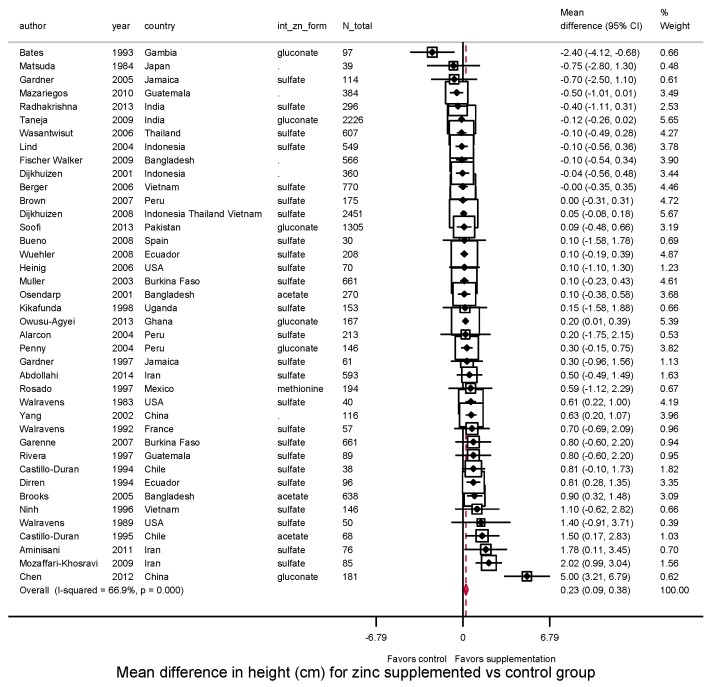
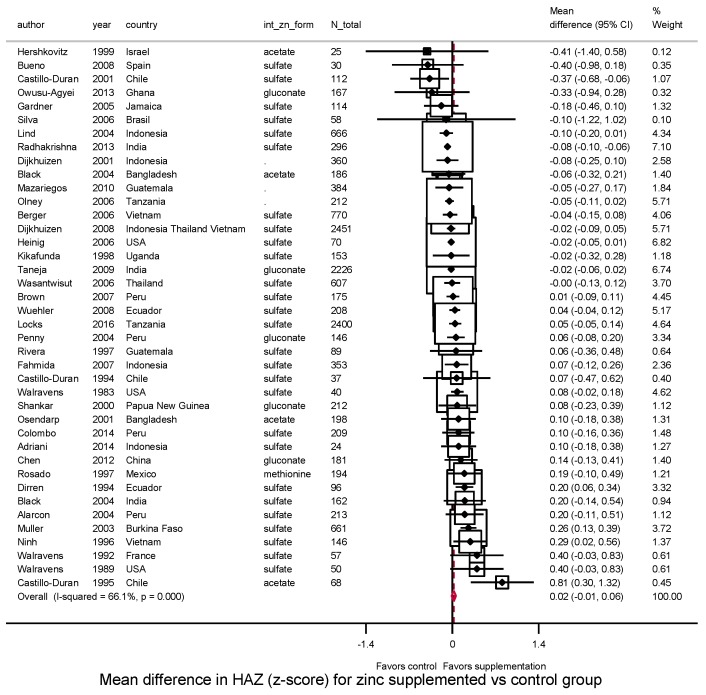
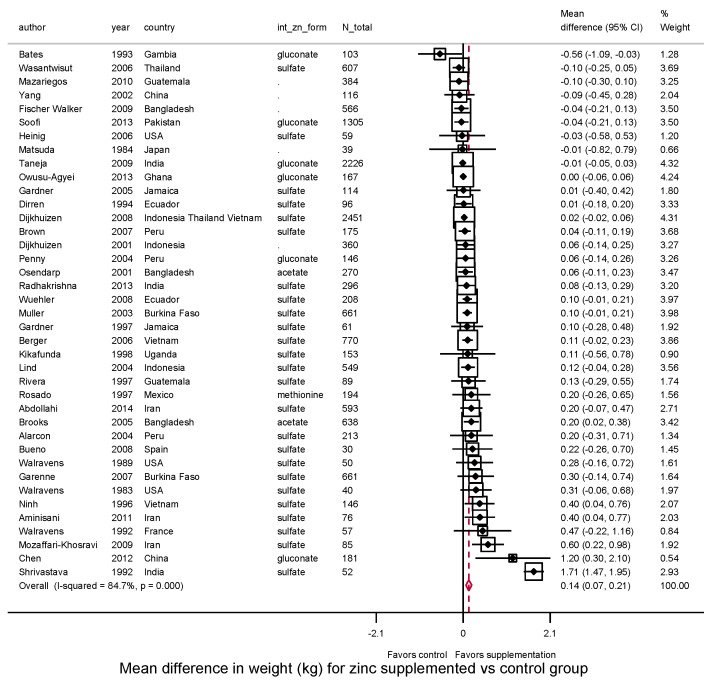
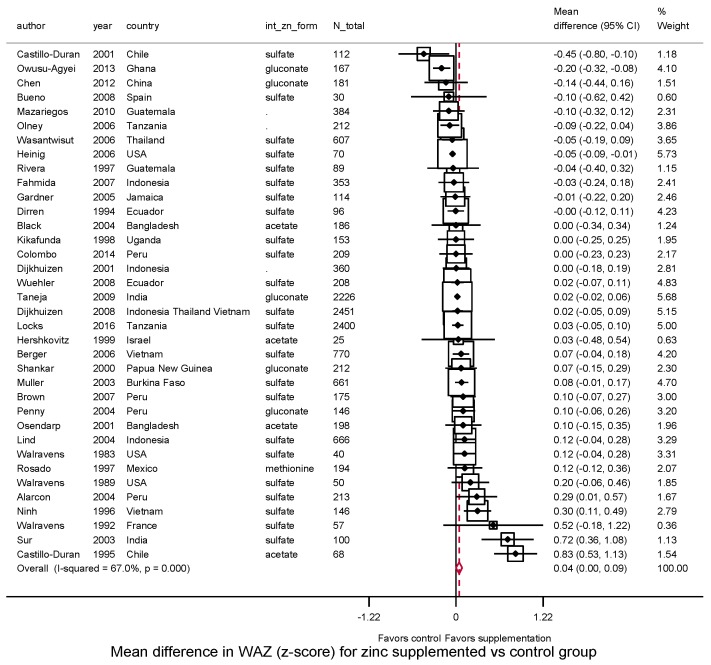
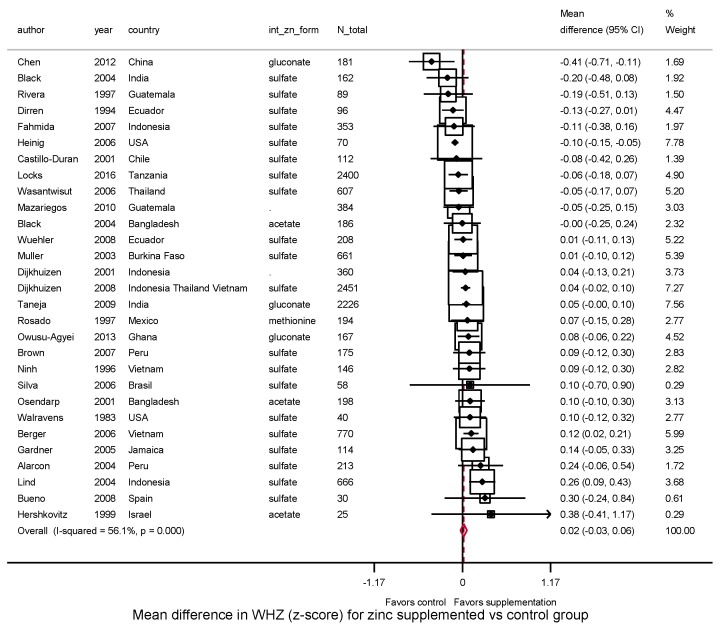
(1) Background: The effects of zinc supplementation on child growth, and prior reviews of these studies, have shown mixed results. We aim to systematically review and meta-analyze randomized controlled trials evaluating effects of preventive zinc supplementation for 3 months or longer during pregnancy or in children up to age 5 years on pregnancy outcomes and child growth; (2) Methods: We searched PubMed, EMBASE, Cochrane Library, Web of Science, and trial registries for eligible trials up to October 10, 2017. Inclusion selection and data extractions were performed independently and in duplicate. Study quality was evaluated by the Cochrane Risk of Bias tool. Findings were pooled using random effects meta-analysis, with heterogeneity assessed by I² and τ² statistic, stratified analyses, and meta-regression, and publication bias by Egger's and Begg's tests; (3) Results: Seventy-eight trials with 34,352 unique participants were identified, including 24 during pregnancy and 54 in infancy/childhood. Maternal zinc supplementation did not significantly increase birth weight (weighted mean difference (WMD) = 0.08 kg, 95%CI: -0.05, 0.22) or decrease the risk of low birth weight (RR = 0.76, 95%CI: 0.52-1.11). Zinc supplementation after birth increased height (WMD = 0.23 cm, 95%CI: 0.09-0.38), weight (WMD = 0.14 kg, 95%CI: 0.07-0.21), and weight-for-age Z-score (WMD = 0.04, 95%CI: 0.001-0.087), but not height-for-age Z-score (WMD = 0.02, 95%CI: -0.01-0.06) or weight-for-height Z score (WMD = 0.02, 95%CI: -0.03-0.06). Child age at zinc supplementation appeared to modify the effects on height (P-interaction = 0.002) and HAZ (P-interaction = 0.06), with larger effects of supplementation starting at age ≥2 years (WMD for height = 1.37 cm, 95%CI: 0.50-2.25; WMD for HAZ = 0.12, 95%CI: 0.05-0.19). No significant effects of supplementation were found on the risk of stunting, underweight or wasting; (4) Conclusion: Although the possibility of publication bias and small study effect could not be excluded, the current meta-analysis indicates that zinc supplementation in infants and early childhood, but not pregnancy, increases specific growth outcomes, with evidence for a potentially stronger effect after 2 years of age. These findings inform recommendation and policy development for zinc supplementation to improve growth among young children.
Keywords: child growth; meta-analysis; randomized controlled trial; systematic review; zinc supplementation.
Conflict of interest statement
Mozaffarian reports ad hoc honoraria or consulting from Boston Heart Diagnostics, Haas Avocado Board, Astra Zeneca, GOED, DSM, Pollock Communications, and Life Sciences Research Organization; chapter royalties from UpToDate; and scientific advisory board for Elysium Health, and Omada Health. Harvard University has been assigned patent US8889739 B2, listing Mozaffarian as one of three co-inventors, for “Use of transpalmitoleic acid in identifying and treating metabolic disease”. Duggan reports royalties from UpToDate, and PMPH; All other authors declare no conflict of interest. The study is sponsored by Bill & Melinda Gates Foundation, grant number OPP1099505. CPD was supported in part by NIH grants K24DK104676 and 2P30DK040561. The founding sponsors had no role in the design of the study; in the collection, analyses, or interpretation of data; in the writing of the manuscript, and in the decision to publish the results.
Figures
References
-
- Black R.E., Victora C.G., Walker S.P., Bhutta Z.A., Christian P., de Onis M., Ezzati M., Grantham-McGregor S., Katz J., Martorell R., et al. Maternal and child undernutrition and overweight in low-income and middle-income countries. Lancet. 2013;382:427–451. doi: 10.1016/S0140-6736(13)60937-X. - DOI - PubMed
Publication types
MeSH terms
Substances
Grants and funding
LinkOut - more resources
Full Text Sources
Other Literature Sources
Medical
